
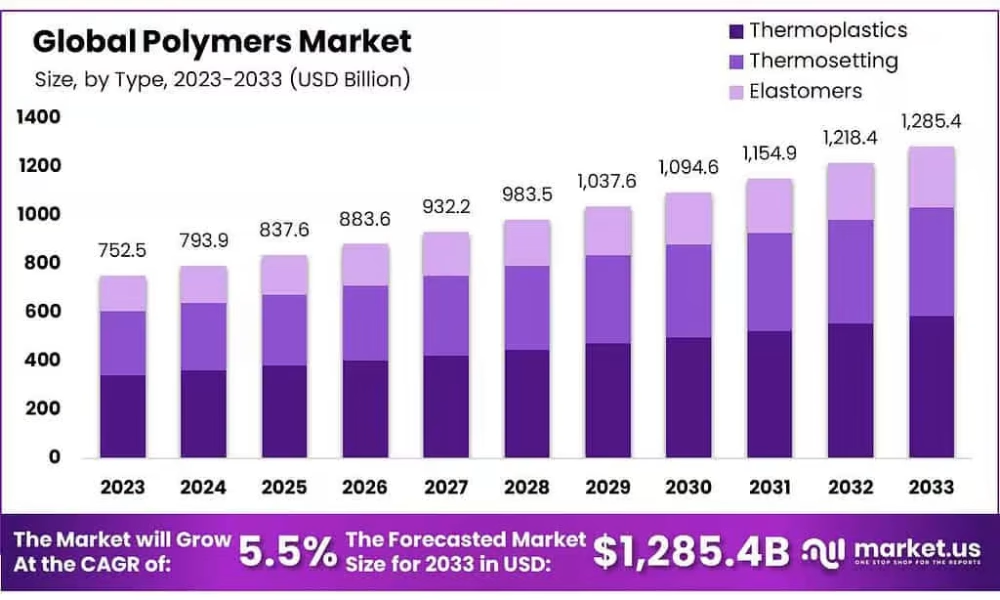
According to market.us, the global polymers market is projected to reach USD 1,285.4 billion by 2033, up from USD 752.5 billion in 2023, expanding at a CAGR of 5.5% over the forecast period. This market encompasses the production and distribution of polymers—large molecules formed by repeating structural units—which are integral to industries such as packaging, construction, automotive, and consumer goods.
Market growth is primarily driven by increasing demand for lightweight and durable materials, particularly in the automotive and aerospace sectors, along with growing environmental awareness that is accelerating the adoption of biodegradable alternatives. Technological advancements in polymer science are also unlocking new applications across industries.
The Asia-Pacific region, especially China and India, remains a dominant force due to its manufacturing strength, low-cost labor, and expanding domestic markets. However, the industry faces challenges including environmental regulations, raw material price fluctuations, and sustainability concerns linked to synthetic polymers.
Key Takeaways
- Market Projection: Expected to reach USD 1285.4 billion by 2033, growing at 5.5% CAGR from USD 752.5 billion in 2023.
- Synthetic Dominance: Synthetic Polymers held over 60.3% market share in 2023, led by materials like polyethylene and polypropylene.
- Thermoplastics Lead: Dominated with 45.6% market share in 2023, valued for recyclability and versatility.
- Packaging Primacy: Captured 31.6% market share in 2023, driven by plastics’ lightweight nature and durability.
- Asia Pacific region emerges as a dominant force in the polymers market, boasting a substantial market share of 41.9%
Access a Complimentary Sample of This Premium Report: https://market.us/report/polymers-market/request-sample/
Factors Affecting the Growth of the Polymers Market
Industrial Demand Across Key Sectors: The polymers market is significantly influenced by demand from industries such as automotive, construction, packaging, electronics, and healthcare. The use of polymers in lightweight vehicle parts, insulation materials, flexible packaging, and medical devices drives consistent consumption. Growth in these sectors directly contributes to increased polymer utilization.
Environmental Regulations and Sustainability Trends: Rising concerns about plastic pollution and environmental degradation have led to stricter regulations on the production and disposal of synthetic polymers. These policies encourage the development of biodegradable and bio-based alternatives. Regulatory frameworks and public pressure are shaping market strategies and innovation priorities across the polymer industry.
Raw Material Availability and Price Volatility: Most synthetic polymers are derived from petrochemicals. Therefore, fluctuations in crude oil and natural gas prices can affect polymer production costs. Any disruptions in raw material supply chains, due to geopolitical issues or trade restrictions, may also impact pricing and availability, influencing market stability.
Advancements in Polymer Technology: Ongoing innovations in polymer chemistry and processing techniques are expanding the application range of both traditional and advanced polymers. High-performance polymers, recyclable plastics, and smart polymers are gaining prominence, providing new opportunities for manufacturers and end users.
Growth of Emerging Economies: The rapid industrialization and urban development in emerging economies, particularly in Asia-Pacific, are boosting polymer demand. Infrastructure projects, increased consumer spending, and expansion in manufacturing capabilities in countries such as China and India are supporting market expansion in these regions.
Key Market Segmentation
By Category Analysis
In 2023, synthetic polymers dominated the global polymers market, accounting for over 60.3% of the total share. Materials such as polyethylene, polypropylene, PVC, and polystyrene remained widely used across key industries including packaging, automotive, electronics, and construction.
Their market leadership is attributed to their cost-efficiency, durability, and adaptability, which support a wide range of industrial applications. Advancements in synthetic polymer formulations have further improved their strength and reduced weight, reinforcing their dominance.
Although holding a smaller portion of the market, natural polymers are steadily gaining relevance, driven by rising environmental concerns and the shift toward sustainable production. Derived from sources like cellulose, starch, and proteins, natural polymers offer biodegradability and are increasingly utilized in pharmaceuticals, medical devices, and eco-friendly packaging.
Their growth is supported by technological improvements and regulatory support favoring sustainable materials. Overall, while synthetic polymers maintain market leadership, natural polymers are emerging in applications where environmental sustainability is critical.
By Product Type Analysis
In 2023, thermoplastics held the leading position in the global polymers market with a share exceeding 45.6%. Their dominance is driven by their recyclability and ease of remolding without chemical alteration, making them highly suitable for industries such as automotive, construction, and consumer goods. Widely used thermoplastics include polyethylene, polypropylene, and PVC, valued for their durability, corrosion resistance, and flexibility.
Thermosetting polymers, which cannot be remelted once cured, play a vital role in high-performance applications. Materials like epoxy resins, phenolic resins, and polyurethanes are preferred in electronics, coatings, and adhesives due to their heat resistance and mechanical strength.
Elastomers, known for their high elasticity, are essential in products requiring flexibility, such as tires, seals, and gaskets. These include both natural rubber and synthetic types like styrene-butadiene rubber (SBR), commonly used in automotive and medical sectors.
By Application Analysis
In 2023, packaging emerged as the leading application segment in the global polymers market, accounting for over 31.6% of the total share. This dominance is attributed to the extensive use of polymers like polyethylene and polypropylene in packaging consumer goods, food and beverages, and industrial materials, driven by their lightweight, durable, and cost-effective properties.
The consumer goods sector also represents a major application area, where polymers are used to manufacture household items, electronics, and personal care products, offering strength, flexibility, and design versatility.
In the building and construction industry, polymers are employed in insulation, piping, and flooring applications due to their corrosion resistance, thermal efficiency, and lightweight structure, contributing to improved building performance and durability.
The medical devices sector relies heavily on polymers for products such as syringes, tubing, implants, and prosthetics. Their biocompatibility and ability to meet sterilization standards make them essential for medical use.
Polymers also play a significant role in the automotive industry, used in components like bumpers, dashboards, and seating. The trend toward lightweight vehicles for enhanced fuel efficiency continues to drive the adoption of high-performance polymers across automotive applications.
Market Key Segments
By Category
- Natural Polymers
- Synthetic Polymers
Product Type
- Thermoplastics
- Thermosetting
- Elastomers
Application
- Consumer Goods
- Packaging
- Building & Construction
- Medical Devices
- Automotive
- Others
Regional Analysis
The Asia Pacific region led the global polymers market in 2023, holding a dominant share of 41.9%. The market in this region is expected to reach USD 315.29 billion by the end of the forecast period, driven by high polymer demand across the packaging, construction, automotive, and textile industries. Countries such as China, India, Japan, and Australia are key contributors, with expanding manufacturing capacities and a growing focus on sustainable materials and production practices.
North America is experiencing steady market growth, supported by increasing demand for eco-friendly polymer-based products. The region’s industrial diversity and technological advancements in polymer applications continue to drive market adoption.
In Europe, the polymers market is also on a notable growth path, driven by rising environmental awareness and regulatory pressure favoring sustainable practices. The availability of advanced polymer materials and strong industry adherence to environmental standards are supporting broader usage across sectors such as packaging, automotive, and consumer goods.
Market Key Players
- Dow Chemical Company
- Lyondell Basell Industries N.V.
- Exxon Mobil Corporation
- SABIC
- BASF SE
- INEOS AG
- Evonik Industries AG
- Royal DSM
- Eastman Chemical Company
- Covestro AG
- Mitsui Chemicals Inc
- Eni S.P.A.
- Chevron Phillips Chemical Company LLC
- LANXESS
- Others
Get in Touch with Us:
Market.us (Powered By Prudour Pvt. Ltd.)
Address: 420 Lexington Avenue, Suite 300 New York City, NY 10170, United States
Send Email: [email protected]
Refer to More Related Reports:



