
Polyfluoroalkyl Substances (PFAS) Waste Management Market Size and Trend Analysis
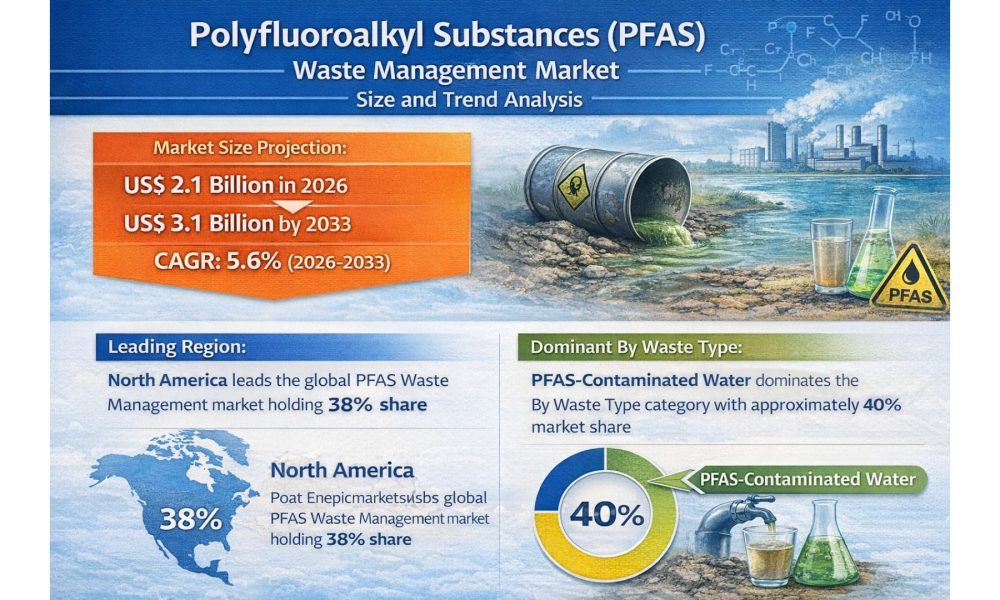
The global polyfluoroalkyl substances (PFAS) waste management market is gaining significant traction as environmental concerns surrounding “forever chemicals” intensify worldwide. According to market estimates, the industry is expected to be valued at US$ 2.1 billion in 2026 and is projected to reach approximately US$ 3.1 billion by 2033, growing at a CAGR of 5.6% during the forecast period (2026–2033). This steady growth reflects the increasing urgency to address PFAS contamination in water, soil, and industrial waste streams.
PFAS are synthetic chemicals widely used in industries such as firefighting foams, textiles, packaging, and electronics due to their resistance to heat, water, and oil. However, their persistence in the environment and potential health risks—such as cancer and hormonal disruption—have made their disposal and treatment a global priority. As a result, governments, industries, and environmental agencies are investing heavily in PFAS waste management technologies.
Get Your FREE Sample Report Instantly – Click Now: https://www.persistencemarketresearch.com/samples/36341
Growing Environmental and Regulatory Pressure
One of the strongest drivers of the PFAS waste management market is the rapid tightening of environmental regulations across major economies. Regulatory bodies such as the U.S. Environmental Protection Agency (EPA) and European agencies are enforcing strict limits on PFAS concentrations in drinking water and industrial discharge. These regulations are compelling industries to adopt advanced waste management and remediation solutions.
The increasing number of contamination incidents—especially in groundwater, landfills, and wastewater systems—has further accelerated regulatory action. Governments are now implementing monitoring programs and remediation mandates, creating a strong demand for PFAS waste treatment services. Additionally, global initiatives focused on sustainability and environmental protection are encouraging industries to invest in safer waste disposal practices.
Rising Awareness of Health and Environmental Risks
Public awareness regarding the dangers of PFAS has grown substantially in recent years. Often referred to as “forever chemicals,” PFAS do not degrade naturally and accumulate in ecosystems and human bodies over time. Studies have linked PFAS exposure to serious health issues, including cancer, liver damage, and immune system disruption.
This heightened awareness is pushing municipalities and industries to proactively manage PFAS waste. Wastewater treatment plants, landfills, and industrial facilities are increasingly under scrutiny for their role in spreading PFAS contamination. As a result, there is a growing demand for effective waste management solutions that can safely remove or destroy these persistent compounds.
Advancements in PFAS Treatment Technologies
Technological innovation is playing a crucial role in shaping the PFAS waste management market. Traditional methods such as granular activated carbon (GAC) and ion exchange resins are widely used for PFAS removal, but they often generate secondary waste that requires further treatment.
Emerging technologies, including membrane filtration, electrochemical oxidation, plasma treatment, and advanced adsorption materials, are gaining traction due to their ability to improve efficiency and reduce waste. These advanced solutions are designed not only to capture PFAS but also to break down their strong carbon-fluorine bonds, enabling complete destruction.
Recent innovations in filtration materials and non-thermal destruction methods are also enhancing the scalability and cost-effectiveness of PFAS treatment systems. These developments are expected to create new growth opportunities for technology providers and waste management companies.
Expanding Applications Across End-Use Industries
The PFAS waste management market serves a wide range of industries, each contributing to demand growth. The industrial sector is the largest contributor, driven by the extensive use of PFAS in manufacturing processes such as metal plating, electronics, and chemical production.
Municipal applications are also expanding rapidly, particularly in drinking water treatment and wastewater management. Governments and utilities are investing in large-scale treatment systems to ensure safe water supply and compliance with regulatory standards.
In addition, sectors such as aviation, defense, and firefighting are significant contributors due to the use of PFAS-containing firefighting foams. The need to manage legacy contamination from these applications is creating long-term demand for remediation and waste management services.
Market Segmentation
The PFAS waste management market can be segmented based on treatment method and end-use application:
By Treatment Method:
- Adsorption (Activated Carbon, Resins)
- Membrane Filtration
- Thermal Destruction
- Chemical Oxidation
- Emerging Technologies
Among these, adsorption-based methods currently dominate due to their widespread adoption and cost-effectiveness. However, destruction technologies are expected to gain momentum as industries seek permanent solutions.
By Application:
- Industrial Waste Management
- Municipal Water & Wastewater Treatment
- Landfill and Leachate Treatment
- Firefighting Foam Disposal
- Others
The industrial segment holds the largest share, followed by municipal water treatment applications.
Regional Insights and Market Dynamics
Geographically, North America leads the PFAS waste management market, driven by stringent environmental regulations, high awareness levels, and significant investments in remediation projects. The United States, in particular, has been at the forefront of PFAS regulation and cleanup initiatives.
Europe follows closely, supported by strict regulatory frameworks and sustainability goals. The region is actively investing in advanced treatment technologies and research initiatives to address PFAS contamination.
Meanwhile, the Asia-Pacific region is emerging as a high-growth market due to rapid industrialization and increasing environmental awareness. Countries such as China, India, and Japan are gradually implementing stricter regulations, which is expected to drive demand for PFAS waste management solutions in the coming years.
Challenges and Market Constraints
Despite its promising growth, the PFAS waste management market faces several challenges. One of the primary issues is the high cost of treatment technologies, particularly for advanced destruction methods. These costs can be prohibitive for developing regions and small-scale industries.
Another major challenge is the complexity of PFAS removal and destruction. Many existing technologies are effective only for certain types of PFAS, especially long-chain compounds, while short-chain PFAS remain difficult to treat.
Additionally, the lack of standardized global regulations creates uncertainty for market players. Variations in permissible PFAS limits across regions make it difficult for companies to develop uniform solutions.
Emerging Opportunities and Future Trends
The PFAS waste management market presents several growth opportunities. Increasing investments in wastewater infrastructure and environmental remediation projects are expected to drive demand for advanced treatment solutions. Governments and private organizations are collaborating to address large-scale contamination issues, creating new business opportunities.
The development of sustainable and cost-effective treatment technologies is another key trend. Companies are focusing on innovations that reduce operational costs and environmental impact, such as regenerable adsorbents and energy-efficient destruction methods.
Moreover, the integration of digital monitoring and AI-driven analytics is enhancing the efficiency of PFAS detection and treatment systems. These technologies enable real-time monitoring and optimization of waste management processes, improving overall performance.
Get a Customized Market View in One Click: https://www.persistencemarketresearch.com/request-customization/36341
Competitive Landscape
The PFAS waste management market is characterized by the presence of both global environmental service providers and specialized technology companies. Key players include:
- Veolia
- AECOM
- Xylem
- Pentair
- WSP
- Jacobs
- CDM Smith
These companies focus on technological innovation, strategic partnerships, and large-scale project execution to strengthen their market position. Emerging players are also gaining traction by developing innovative treatment materials and cost-effective solutions.
Future Outlook
The future of the PFAS waste management market looks promising, driven by increasing environmental awareness, regulatory pressure, and technological advancements. As industries and governments prioritize sustainable waste management practices, the demand for PFAS treatment solutions is expected to grow steadily.
While challenges such as high costs and technological limitations persist, ongoing research and innovation are likely to address these issues over time. The shift toward complete PFAS destruction, rather than temporary removal, will be a key trend shaping the market’s evolution.
In conclusion, the PFAS waste management market is poised for sustained growth, supported by global efforts to combat environmental contamination and protect public health. As regulatory frameworks strengthen and technologies advance, the market will play a critical role in addressing one of the most pressing environmental challenges of the modern era.
About Persistence Market Research:
Persistence Market Research delivers strategic research solutions that drive business growth. Founded in 2012 and registered in England and Wales in 2023 as Persistence Research & Consultancy Services Ltd., we have completed 3,600+ custom and syndicated studies and supported 2,700+ projects for leading research firms. Combining traditional methodologies with modern tools, we provide actionable insights to multinational corporations, consultants, investors, and government bodies, earning strong trust through long-term client relationships.
Contact Us:
Persistence Market Research
Second Floor, 150 Fleet Street,
London, EC4A 2DQ, United Kingdom
USA Phone: +1 646-878-6329
UK Phone: +44 203-837-5656
Email: [email protected]
Web: https://www.persistencemarketresearch.com




