
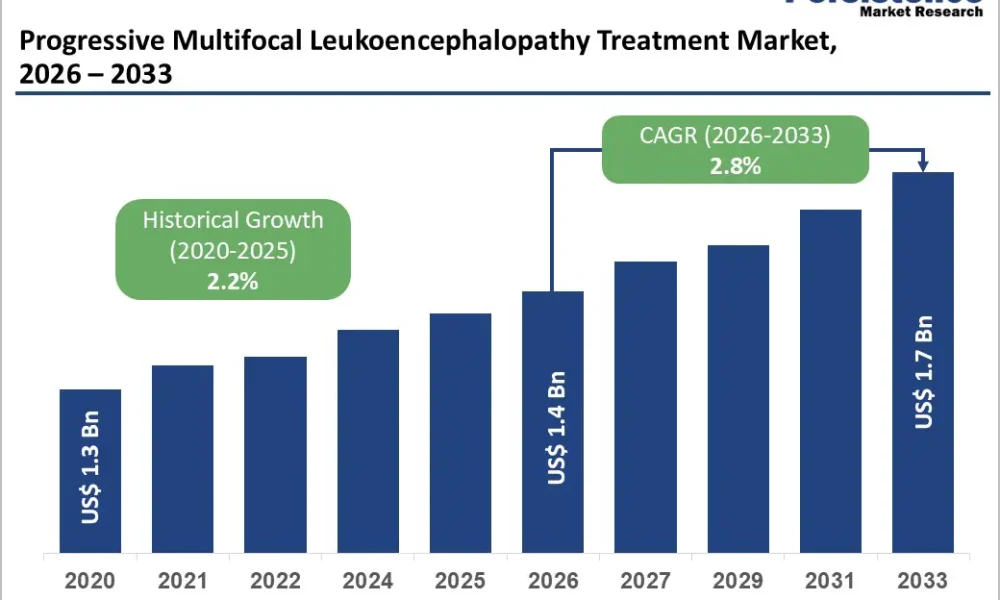
The global progressive multifocal leukoencephalopathy (PML) treatment market is projected to reach a valuation of US$ 1.4 billion in 2026 and is expected to grow to US$ 1.7 billion by 2033, registering a CAGR of 2.8% during the forecast period from 2026 to 2033. The market exhibits gradual growth, driven primarily by the increasing prevalence of immunocompromised populations, rising HIV infections, and enhanced diagnostic awareness of rare neurological disorders. Among regions, North America currently dominates the market due to advanced healthcare infrastructure, robust diagnosis rates, and strong access to specialized neurology and infectious disease care. Meanwhile, Asia-Pacific is emerging as the fastest-growing region, fueled by expanding healthcare access, improving treatment availability, and heightened awareness of rare neurological diseases.
Download Your Free Sample & Explore Key Insights: https://www.persistencemarketresearch.com/samples/15679
Market Dynamics
Drivers – Increasing Prevalence of Immunocompromised Conditions
The rising prevalence of immunocompromised populations is a primary driver for the PML treatment market. Individuals with compromised immunity, such as people living with HIV (PLWH), transplant recipients, and patients undergoing immunosuppressive therapy, are highly susceptible to opportunistic infections like PML. Global estimates indicate that over 38 million people live with HIV, and despite the availability of antiretroviral therapy (ART), many remain at risk due to low CD4 counts or incomplete immune restoration. In the United States, approximately 1.2 million people live with HIV, creating a significant population vulnerable to PML. The persistent growth of immunocompromised groups reinforces the market demand for effective treatment solutions and supports continued investment in therapeutic development.
Advances in pharmaceutical and biotechnology R&D further drive market growth. Governments and industry organizations have invested significantly in drug discovery and development, emphasizing the need for accurate and high-throughput analytical techniques to support regulatory compliance and therapeutic innovation. For instance, the global pharmaceutical industry spent around USD 129 billion on R&D in 2021, reflecting sustained efforts to address complex diseases and rare conditions such as PML.
Restraints – High Mortality and Prognosis Challenges
PML is associated with poor prognosis and high mortality, which constrains market growth. Historically, before effective HIV therapy, median survival after PML diagnosis was approximately six months, and most patients died within two years. Even with modern ART, mortality remains significant, with 30–50% of patients dying within the first few months and many survivors experiencing severe neurological deficits. The aggressive nature of JC virus–induced brain damage and the absence of widely effective targeted therapies contribute to this high fatality rate.
Clinical data suggest an overall PML mortality rate of 74.5–78% in HIV populations and up to 90% in non-HIV groups, highlighting the limited long-term efficacy of existing therapies. One-year survival often remains below 60% without substantial immune recovery. These statistics underscore the challenge clinicians face in managing PML and limit the adoption of new treatments, as effective therapeutic options remain scarce.
Opportunity – Development of JC Virus-Targeted Antivirals
PML is caused by the reactivation of the John Cunningham virus (JCV), a ubiquitous polyomavirus latent in 50–80% of adults. Current treatments focus on restoring immune function rather than directly targeting JCV. There are no approved direct-acting antivirals for JCV, creating a significant opportunity for novel therapeutic development. Targeted antiviral agents could potentially block viral replication or prevent viral entry, reducing viral burden and improving patient outcomes.
Although investigational agents such as cytarabine and cidofovir have been studied, they have not demonstrated sufficient clinical efficacy. The high prevalence of latent JCV infection and the lack of effective antivirals highlight an unmet need for therapies specifically designed to target the virus, representing a critical opportunity for pharmaceutical innovation in the PML treatment market.
Get Custom Insights Designed for Your Businecss: https://www.persistencemarketresearch.com/request-customization/15679
Market Segmentation
By Treatment – Anti-retroviral Therapy Dominates
Anti-retroviral therapy (ART) is the dominant treatment segment, accounting for an estimated 45.1% of the global market in 2025. ART is central to managing HIV-associated PML by restoring immune function, suppressing HIV replication, and increasing CD4 counts, thereby improving survival rates and neurological outcomes. Before the widespread use of ART, 3–7% of individuals with AIDS developed PML. Immune reconstitution via ART significantly enhances prognosis, making it the primary therapeutic strategy. The central role of ART underscores the focus on immune restoration rather than direct antiviral interventions against JCV.
By Indication – HIV/AIDS Drives Most Cases
HIV/AIDS accounts for approximately 80–85% of PML cases globally, making it the leading underlying condition associated with the disease. The profound immune suppression observed in advanced HIV infection facilitates JC virus reactivation, driving PML pathogenesis. While ART has reduced incidence, late diagnosis or untreated HIV continues to contribute to the PML burden, sustaining the predominance of HIV/AIDS as the key indication segment in the treatment market.
Regional Insights
North America
North America leads the PML treatment market with an estimated 39.1% share in 2025. The region benefits from advanced healthcare infrastructure, high-quality medical services, and robust diagnostic capabilities such as MRI and cerebrospinal fluid testing. These resources enable early detection of PML in immunocompromised patients, particularly those living with HIV/AIDS or undergoing immunosuppressive therapies. Specialized neurology and infectious disease centers, coupled with strong access to ART and comprehensive patient monitoring programs, contribute to North America’s market dominance.
Europe
Europe is a critical market due to high healthcare standards, extensive immunocompromised populations, and rigorous rare disease surveillance. The European Union maintains robust registries for HIV/AIDS and multiple sclerosis, two major conditions associated with PML. MS prevalence in Europe is among the highest globally, with up to 200 cases per 100,000 people in certain countries, increasing exposure to immunomodulatory therapies that elevate PML risk. Advanced diagnostic imaging and integrated care pathways support early detection and effective management, making Europe a strategically important market for PML treatment.
Asia-Pacific
Asia-Pacific is the fastest-growing region due to expanding healthcare access, rising at-risk populations, and enhanced diagnostic capabilities. The region carries a significant HIV burden, with approximately 6.2 million people living with HIV in Southeast and East Asia. Healthcare improvements, such as India’s increased expenditure from 3.5% of GDP in 2019 to over 4% in 2024, are enhancing access to neurological care and advanced imaging. Growing awareness of rare neurological disorders and increasing use of immunosuppressive therapies further drive case identification and treatment adoption, fueling regional market growth.
Competitive Landscape
Key stakeholders in the PML treatment market focus on improving early diagnosis, immune restoration, and patient monitoring. By enhancing detection accuracy, treatment outcomes, and care coordination, these companies support HIV/AIDS, transplant, and immunosuppressive patient management, streamline clinical decision-making, and enable better survival. These efforts are driving adoption of therapies, expanding access, and contributing to global market growth.
Key Industry Developments
In February 2025, the U.S. Food and Drug Administration (FDA) approved Pfizer’s ADCETRIS® combination regimen for relapsed or refractory Diffuse Large B-Cell Lymphoma (DLBCL), providing a new therapeutic option for patients unresponsive to prior therapies. In March 2024, Pfizer announced positive Phase 3 clinical trial results for the ADCETRIS® regimen, showing improved overall survival in relapsed or refractory DLBCL patients compared to standard therapies. While not specific to PML, these developments demonstrate the continued focus on innovative therapies and clinical advancements within immunocompromised populations.
Checkout Now & Download Complete Market Report: https://www.persistencemarketresearch.com/checkout/15679
Companies Covered
Key players in the progressive multifocal leukoencephalopathy treatment market include Pfizer, Inc., F. Hoffman – La Roche Ltd., Gilead Sciences, Inc., GSK, Sanofi S.A., Allergan plc (Actavis plc), Novartis AG, Viatris Inc., AbbVie Inc., Bristol-Myers Squibb Company, and other emerging players. These organizations focus on research and development of therapies that improve immune function, manage opportunistic infections, and advance treatment outcomes for PML patients globally.
Market Outlook
The progressive multifocal leukoencephalopathy treatment market is poised for steady growth from 2026 to 2033, expanding from US$ 1.4 billion to US$ 1.7 billion at a CAGR of 2.8%. Drivers such as increasing immunocompromised populations, rising HIV prevalence, improved diagnostic awareness, and expanding treatment access are expected to sustain market momentum. While high mortality and limited targeted therapies present challenges, opportunities in JC virus-targeted antivirals, immunomodulatory approaches, and novel diagnostics offer potential for transformative advancements. Regionally, North America will maintain leadership due to advanced healthcare infrastructure and specialized care, while Asia-Pacific is expected to demonstrate the fastest growth driven by expanding healthcare access, rising awareness, and improved treatment availability.
By treatment type, anti-retroviral therapy will continue to dominate, reflecting its central role in managing HIV-associated PML. By indication, HIV/AIDS remains the leading driver of PML cases, emphasizing the ongoing need for immune restoration-focused interventions. Strategic investments in research, clinical trials, and early detection tools, alongside the development of innovative targeted therapies, will be critical in shaping the future of the PML treatment market and improving outcomes for affected patients worldwide.
In conclusion, the progressive multifocal leukoencephalopathy treatment market presents a niche yet steadily growing segment of the global neurological and infectious disease therapy landscape. With gradual growth projected through 2033, the market is characterized by opportunities for targeted therapeutic innovation, regional expansion, and enhanced disease management strategies. The combination of unmet medical needs, evolving treatment paradigms, and increased awareness of rare neurological conditions positions the PML treatment market for sustained growth and clinical advancement.




