
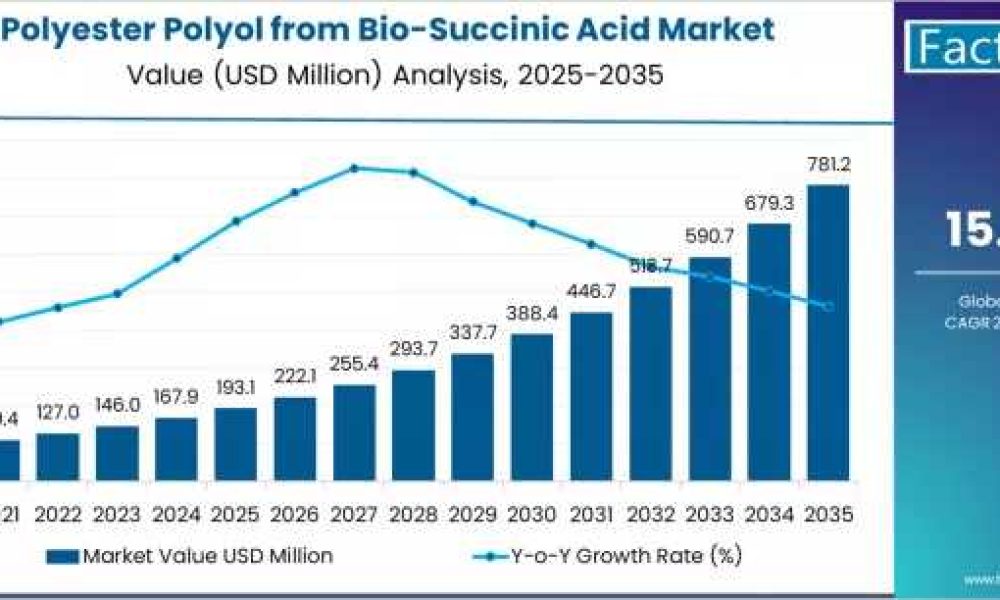
Global Polyester Polyol from Bio-Succinic Acid Market Set for Robust Growth, Projected to Reach $666.8 Million by 2036
The global industrial landscape is witnessing a decisive shift toward sustainable chemistry, with the Polyester Polyol from Bio-Succinic Acid Market emerging as a cornerstone of the green polymer revolution. New industry analysis indicates that as manufacturers move away from petrochemical-based intermediates, the market for bio-derived polyester polyols is projected to expand significantly, reaching an estimated value of $666.8 million by 2036.
This growth is underpinned by a compound annual growth rate (CAGR) of approximately 14.2% over the 2026–2036 forecast period. The transition is primarily fueled by the urgent need for low-carbon alternatives in the production of polyurethanes (PU), which serve critical roles in the automotive, construction, and consumer goods sectors.
Request for Sample Report | Customize Report |purchase Full Report – https://www.factmr.com/connectus/sample?flag=S&rep_id=11475
Bridging the Gap: Who, What, and Why
Polyester polyols derived from bio-succinic acid are essential building blocks for high-performance polyurethane materials. Unlike traditional versions synthesized from petroleum-based adipic acid, these polyols utilize renewable feedstocks—such as corn-derived sugars and starch—processed through advanced fermentation technologies.
Who: Leading chemical innovators including BASF SE, Dow, Covestro, and Mitsui & Co. are at the forefront of this transition, scaling up biorefinery capabilities to meet industrial demand.
What: The market focuses on both aliphatic and aromatic polyester polyols, which are utilized to create eco-friendly foams, elastomers, coatings, and adhesives.
Where: While the Asia-Pacific region currently leads in production volume and consumption—driven by rapid industrialization in China and India—North America and Europe are seeing the fastest regulatory-driven adoption due to initiatives like the EU Green Deal and the U.S. BioPreferred Program.
When: The shift is happening now, with the 2026–2036 period marked as the decade of industrial de-fossilization.
Key Market Drivers and Technical Advancements
The demand for bio-succinic acid-based polyols is no longer solely a matter of corporate social responsibility; it is a performance-driven choice. Modern bio-based linear polyester polyols can achieve 100% renewable content when paired with bio-1,3-propanediol or bio-1,4-butanediol.
Recent breakthroughs in fermentation efficiency have addressed historical bottlenecks. For instance, optimized E. coli strains have significantly increased succinic acid titers, making the bio-based route increasingly cost-competitive with the butane-based maleic anhydride process. Furthermore, these polyols provide specific advantages in polyurethane elastomers, offering superior solvent resistance and hydrolytic stability comparable to high-end adipate-based systems.
Industry Applications: Beyond Sustainability
The versatility of bio-succinic acid-based polyester polyols is expanding their footprint across several high-growth segments:
Construction & Infrastructure: Used in high-strength adhesives for bonding wood, ceramics, and concrete, offering moisture and temperature resistance.
Automotive Interiors: Increasing use in seating textiles, gearshift knobs, and reinforcing beams as manufacturers aim for circular vehicle designs.
Footwear & Apparel: High-performance TPU (Thermoplastic Polyurethane) elastomers for durable soles and waterproof textile coatings.
Rigid & Flexible Foams: Critical for energy-efficient insulation and comfortable furniture applications.
Challenges and the Road to 2036
Despite the optimistic outlook, the industry faces hurdles. High production costs relative to volatile crude oil prices remain a primary restraint. Additionally, some bio-based rigid foams have historically shown slightly lower compressive strength (10–15%) compared to traditional aromatic polyols. However, current R&D is bridging this gap through the incorporation of branched diols to optimize melting points and crystallinity, ensuring that green alternatives do not compromise on structural integrity.
As we move toward 2036, the market is expected to witness further consolidation, with strategic partnerships between biotech startups and established chemical giants becoming the norm to secure stable supply chains of renewable feedstocks.
About the Industry Analysis: This market update provides a comprehensive overview of the Polyester Polyol from Bio-Succinic Acid sector, focusing on sustainable chemical intermediates and their role in the global bio-economy. For further insights into the 2026-2036 forecast, analysts and investors are encouraged to monitor emerging biorefinery capacities and regional legislative shifts.
– Contact Us –
11140 Rockville Pike, Suite 400, Rockville,
MD 20852, United States
Tel: +1 (628) 251-1583 | [email protected]
About Fact.MR
Fact.MR is a global market research and consulting firm, trusted by Fortune 500 companies and emerging businesses for reliable insights and strategic intelligence. With a presence across the U.S., UK, India, and Dubai, we deliver data-driven research and tailored consulting solutions across 30+ industries and 1,000+ markets. Backed by deep expertise and advanced analytics, Fact.MR helps organizations uncover opportunities, reduce risks, and make informed decisions for sustainable growth.
Related Reports



