
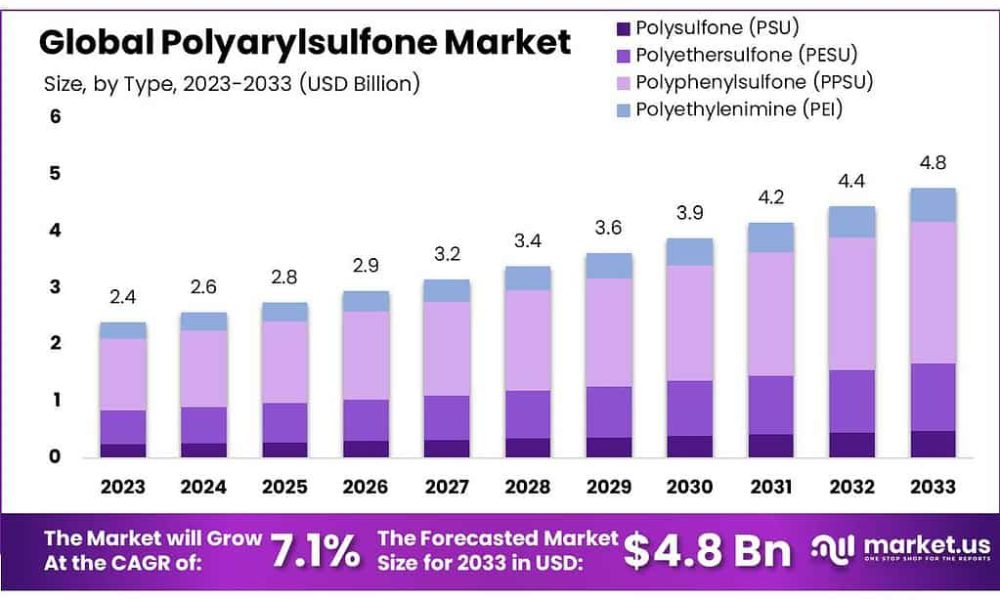
According to market.us, the Polyarylsulfone Market size is expected to be worth around USD 4.8 billion by 2033, rising from USD 2.4 billion in 2023, reflecting a steady compound annual growth rate (CAGR) of 7.1% during the forecast period from 2023 to 2033. This growth can be attributed to increasing demand for high-performance thermoplastics in industries such as healthcare, automotive, aerospace, and electronics.
Polyarylsulfone (PAS) materials are widely recognized for their excellent thermal stability, mechanical strength, and resistance to chemicals and hydrolysis, making them suitable for applications requiring long-term durability under harsh conditions. The healthcare sector, in particular, continues to drive consumption due to PAS’s sterilizability and biocompatibility, especially in surgical instruments, dental tools, and reusable medical devices.
Meanwhile, the automotive industry is adopting PAS for lightweight components to improve fuel efficiency without compromising strength or heat resistance. Additionally, in electronics, PAS is being utilized in insulating components due to its flame retardancy and dielectric properties.
Growing environmental concerns and regulatory pressure are also encouraging a shift toward durable, recyclable alternatives, further supporting the market outlook. As industrial applications expand across both developed and emerging regions, the global polyarylsulfone market is poised for sustained and promising growth over the next decade.
Key Takeaways
- Polyarylsulfone Market is anticipated to reach around USD 4.8 billion in 2033, soaring from USD 2.4 billion in 2023, At a CAGR of 7.1%.
- In 2023, polyphenylsulfone led the market, 52.6% share due to its outstanding properties.
- Healthcare emerged as the primary end-user, holding over 31.2% share in 2023.
- Asia-Pacific Dominance led the market in 2023, accounting for over 42.3% share
Access a Complimentary Sample of This Premium Report: https://market.us/report/polyarylsulfone-market/request-sample/
Factors Affecting the Growth of the Polyarylsulfone Market
Rising Demand from the Healthcare Sector: The healthcare industry has emerged as a key consumer of polyarylsulfone due to its biocompatibility, high-temperature resistance, and ability to withstand repeated sterilization processes. Its use in surgical instruments, dental devices, and diagnostic equipment is expanding, supporting consistent demand growth.
Expansion of the Automotive and Aerospace Industries: The growing need for lightweight, heat-resistant, and durable components in automotive and aerospace applications is positively influencing polyarylsulfone consumption. The material’s excellent mechanical and thermal properties make it a preferred alternative to metal and other polymers in demanding engineering applications.
Technological Advancements in Polymer Engineering: Innovations in polymer processing and formulation techniques have improved the performance of polyarylsulfone products, enabling their adoption in more complex and critical applications. Enhanced grades and blends tailored to specific end-use requirements are further broadening its market potential.
Environmental Regulations and Shift Toward Sustainable Materials: Stricter environmental policies and the global push toward sustainable manufacturing are prompting industries to adopt materials that offer durability and recyclability. Polyarylsulfone, being a long-life engineering thermoplastic, aligns well with these sustainability goals.
Growth in Electrical and Electronics Applications: The electrical and electronics sector relies on materials with high dielectric strength and flame retardancy. Polyarylsulfone’s ability to perform under high voltage and elevated temperatures makes it suitable for circuit breakers, connectors, and other insulation components, driving its use in this field.
Key Market Segmentation
By Type Analysis
In 2023, Polyphenylsulfone (PPSU) led the Polyarylsulfone market with a dominant share of over 52.6%, driven by its superior thermal resistance, mechanical strength, and chemical durability. Its wide application across aerospace, automotive, healthcare, and household goods sectors contributed significantly to this leadership.
PPSU’s ability to withstand repeated high-temperature steam sterilization without degradation made it especially valuable for medical and dental instruments, boosting its adoption in the healthcare industry.
Polyethersulfone (PESU) found extensive use in safety shields, printed circuits, and connectors, while Polysulfone (PSU) experienced rising demand due to its compatibility with FDA standards and growing importance in food safety, particularly in membrane production. PSU’s applications are expanding in the oil & gas and wastewater treatment sectors.
Polyarylsulfone (PAS), although used in niche applications, plays a role in beverage production and food processing, especially for cereals and dairy products. Overall, the market is expected to expand further, supported by increasing demand in sanitation, membrane technology, and high-performance applications.
By End-Uses Analysis
In 2023, the healthcare sector emerged as the leading end-user in the Polyarylsulfone market, accounting for a significant share of over 31.2%. This dominance was largely driven by the widespread use of Polyphenylsulfone (PPSU) in medical device manufacturing, where its resistance to high-temperature sterilization and chemical degradation proved essential.
Polyether sulfone (PESU) membranes are also projected to gain a substantial share in the coming years due to their versatile pore sizes, high flow rates, and strong chemical resistance, making them well-suited for filtration in medical and industrial settings.
Beyond healthcare, Polyarylsulfone materials are found to be increasing in usage in electronics for components like switch latches, thanks to their lightweight nature, high impact strength, and dimensional stability. Additionally, their thermal resistance, low moisture absorption, and chemical durability have led to applications in household appliances, including espresso machines and pipe fittings.
Key Market Segments
By Type
- Polyetherimide (PEI) & Polyethersulfone (PESU)
- Polysulfone (PSU)
- Polyphenylsulfone (PPSU)
By End-Uses
- Food and Beverages
- Electrical & electronics
- Automotive
- Healthcare
- Water treatment
- Aerospace
- Other End-Uses
Regional Analysis
In 2023, the Asia Pacific (APAC) region held the largest share of the Polyarylsulfone market, accounting for over 42.3% of global revenue. This dominance is supported by a well-established thermoplastics industry and continuous advancements across key sectors such as automotive, aerospace, and medical technologies.
The region is expected to grow at the fastest pace during the forecast period, driven by increasing automotive production, a growing population, rising living standards, and rapid industrial development. The presence of large automakers and expanding infrastructure further supports market expansion.
In addition, rising demand for consumer electronics, particularly in emerging economies such as Saudi Arabia and Qatar, along with the growing adoption of wearable technology, is expected to boost demand for Polyarylsulfone in electrical and electronic applications.
In the Middle East and Africa (MEA), the market is projected to expand further due to factors such as the lifting of sanctions on Iran and ongoing economic diversification initiatives by Gulf Cooperation Council countries, enhancing the region’s manufacturing and industrial base.
Key Market Players
- BASF
- Sabic
- Solvay
- Quadrant AG
- Sumitomo Chemicals Co., Ltd.
- Ensinger
- Polymer Industries
- Techmer PM (Polymer Modifiers)
- RTP Company
- Westlake Plastics Company, Inc.
Get in Touch with Us:
Market.us (Powered By Prudour Pvt. Ltd.)
Address: 420 Lexington Avenue, Suite 300 New York City, NY 10170, United States
Send Email: [email protected]
Refer to More Related Reports:



