
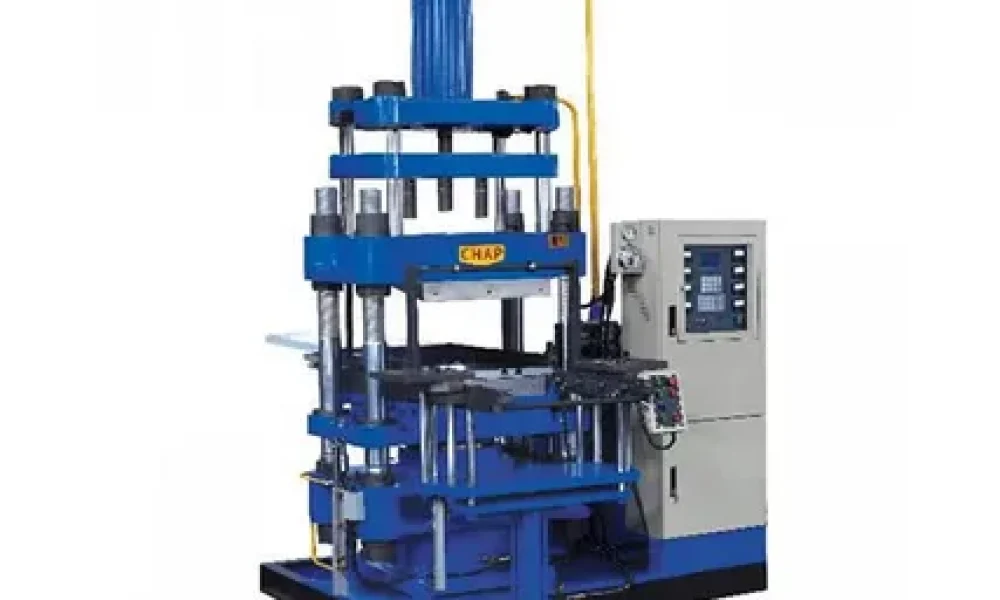
The global plastic press machine market is entering a decade of steady expansion, with demand fueled by automotive innovation, packaging sustainability, and precision molding for electronics and medical devices. According to the latest industry outlook, the market is set to grow from USD 412.3 million in 2025 to USD 598.6 million by 2035, registering a CAGR of 3.8%.
This trajectory highlights the sector’s vital role as a niche within the larger plastic processing machinery market, valued at USD 45 billion globally. With medium-duty machines expected to lead demand at 44% market share in 2025, manufacturers are retooling to balance efficiency, reliability, and affordability for both established industrial giants and emerging regional producers.
A Market at the Crossroads of Innovation and Demand
The growth of the plastic press machine market mirrors global industrial transitions. Automotive OEMs are turning to precision plastic forming for lightweight panels, EV battery enclosures, and hybrid interior components. In parallel, the packaging sector is under pressure to process recycled and biodegradable polymers with higher tolerances, pushing machine makers to enhance forming accuracy.
In Asia, more than 37% of installed plastic press machines in 2023 were deployed for thermoplastic sheet processing, a trend expected to accelerate as China and India continue scaling their component manufacturing bases. By 2026, medical device and consumer electronics producers in Southeast Asia and Latin America will emerge as key growth drivers.
“The need for energy-efficient, automated, and digitally compatible press machines is shaping procurement strategies worldwide,” explained an analyst from the report. “We’re seeing investments not just in heavy-duty presses for automotive, but also in compact, hybrid machines designed for consumer packaging and healthcare.”
Request Your Sample Now: https://www.futuremarketinsights.com/reports/sample/rep-gb-22489
Segmental Insights – Where Growth is Concentrated
Hydraulic Press Machines: Retaining their dominance with a projected 41% share in 2025, hydraulic presses remain indispensable for high-tonnage, complex molding. Their superior control and consistency make them a preferred choice across packaging, household appliances, and industrial components.
Medium-Duty Capacity: Accounting for 44% of market share by 2025, these machines strike the ideal balance between throughput and efficiency, serving SMEs and regional plastic converters producing consumer goods and electronic housings.
Automotive End-Use: With 32% of the market, the automotive industry continues to drive demand for press-molded plastic parts. From dashboards and trims to EV battery casings, plastic press machines support cost-efficient, large-scale production with consistent quality.
Regional and Country-Level Trends
While the global CAGR sits at 3.8%, regional variations reveal divergent growth paths:
India leads globally with a 4.5% CAGR, propelled by government incentives for domestic manufacturing and precision machinery upgrades in medical molding and electronics.
China follows with a 4.2% CAGR, driven by EV component demand and smart factory integrations in Suzhou and Dongguan.
Italy (3.7%) is witnessing strong demand from medical disposables and food-grade packaging, with northern regions leading installations of cleanroom-ready machines.
United States (3.5%) continues investing in dual-shot and gas-assisted presses, particularly for defense and life sciences.
Germany (3.3%) lags slightly, but maintains its strength in AI-integrated, hybrid press systems for automotive lightweighting and industrial electronics.
This regional diversity highlights how emerging economies are driving volume growth, while developed markets focus on automation, precision, and sustainability.
Established Leaders and Emerging Challengers
The market landscape is a mix of global incumbents and ambitious newcomers:
Schuler Group (Andritz Schuler) remains the global leader with an estimated 33% share, leveraging its high-tonnage and servo-driven presses. Its recent Canton, Michigan expansion added a 5,000-ton hydroforming press and advanced automation systems, underscoring its commitment to scaling North American operations.
Arburg GmbH specializes in modular injection press systems, carving a strong position in electronics and medical molding where precision and cleanroom compatibility are critical.
Trinks Inc. continues to dominate in North America with its hydraulic press solutions, especially in packaging and automotive applications.
Wabash MPI and Harsle are carving mid-market niches, focusing on laboratory applications, educational institutions, and low-tonnage industrial needs. Their strategy revolves around affordability and modularity, appealing to SMEs and technical institutes.
Cosmos and other emerging manufacturers from Asia are finding success with cost-sensitive hybrid systems, targeting regional converters and contract manufacturers.
Together, these players reflect a competitive but innovation-driven landscape, where established giants and new entrants coexist by tailoring strategies to market tiers.
Get the Report Brochure Now: https://www.futuremarketinsights.com/reports/brochure/rep-gb-22489
Key Market Dynamics – What’s Driving Change?
High-Tonnage Surge in Automotive: Orders for 800+ ton machines surged 31% YoY as automakers pivoted to lightweight plastic alternatives for structural parts. Servo-hydraulic presses are cutting cycle times by 18% and rejection rates by 22%.
Hybrid Systems in Packaging: Hybrid presses now account for 44% of unit sales in consumer packaging lines. With energy savings of up to 21% and defect reductions nearing 20%, they are becoming the preferred choice for high-volume, low-margin packaging lines.
Digital and AI Integration: From pre-programmed mold recall reducing changeovers to AI-monitored presses in Germany, digitalization is becoming a standard feature across advanced economies.
Shift to Recycled Resins: Sustainability regulations are prompting demand for machines capable of handling reclaimed polymers with high dimensional accuracy. This is especially visible in Europe and North America.
Industry Voices
Commenting on the sector’s direction, a Schuler Group executive stated:
“Our expansion in North America is more than just capacity growth—it’s about building next-gen forming solutions that align with EV innovation and circular economy goals.”
Meanwhile, a representative from Harsle emphasized accessibility:
“Emerging markets don’t just need high-tech machines—they need affordable, reliable systems that SMEs can deploy. That’s where we’re innovating.”
Future Outlook
The plastic press machine market is poised to become a cornerstone of modern manufacturing, enabling industries to transition toward lightweighting, recyclability, and automation-driven efficiency. With India and China leading volume growth, and Germany, Italy, and the U.S. investing in smart systems, the decade ahead will balance scaling capacity with sustainability and precision.
As established players like Schuler, Arburg, and Trinks strengthen global footprints, emerging firms such as Harsle and Cosmos will play a vital role in democratizing access to advanced molding technology. The result is a more inclusive, competitive, and innovation-rich market.



