
Plant-Based Food and Beverage Market Overview:
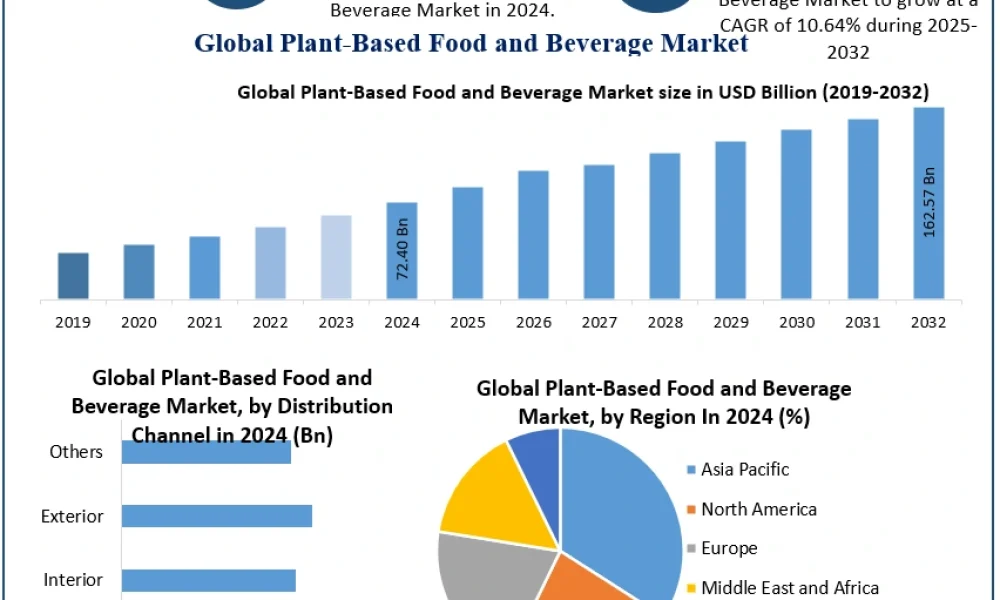
Plant-Based Food and Beverage Market is valued at USD 72.40 billion in 2024 and is projected to reach USD 162.57 billion by 2032, growing at a CAGR of 10.64%. Rising health consciousness, sustainability-driven consumption, and rapid innovation in plant-derived meat and dairy substitutes are fueling expansion across all major regions, with Asia Pacific leading market growth through environmental awareness and cultural preferences encouraging plant-based diets.
Key Highlights & Insights
Market Size & Growth: The plant-based food and beverage market will expand from USD 72.40 billion (2024) to USD 162.57 billion (2032) at a robust CAGR of 10.64%.
Dominating Region: Asia Pacific leads the global market owing to strong cultural and religious adoption of plant-based diets, rising environmental concerns, and rapid urban lifestyle transitions in India, China, and Australia.
Leading Segment: Plant-Based Milk Alternatives hold the largest market share (over 40% in 2024), boosted by the popularity of almond, soy, oat, and coconut milk as lactose-free, eco-friendly substitutes.
Key Driver: Growing consumer health awareness, supported by government campaigns on sustainable living and a surge in R&D investment for improving product texture, nutrition, and taste, propel market momentum.
Get a sample of the report:https://www.maximizemarketresearch.com/request-sample/111733/
Recent Developments
2024–2025: Major brands like Beyond Meat (U.S.), Vitasoy International (Hong Kong), and Danone (U.S./France) expand global product portfolios, launching high-protein, fortified plant-based beverages and meats.
Investment Boom: Venture capital-backed startups in Europe and North America are innovating in clean-label formulations and sourcing methods, while Asian players emphasize plant-based dairy and indigenous protein sources.
Technological Advancements: Oatly (Sweden) and Ripple Foods (U.S.) deploy new ingredient technologies to improve taste and texture, narrowing the sensory gap between plant-based and traditional products.
Retail Expansion: E-commerce growth and partnerships with mainstream supermarket chains (such as Tesco, Whole Foods, and Alibaba Fresh) enhance accessibility and affordability of plant-based products.
Market Dynamics
Growth Drivers:
Escalating prevalence of lifestyle diseases like obesity and heart disorders pushing demand for low-cholesterol, nutrient-rich diets.
Rising consumer concern over climate change, deforestation, and water consumption from animal agriculture.
Technological innovation in protein extraction and food processing improving mimicry of meat and dairy products.
Millennials and Gen Z driving ethical and sustainable consumption, favoring animal-free products.
Challenges:
Perceived limitations in taste, texture, and mouthfeel compared to traditional animal-based foods.
Price premium of plant-based options due to specialized production and limited scale.
Skepticism and misinformation related to plant-based nutrition and health benefits hinder mass-market adoption.
Regional Analysis
Asia Pacific: Dominates global share, supported by strong vegetarian cultures in India and Southeast Asia, religious influences, and eco-conscious younger consumers. Key regional players like Vitasoy, OmniPork, and Sanitarium drive innovation in dairy and meat alternatives.
North America: The most mature market, led by brands such as Beyond Meat, Impossible Foods, and Califia Farms, with plant-based meats now mainstream in supermarkets and restaurants.
Europe: Strong growth powered by sustainability goals under the EU’s “Green Deal” and demand from health-conscious consumers in Germany, the UK, and France.
Middle East & Africa and South America: Emerging regions witnessing increased awareness and gradual retail penetration through global and regional partnerships.
Product Segmentation
By Type:
Plant-Based Milk Alternatives: Almond milk, Soy milk, Oat milk, Coconut milk, Rice milk.
Plant-Based Meat Substitutes: Tofu, Tempeh, Seitan, Others.
Others: Plant-based snacks, yogurts, and sauces.
By Distribution Channel: Retail stores, E-commerce, and Foodservice outlets.
By Region: North America, Europe, Asia Pacific, Middle East & Africa, South America.
Key Trends
Rising adoption of fortified plant-based products rich in vitamins and minerals to match animal-based nutritional profiles.
Integration of local ingredients and flavors to align with regional palates.
Growth in private-label and premium plant-based brands driving accessibility and trust.
Innovations in fermentation technologies improving fidelity of plant-based proteins to traditional food structures.
Increasing collaborations between food tech startups and global corporations to scale R&D and production.
Quote
“The rapid boom in Asia Pacific’s plant-based movement demonstrates how sustainability, culture, and health can intersect to reshape dietary practices globally. As consumers look for cleaner, nutritious, and planet-friendly alternatives, the plant-based food and beverage market is setting new benchmarks for innovation and conscious consumption.”
Contact Maximize Market Research:
3rd Floor, Navale IT Park, Phase 2
Pune Bangalore Highway, Narhe,
Pune, Maharashtra 411041, India
[email protected]
+91 96071 95908, +91 9607365656
About Maximize Market Research:
Maximize Market Research is a multifaceted market research and consulting company with professionals from several industries. Some of the industries we cover include medical devices, pharmaceutical manufacturers, science and engineering, electronic components, industrial equipment, technology and communication, cars and automobiles, chemical products and substances, general merchandise, beverages, personal care, and automated systems. To mention a few, we provide market-verified industry estimations, technical trend analysis, crucial market research, strategic advice, competition analysis, production and demand analysis, and client impact studies.




