
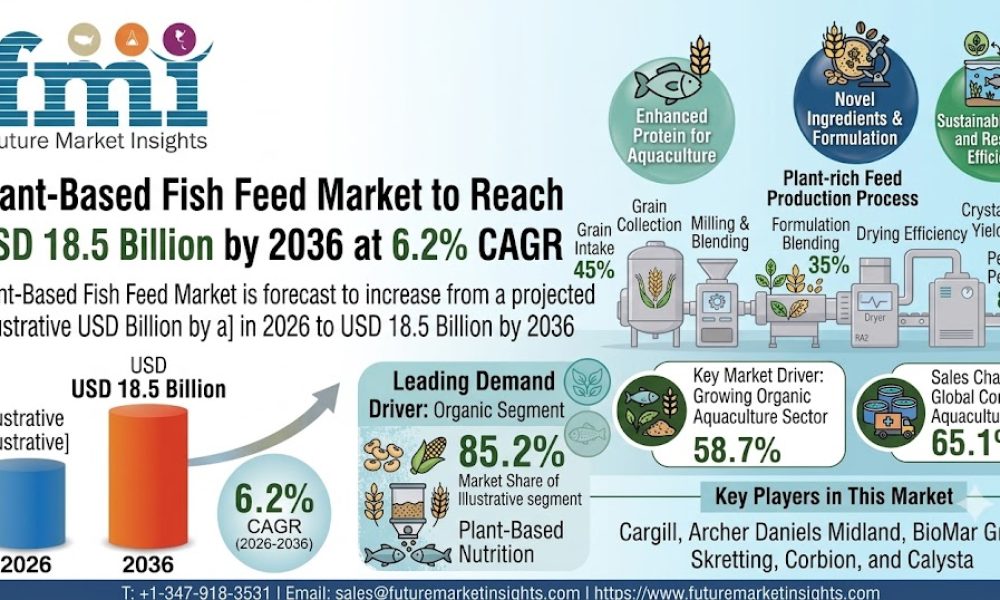
The global Plant-Based Fish Feed Market is forecast to increase from USD 10.1 billion in 2026 to USD 18.5 billion by 2036, expanding at a 6.2% CAGR during the 2026-2036 forecast period, according to Future Market Insights. The market stood at USD 9.5 billion in 2025. Growth is being supported by fish farms exploring plant-rich diets to widen ingredient options and reduce dependence on marine protein and oil inputs, alongside advances in processing and formulation that improve nutrient access and feed performance.
Get detailed market forecasts, competitive benchmarking, and pricing trends:
https://www.futuremarketinsights.com/reports/sample/rep-gb-
Regional Segment Leaders
As this is a global Plant-Based Fish Feed Market report, the segment analysis reflects nature, end-use applications, feed form, species requirements, and production practices across key aquaculture markets.
- Organic – 85.2% of Nature revenue in 2026: Certified crop sourcing requirements in organic feed programs support demand for plant-based ingredients that can meet defined production and certification standards.
- Commercial – 81.6% of End-use Application revenue in 2026: Commercial aquaculture operations purchase feed throughout production cycles, supporting the continued use of plant-rich formulations in routine fish farming.
- Pellet – 53.8% of Form revenue in 2026: Pelletized feed supports water stability and controlled nutrient delivery, making it an important format for commercial aquaculture operations.
Market Growth Context
The Plant-Based Fish Feed Market is developing around the need to broaden feed ingredient options while reducing dependence on marine protein and oil inputs. Fish farms are increasingly testing plant-rich diets to determine whether they can deliver stable growth, feed conversion, and species-specific nutritional performance under commercial production conditions.
Feed conversion remains an important measure for producers because it shows how efficiently fish convert feed into body growth. Improvements in ingredient processing are helping feed manufacturers address some of the nutritional limitations associated with plant proteins.
In March 2025, an Aquaculture-reported greater amberjack trial evaluated a diet containing 44.5% plant proteins. Enzyme-treated ingredients improved nutrient access in the plant-rich diet, providing a practical pathway for feed manufacturers seeking to increase plant content while maintaining species-specific nutritional requirements.
However, nutrient balance remains an important adoption consideration. Plant ingredients can differ in amino acid profiles, digestibility, and taste across fish species. Feed manufacturers therefore need to validate formulations through species-specific trials before expanding plant-rich diets across commercial production systems.
Country adoption is also following different paths because aquaculture structures, farm species, and feed regulations vary between markets. Germany illustrates how farm structure can influence the evidence expected during feed approval. In June 2026, Destatis reported 16,550 tonnes of farmed fish production during 2025. German trout farms and other fish producers operate within species-specific nutritional requirements and European Union feed rules.
The United Kingdom presents another distinct production environment, with salmon farming concentrating substantial feed volumes among fewer producers. This structure makes farm-level performance and consistent feed results important considerations when evaluating new plant-rich formulations.
Commercial success through 2036 is expected to depend on improving plant-protein digestibility, maintaining nutrient balance, demonstrating stable growth and feed conversion, and developing pellet formats that provide consistent nutrient delivery under aquaculture conditions.
Competitive Landscape
The competitive landscape features companies supplying complete aquaculture feeds, plant-based feed ingredients, alternative proteins, and nutritional solutions for fish farming.
- Aquaculture Feed & Ingredient Suppliers: Cargill, Archer Daniels Midland, BioMar Group, Skretting, Corbion, and Calysta are among the companies identified as supplying complete feeds or ingredients used in plant-rich fish diets.
Competitive differentiation depends on ingredient quality, species-specific nutritional performance, digestibility, feed conversion, pellet stability, taste acceptance, and the ability to demonstrate consistent results under commercial farming conditions.
Feed manufacturers are also focusing on processing technologies that improve nutrient access from crop-based proteins. Enzyme treatment and other formulation approaches can help address differences in digestibility and nutrient availability, while species trials remain important for validating performance before broader commercial adoption.
Get the Complete Story – Read More About the Plant-Based Fish Feed Market:
https://www.futuremarketinsights.com/reports/plant-based-fish-feed-market
Analyst Perspective
“Plant-rich feed is likely to expand as processing makes crop proteins easier for more fish species to use. Feed makers should build species trials and pellet data early because farms need stable growth before wider adoption.” – Nandini Roy Choudhury, Principal Consultant, Future Market Insights
About Future Market Insights (FMI)
Future Market Insights, Inc. (FMI) is an ESOMAR-certified, ISO 9001:2015 market research and consulting organization, trusted by Fortune 500 clients and global enterprises. With operations in the U.S., UK, India, and Dubai, FMI provides data-backed insights and strategic intelligence across 30+ industries and 1200 markets worldwide.
For Press & Corporate Inquiries
Rahul Singh
AVP – Marketing and Growth Strategy
Future Market Insights, Inc.
+91 8600020075
For Sales: [email protected]
For Media: [email protected]
For Web: https://www.futuremarketinsights.com/



