
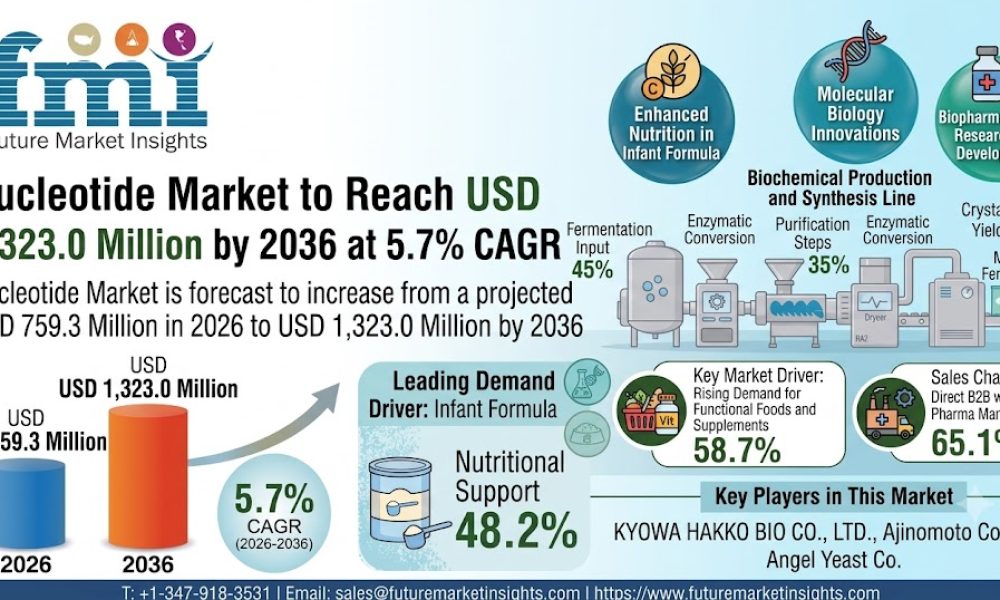
The global nucleotide market is forecast to increase from USD 759.3 million in 2026 to USD 1,323.0 million by 2036, expanding at a 5.7% CAGR during the 2026-2036 forecast period, according to Future Market Insights. The market stood at USD 718.3 million in 2025. Growth is being supported by increasing use of nucleotide materials across pharmaceutical development, genomic research, DNA synthesis, and assay workflows, where purity, lot consistency, traceability, and process compatibility remain important.
Get detailed market forecasts, competitive benchmarking, and pricing trends:
https://www.futuremarketinsights.com/reports/sample/rep-gb-11035
Regional Segment Leaders
As this is a global Nucleotide Market report, the segment analysis reflects application areas, technology platforms, nucleotide types, and research and manufacturing requirements across key life-sciences markets.
- Pharmaceuticals – 63.4% of Application demand in 2026: Pharmaceutical workflows require qualified nucleotide materials with consistent purity and specifications, particularly where material changes can affect validated processes, assay performance, or manufacturing outcomes.
- TaqMan Allelic Discrimination – 47.5% of Technology demand in 2026: Probe-based genotyping applications support demand for nucleotide materials that are compatible with routine testing workflows and provide consistent analytical performance.
- Canonical Purine and Pyrimidine Products: Nucleotide Type includes canonical purine and pyrimidine products alongside modified and other nucleotide materials used across research, pharmaceutical, and formulation workflows.
Market Growth Context
The Nucleotide Market is developing around the increasing use of nucleotide materials in pharmaceutical and research activities. DNA synthesis, assay development, and related analytical processes increasingly rely on consistent material performance across repeated workflows.
As these applications move from research and development into more controlled production environments, the quality and consistency of nucleotide materials become increasingly important. Variations in material quality can affect amplification, synthesis, assay performance, or downstream manufacturing processes after workflows have been qualified.
Buyers are therefore expected to evaluate purity, lot consistency, traceability, and change-management requirements when selecting nucleotide suppliers. Supplier changes may require requalification when replacement materials influence assay performance, formulation behavior, process control, or regulatory documentation.
Regional demand is also being shaped by developments in biopharmaceutical manufacturing, genomic research, and precision medicine. South Korea is expanding biopharma production and genomic research, while Japan continues to support genomic drug discovery. The UK is developing life-sciences research and manufacturing capabilities, and Germany is strengthening genomic infrastructure. In the USA, sequence data and clinical research are increasingly connected through precision medicine initiatives.
These developments are expected to support demand for nucleotide materials through 2036. Buyers will continue to assess technical documentation, process fit, supply continuity, and technical support before changing qualified materials.
Competitive Landscape
The competitive landscape includes companies participating in nucleotide-related materials, biochemical manufacturing, pharmaceutical inputs, and research applications.
- Nucleotide & Biochemical Material Suppliers: KYOWA HAKKO BIO CO., LTD., Ajinomoto Co., Inc., and Angel Yeast Co. are among the companies identified with active nucleotide-related roles.
Competitive differentiation is expected to depend on specification control, material consistency, documentation, technical support, supply continuity, and the ability to maintain performance as nucleotide applications progress from development-stage research to routine pharmaceutical and analytical workflows.
Supplier qualification remains an important consideration because material changes can affect validated assays, manufacturing processes, formulation behavior, and regulatory documentation. Companies that can provide consistent specifications and reliable supply are positioned to address these requirements across research and controlled production environments.
Get the Complete Story – Read Nucleotide Market More About Our Latest Report: https://www.futuremarketinsights.com/reports/nucleotide-market
Analyst Perspective
“Regulated nucleotide demand will continue to favor suppliers that carry specification control from development into routine production. Qualification is becoming more difficult when material changes affect validated assays, manufacturing steps, or regulatory documentation.” – Nandini Roy Choudhury, Principal Consultant, Future Market Insights
About Future Market Insights (FMI)
Future Market Insights, Inc. (FMI) is an ESOMAR-certified, ISO 9001:2015 market research and consulting organization, trusted by Fortune 500 clients and global enterprises. With operations in the U.S., UK, India, and Dubai, FMI provides data-backed insights and strategic intelligence across 30+ industries and 1200 markets worldwide.
For Press & Corporate Inquiries
Rahul Singh
AVP – Marketing and Growth Strategy
Future Market Insights, Inc.
+91 8600020075
For Sales: [email protected]
For Media: [email protected]
For Web: https://www.futuremarketinsights.com/



