
Pig Iron Market Overview :
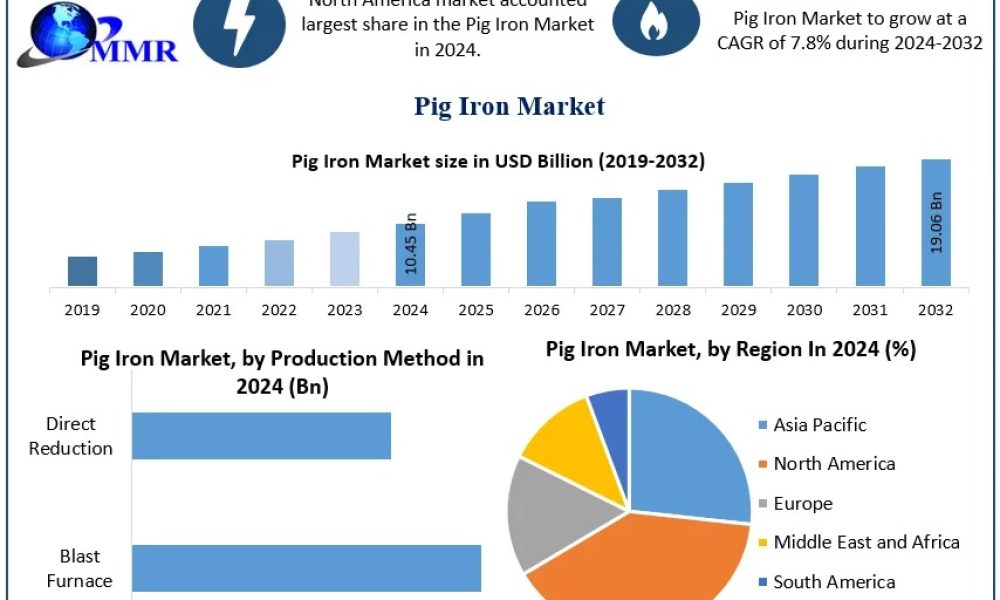
Pig Iron Market is valued at USD 10.45 billion in 2024 and is forecast to grow at a CAGR of 7.8% to reach USD 19.06 billion by 2032. Pig iron, created by smelting iron ore with high-carbon fuel and various reductants in blast and electric furnaces, is the backbone raw material for steelmaking and a key ingredient across construction, infrastructure, automotive, and energy sectors.
Key Highlights & Insights
Market Size & Growth: USD 10.45 billion in 2024, projected to rise to USD 19.06 billion by 2032 at 7.8% CAGR.
Dominating Region: North America is expected to lead the pig iron market, driven by demand from construction, automotive, and manufacturing. Notably, American steel firms increased pig iron imports from Ukraine by 40.2% in July 2023 amid evolving global supply chains. China, Russia, Brazil, and India remain major producers, while the U.S., Germany, and Japan are primary consumers.
Leading Segment: Nodular pig iron is the fastest-growing type, prized in automotive for cast iron parts needing enhanced ductility and strength – especially in engine blocks, crankshafts, and pipes for construction and transportation.
Key Driver: Robust demand from construction and automotive industries, supported by infrastructure investment, urbanization, and the pursuit of steel with advanced mechanical properties.
Recent Developments
Firms like ArcelorMittal, Nucor Corporation, Tata Steel, and Baowu Steel Group are adopting advanced smelting and blast furnace technologies to increase efficiency and reduce carbon footprint.
July 2023 saw a surge in U.S. pig iron imports from Ukraine (119.6 thousand tons, up 40.2% in one month; 2.3x increase year-over-year for Jan-July 2023) as American steelmakers diversified raw material sources.
Jindal Stainless’ 2023 joint venture in Indonesia for a nickel pig iron plant and Baowu Group’s collaboration in Sulawesi signal growing investment in specialty pig iron and value chain diversification.
European steelmakers, exemplified by Italy and Turkey, remain the leading importers of Russian pig iron, reflecting dynamic global trade flows.
For full access to the data, request a sample report now :https://www.maximizemarketresearch.com/request-sample/189389/
Market Dynamics
Growth Drivers:
Increasing construction and infrastructure development, particularly in emerging markets and BRICS nations.
Automotive sector’s demand for high-strength and ductile iron components.
Technological advances in blast furnace operations, recycling, and electric arc furnace (EAF) production for efficiency and sustainability.
Stricter global environmental regulations (EU carbon neutrality, recycling mandates) pushing for cleaner and greener production methods.
Challenges:
Economic fluctuations, energy and raw material price volatility.
Environmental restrictions demanding high investment in emission control and process improvements.
Cyclicality of steel and manufacturing sectors, trade barriers, and competition from alternative materials.
Overcapacity risks and technological shifts in steelmaking (e.g., hydrogen-based direct reduction).
Opportunities:
Expansion in infrastructure projects (e.g., China’s Belt and Road Initiative), urbanization, and EV production.
Growth in renewable energy sector, with pig iron required in wind turbines and solar supports.
Advances in recycling, “green pig iron,” and R&D for blast furnace efficiency and emission reduction.
New joint ventures and capacity expansion in Asia and Latin America.
Regional Analysis
North America: Leading market, driven by construction, automotive manufacturing, EAF technology adoption, and growing imports from Ukraine and Brazil.
Europe: Strong demand from automotive, industrial, and construction sectors; Italy and Turkey emerge as major pig iron importers, with enhanced production and import capacity.
Asia Pacific: Largest producer—China, India, Japan, and Indonesia—propelled by industrial expansion, infrastructure projects, and manufacturing growth.
Latin America, Middle East, Africa: Brazil stands out in production and exports, while emerging markets leverage investments for industrial growth.
Product Segmentation
By Type: Basic pig iron, Foundry pig iron, Nodular pig iron (automotive/engineering leader)
By Production Method: Blast furnace (largest), Direct reduction, Electric arc furnace (growing)
By End-User: Construction and infrastructure, automotive, transportation, energy industry, foundries
Key Trends
Advanced smelting and blast furnace innovations for emission reduction and resource efficiency.
Surge in pig iron recycling, use of eco-friendly processes, and carbon-neutral steel initiatives.
Increasing specialization for nickel pig iron and high-purity pig iron for stainless steel and EV parts.
Diversification of supply chains, new mining/plant investment, and resilient sourcing strategies.
Quote
North America’s leadership in the pig iron market reflects a dynamic blend of technological innovation, resilient supply chains, and growing demand from the construction and automotive sectors. Globally, the market’s evolution is shaped by sustainability imperatives, joint ventures, and the relentless pursuit of stronger, greener iron and steel products.




