
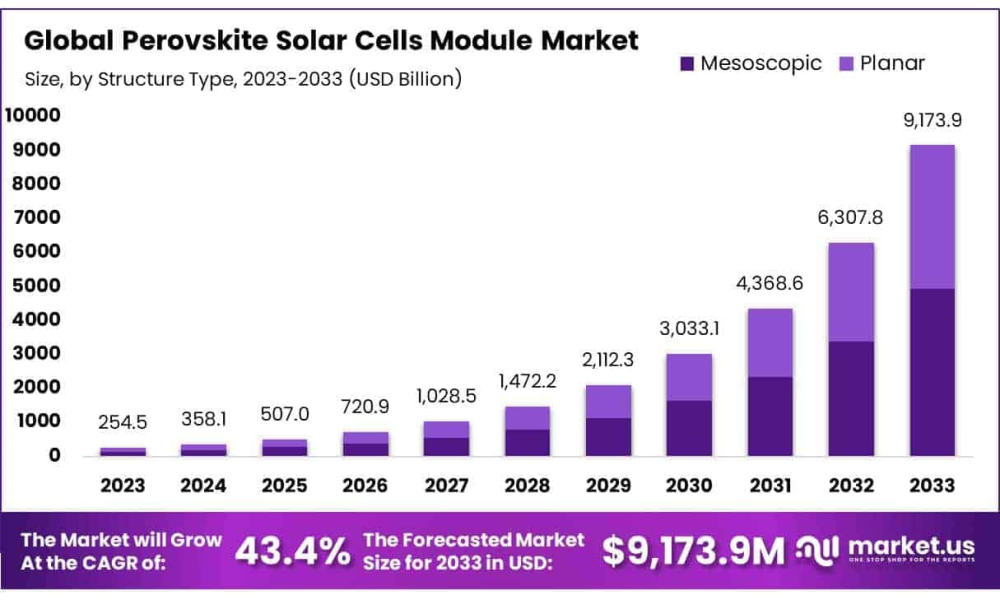
According to market.us, The global Perovskite Solar Cell Module Market is projected to reach approximately USD 9,173.94 million by 2033, rising from USD 254.45 million in 2023, and is expected to grow at an impressive compound annual growth rate (CAGR) of 43.4% from 2024 to 2033. This market demonstrates strong potential to influence the renewable energy sector significantly, driven by the need for high-efficiency, low-cost solar technologies. Perovskite materials, known for their excellent optical absorption and efficient electrical charge transport properties, have made solar cells more versatile and effective for a wide range of energy applications.
Originally developed by IBM in the 1990s and first introduced to the solar energy industry in 2012, perovskite solar cell module market have since gained traction due to their high performance and adaptability. As global energy systems increasingly shift away from non-renewable sources to combat the effects of climate change, renewable technologies like perovskite solar modules are playing a vital role in supporting clean energy transitions. However, ongoing research and development remain essential to address technical and stability challenges, paving the way for commercialization and large-scale deployment in the years ahead.
Key Takeaways
- The global perovskite solar cell module market was valued at USD 254.45 million in 2023.
- The global perovskite solar cells module market is projected to reach USD 9,173.94 million by 2033.
- Among structure type, the mesoscopic held the majority of the revenue share at 53.9%.
- Based on product types, flexible accounted for the largest market share with 61.8%.
- Among types, single junction accounted for the majority of the perovskite solar cell module market share with 62.9%.
- Among technologies, solution method accounted for the majority of the perovskite solar cells module market share with 59.2%.
- Among applications, solar panel accounted for the majority of the perovskite solar cell module market share with 42.9%.
- Based on end-uses, the utility dominated the market with a share of 42.0%.
Access a Complimentary Sample of This Premium Report: https://market.us/report/perovskite-solar-cells-module-market/free-sample/
Factors Affecting the Growth of the Perovskite Solar Cell Module Market
- Technological Advancements and Efficiency Improvements: The rapid increase in power conversion efficiency (PCE) of perovskite solar cells—from below 4% in 2009 to over 25% in recent years—has been a major driver of market interest. Continuous innovation in cell architecture, material engineering, and tandem structures is helping to push the boundaries of performance, making PSC modules competitive with traditional silicon-based technologies.
- Lower Manufacturing Costs and Material Availability: Perovskite solar modules can be produced using low-cost raw materials and simpler fabrication methods such as solution processing and printing techniques. These low-energy manufacturing methods reduce production costs significantly, making PSCs a more attractive option for large-scale deployment, especially in cost-sensitive markets.
- Rising Demand for Renewable Energy: The global push toward cleaner energy sources, driven by climate change mitigation efforts and supportive government policies, is fueling demand for solar technologies. perovskite solar cell module market, with their high efficiency and lightweight characteristics, are emerging as a promising alternative to meet the increasing renewable energy needs of both developed and developing regions.
- Integration in Tandem and Flexible Solar Applications: Perovskite cells can be integrated with existing silicon cells in tandem structures to enhance overall efficiency. Additionally, their flexibility and lightweight nature make them ideal for novel applications such as building-integrated photovoltaics (BIPV), portable devices, and wearables, further broadening their commercial scope.
- Environmental and Stability Concerns: Despite their benefits, the long-term operational stability of perovskite materials and their susceptibility to moisture, heat, and UV light remain key challenges. Moreover, the presence of lead in some formulations raises environmental and regulatory concerns, potentially affecting widespread adoption. Ongoing research is focused on improving durability and developing lead-free alternatives.
Report Segmentation:
Structure Type Analysis: In 2023, mesoscopic structure type held the leading position in the perovskite solar cells module market, accounting for 53.9% of the market share. This dominance is due to the superior performance characteristics and manufacturing advantages of mesoscopic structures compared to planar types. Mesoscopic perovskite solar cell module market exhibit higher power conversion efficiency owing to their excellent light-harvesting and charge-transport capabilities. The mesoporous layer increases internal surface area, enhancing electron collection and contributing to better device efficiency. Additionally, these structures demonstrate greater stability under various environmental conditions, which is essential for real-world solar applications.
Product Type Analysis: Flexible product types accounted for the largest share of the perovskite solar cells module market in 2023, holding 61.8% of the total share. This dominance is attributed to the lightweight, versatile, and bendable nature of flexible PSCs, which are manufactured on substrates such as plastic, metal foils, and flexible glass. These modules are ideal for portable electronics, wearable devices, and integration with unconventional surfaces like vehicle roofs, building facades, and textiles. Their adaptability to diverse applications, along with reduced installation costs and ease of transport, has made flexible PSCs a preferred option for both commercial and emerging markets.
Type Analysis: Single-junction perovskite solar cells led the market in 2023, capturing 63.3% of the total share. Their prominence is attributed to their simpler structure, cost-effectiveness, and ease of scalability compared to multi-junction cells. Single-junction PSCs consist of one active layer that absorbs sunlight and converts it into electricity, enabling lower manufacturing complexity and cost. With continuous improvements in their efficiency, these cells now compete with traditional photovoltaic technologies. Their streamlined design also makes them suitable for a wide range of applications, from small electronic devices to large-scale installations.
Technology Analysis: The solution method dominated the perovskite solar cells module market by technology in 2023, with a 47.6% share. This technique is popular due to its low-cost process, simplicity, and scalability. It involves dissolving perovskite precursor materials in a solvent and depositing the solution on a substrate, making it compatible with various materials including plastics, glass, and metals. The process can be performed at low temperatures, reducing energy costs and supporting the production of flexible modules. Moreover, continuous improvements in solution chemistry and deposition techniques have significantly enhanced the quality and uniformity of perovskite films, supporting broader market adoption.
Application Analysis: Solar panels emerged as the dominant application area in 2023, accounting for 42.9% of the perovskite solar cell module market. This segment’s leadership is driven by the increasing demand for efficient energy generation in both residential and commercial sectors. PSC-based solar panels offer key advantages such as lower production costs and improved performance, particularly under low light or indoor conditions. These benefits make them ideal for large-scale renewable energy projects supported by government policies targeting carbon reduction. The ability to integrate PSCs into conventional panel formats further eases adoption and supports widespread implementation.
End-Use Analysis: In terms of end-users, the utility sector held the largest market share at 54.1% in 2023. The sector’s focus on high-capacity, cost-effective renewable energy solutions has aligned well with the advantages of perovskite solar technology. Utility-scale solar farms require technologies that are not only efficient but also scalable and economically viable—criteria that PSCs increasingly fulfill. Their compatibility with large-scale deposition methods and the potential for rapid deployment make PSCs particularly suitable for extensive solar installations. As global energy demand rises and sustainability targets become stricter, the utility segment is expected to remain a key growth driver in the PSC market.
To Purchase this Premium Report@ https://market.us/purchase-report/?report_id=15931
Key Market Segments
By Structure Type
- Mesoscopic
- Planar
By Product Type
- Rigid
- Flexible
By Type
- Single Junction
- Multi Junction
By Technology
- Solution Method
- One-step
- Two-step
- Vapor-Assisted Solution Method
- Vapor-Deposition Method
By Application
- Smart Glass
- Building-Integrated Photovoltaics
- Solar Panel
- Others
By End-User
- Residential
- Commercial
- Industrial
- Utility
Regional Analysis
In 2023, the Asia-Pacific region emerged as the dominant player in the global perovskite solar cell module market, holding a significant market share of 59.5%. This strong regional presence is primarily driven by the rapid expansion of key industries such as packaging, commercial printing, and labeling—sectors that represent major end-users of perovskite solar technologies. The accelerating pace of industrialization and urbanization in countries like China, India, and across Southeast Asia has further intensified demand for advanced energy solutions.
The growth of the packaging industry, particularly within the consumer goods, food and beverage, pharmaceutical, and e-commerce sectors, has played a crucial role in boosting the market. These industries require high-performance packaging solutions that not only enhance visual appeal but also ensure durability and protection. As the need for energy-efficient and cost-effective solutions rises across these sectors, perovskite solar cell modules are increasingly being adopted due to their flexibility, lightweight design, and potential for integration into smart and sustainable packaging systems. The region’s robust manufacturing infrastructure and supportive policy frameworks are expected to further strengthen its leadership in the global market over the coming years.
Market Key Players
- Hanwha Group
- Toshiba Corporation
- CubicPV
- Greatcell Energy
- Oxford Photovoltaics Ltd
- EneCoat Technologies Co., Ltd
- Swift Solar
- Solaronix SA
- Saule Technologies
- Tandem PV, Inc.
- Hangzhou Microquanta Co. Ltd.
- Perovskia Solar AG
- Front Materials Co. Ltd
- P3C Technology and Solutions Pvt. Ltd.
- Other Key Players
Refer More Related Reports:



