
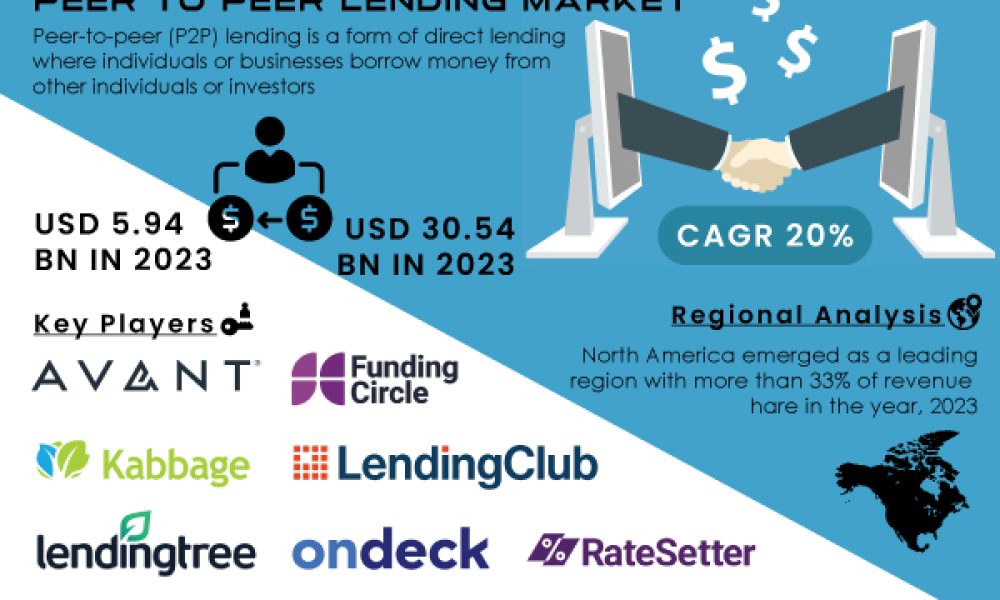
The global Peer-to-Peer (P2P) Lending Market, valued at USD 5.94 billion in 2023, is poised for extraordinary growth, projected to reach USD 30.54 billion by 2032. This represents a robust CAGR of 20% over the forecast period from 2024 to 2032. The market’s acceleration is largely attributed to rising demand for alternative financing models, especially among underserved individuals and small businesses.
Get Sample Copy of Report: https://www.snsinsider.com/sample-request/1278
As traditional banking institutions become less accessible due to rigid lending criteria, peer-to-peer lending platforms are filling the void by connecting borrowers directly with investors. This model enables faster loan disbursal, competitive interest rates, and increased financial inclusion—particularly for borrowers with limited credit histories.
Market Summary
The transformation of the lending landscape through technology is a key catalyst for P2P lending’s rise. Online lending platforms have adopted machine learning and artificial intelligence (AI) to assess creditworthiness and detect fraud in real-time, significantly reducing overhead and default risk. These platforms are disrupting the status quo of financial services by eliminating intermediaries and offering more tailored loan products.
In 2024, regulatory developments are also playing a crucial role in supporting market transparency. The European Union, for example, introduced updated disclosure rules that require platforms to improve risk rating visibility for investors, ensuring more informed decision-making.
From an investor’s standpoint, P2P lending offers compelling returns averaging between 5% and 8%, outperforming many traditional savings accounts. In the U.S. alone, roughly 70% of P2P borrowers are individuals seeking personal loans, while 30% are small enterprises, showcasing the wide range of end-users turning to these platforms for credit access.
Market Share and Segment Insights
By type, the consumer lending segment dominated in 2023, accounting for over 58% of the total revenue. P2P platforms have become particularly attractive for borrowers looking for quick personal loans with fewer procedural hurdles compared to banks. Their streamlined digital interfaces and automated underwriting processes also help reduce cost and time, benefitting both lenders and borrowers.
Meanwhile, the business lending segment is anticipated to register the highest CAGR of 21.8% through 2032. Small businesses and startups are increasingly leveraging P2P lending as a more agile financing method, sidestepping the strict requirements often imposed by traditional banking institutions.
By end-use, non-business loans commanded a dominant 73% revenue share in 2023. These include loans for medical expenses, home renovation, debt consolidation, and educational needs. However, business loans are expected to witness a strong growth rate of 22.1% CAGR, fueled by demand from SMEs seeking quick, flexible funding.
Enquiry Before Buy: https://www.snsinsider.com/enquiry/1278
Market Dynamics
Key Drivers:
- Alternative Financing Demand: Growing credit demand from individuals and small businesses underserved by traditional banks.
- Technological Advancements: AI, machine learning, and data analytics improving credit scoring and fraud detection.
- Higher ROI for Investors: Average investor returns of 6–8% annually are drawing more participants to the lending side.
- User-Friendly Digital Platforms: P2P lending platforms provide transparent loan terms, simple application processes, and faster approvals.
A 2023 survey by TransUnion revealed that 60% of small business owners struggled to access conventional credit and instead turned to P2P platforms. LendingClub’s survey in 2024 confirmed this trend, with 70% of its borrowers citing faster approval times and 65% valuing flexible repayment options.
Key Restraints:
- Regulatory Uncertainty: Fragmented and evolving regulatory environments across different regions can limit scalability and raise compliance costs.
- Default Risks: Lending to borrowers with limited credit history poses inherent risk, which may deter risk-averse investors.
- Cybersecurity Concerns: As digital platforms deal with sensitive financial data, any breach or fraud can undermine user trust.
The U.S. market, for instance, faces dual layers of regulation—federal oversight by the SEC and varying state-level laws. According to a 2023 industry survey, over 40% of platforms cited regulation as a top barrier to growth.
Regional Analysis
North America led the global P2P lending market in 2023, with over 33% of the revenue share. A mature financial ecosystem, widespread digital adoption, and investor appetite for diversified assets have all contributed to the region’s leadership. Moreover, the increasing use of AI—now integrated by roughly 50% of U.S. platforms—is improving platform performance, credit modeling, and fraud prevention.
Asia Pacific is projected to be the fastest-growing region, with a CAGR of 22% through 2032. A vast population of unbanked or underbanked individuals, paired with high digital adoption and a booming SME sector, makes the region ripe for P2P lending growth. Countries like India, Indonesia, and the Philippines are witnessing a surge in demand for quick, affordable credit, and P2P platforms are stepping up to meet this need.
Recent Developments
- March 2024: Jar, a Tiger Global-backed micro-savings app, entered the P2P lending space in partnership with NBFC LenDenClub. Its pilot program “Jar Plus” is undergoing internal testing before a full-scale launch.
- October 2024: LendingClub Corporation partnered with Pagaya Technologies to acquire the IP assets of Tally Technologies, enhancing its credit and risk analytics capabilities.
Key Players
Notable companies operating in the P2P lending space include:
- Lending Club Corporation
- Funding Circle
- Kabbage Inc.
- LendingTree, LLC
- Avant, LLC
- Prosper Funding LLC
- OnDeck
- RateSetter
- Social Finance, Inc. (SoFi)
- Zopa Bank Limited
These players are innovating rapidly—by integrating AI tools, expanding partnerships, and navigating new regulatory landscapes—to capture greater market share and enhance investor trust.
Buy Complete Report: https://www.snsinsider.com/checkout/1278
Conclusion
The peer-to-peer lending market is undergoing a paradigm shift, reshaping how credit is accessed and disbursed globally. With strong tailwinds in the form of digital innovation, increasing borrower demand, and higher returns for investors, the market is poised for sustained expansion. However, navigating regulatory complexities and maintaining risk transparency will be essential for platforms to build long-term resilience.
As fintech continues to evolve, P2P lending is no longer a niche—it’s a mainstream solution redefining the future of finance.
Contact Us:
Jagney Dave – Vice President of Client Engagement
Phone: +1-315 636 4242 (US) | +44- 20 3290 5010 (UK)




