
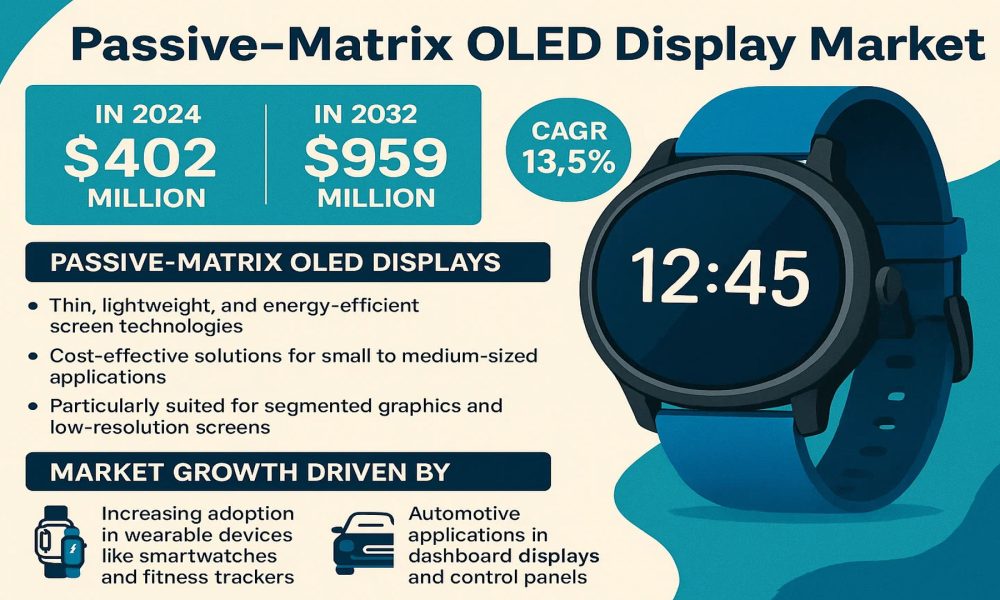
Passive-Matrix OLED Display Market was valued at 402 million in 2024 and is projected to reach US$ 959 million by 2032, at a CAGR of 13.5% during the forecast period.
Passive-Matrix OLED displays are thin, lightweight, and energy-efficient screen technologies that use organic compounds to emit light when electric current is applied. Unlike active-matrix counterparts, PMOLEDs don’t require thin-film transistors (TFTs) for each pixel, making them cost-effective solutions for small to medium-sized applications. These displays are particularly suited for segmented graphics and low-resolution screens.
The market growth is primarily driven by increasing adoption in wearable devices like smartwatches and fitness trackers, where compact size and power efficiency are critical. Furthermore, automotive applications are gaining traction, with PMOLEDs being used in dashboard displays and control panels. However, the technology faces limitations in refresh rates and resolution compared to AMOLED, which may restrain growth in high-end applications. Key manufacturers including RiTdisplay and WiseChip are investing in production capacity expansion to meet rising demand from consumer electronics manufacturers.
Claim Your Free Sample Report- Passive-Matrix OLED Display Market
MARKET DYNAMICS
MARKET DRIVERS
Rising Adoption in Wearable Devices Accelerates Market Growth
The global passive-matrix OLED (PMOLED) display market is experiencing significant growth due to surging demand in wearable technology. Smartwatches, fitness trackers, and other wearables heavily rely on PMOLEDs for their low power consumption and high contrast ratio. The wearable device market is projected to exceed 1 billion units annually by 2030, creating sustained demand for PMOLED displays. Furthermore, the integration of health monitoring features in wearables is driving the need for more versatile display solutions, with PMOLEDs emerging as the preferred choice for many manufacturers due to their energy efficiency and thin form factor.
Automotive Sector Presents Robust Growth Opportunities
Modern vehicles increasingly incorporate PMOLED displays for instrument clusters and secondary information displays. The automotive display market has grown at approximately 8% CAGR since 2020, with PMOLEDs gaining share in the under-5-inch display category. Unlike conventional LCDs, PMOLEDs offer superior visibility in direct sunlight and faster refresh rates – critical features for automotive applications. Several premium automakers have begun adopting PMOLED technology for digital dashboards in their entry-level models, signaling broader market acceptance and potential for volume growth in coming years.
Medical Applications Drive New Demand Vertical
PMOLED displays are finding increasing application in portable medical devices due to their excellent readability and low power requirements. The global market for medical display systems exceeded $3 billion in 2023, with portable diagnostic equipment representing a high-growth segment. Blood glucose monitors, pulse oximeters, and other handheld medical devices benefit from PMOLED’s self-emissive properties that enable clear visibility from any angle without backlight bleeding. With healthcare expenditure rising globally and telemedicine adoption increasing, the demand for such portable medical equipment – and consequently PMOLED displays – is expected to maintain strong growth momentum.
Recent Developments: Passive-Matrix OLED Display Market
- Increased Adoption in Wearable Devices: PMOLED displays are seeing rising demand in fitness trackers, smartwatches, and healthcare monitoring devices due to their low power consumption and high contrast ratios.
- Flexible and Transparent PMOLED Displays: Companies are investing in flexible and transparent PMOLED technologies to cater to innovative designs in automotive dashboards, smart clothing, and AR devices.
- Collaborations and Partnerships: Leading display manufacturers are collaborating with electronics brands to integrate PMOLED displays into smaller devices, emphasizing compact, efficient screens.
- Enhanced Lifespan and Brightness: Recent R&D efforts are focused on improving the operational life and brightness of PMOLED panels, making them more competitive against AMOLED displays for small-screen applications.
- Market Expansion in Asia-Pacific: Asia-Pacific is witnessing strong growth due to increased consumer electronics production in China, South Korea, and Japan, driving higher PMOLED adoption.
- Emergence in Automotive and Industrial Applications: PMOLED displays are being increasingly used in instrument panels, industrial control systems, and small information displays where cost-effectiveness and readability are critical.
MARKET OPPORTUNITIES
Emerging Smart Home Devices Present New Growth Frontier
The rapid expansion of smart home technology creates significant opportunities for PMOLED display integration. Smart thermostats, security system panels, and appliance interfaces increasingly incorporate small displays for user interaction. PMOLED’s sunlight readability and wide operating temperature range make it particularly suitable for these applications. The global smart home device market is projected to grow at over 10% CAGR through 2030, representing a substantial new addressable market for PMOLED technology beyond traditional wearable applications.
Industrial IoT Applications Open New Possibilities
Industrial equipment increasingly incorporates digital interfaces for monitoring and control. PMOLED displays offer advantages in harsh industrial environments where vibration resistance, wide temperature tolerance, and long-term reliability are critical. The industrial display market has grown steadily at 6-7% annually, with particular strength in Asia-Pacific manufacturing regions. As Industrial IoT adoption accelerates, demand is expected to increase for robust display solutions in factory automation, process control, and equipment monitoring applications where PMOLED technology could compete effectively.
Advancements in Flexible Display Technology
Recent breakthroughs in flexible PMOLED technology present opportunities in new product categories. Bendable and foldable displays are gaining traction in consumer electronics, with several manufacturers developing flexible PMOLED prototypes for wearable and portable applications. While technical challenges remain in scaling flexible PMOLED production, successful commercialization could open significant new market segments. Industry analysts project the flexible display market to exceed $50 billion by 2030, representing a potentially transformative opportunity for PMOLED technology to expand beyond its current strongholds.
Claim Your Free Sample Report- Passive-Matrix OLED Display Market
List of Key PMOLED Display Manufacturers
- RiTdisplay Corporation (Taiwan)
- WiseChip Semiconductor Inc. (Taiwan)
- Qingyue Optoelectronics Co., Ltd. (China)
- Truly International Holdings Ltd. (Hong Kong)
- Soar Optics Co., Ltd. (China)
- Pioneer Corporation (Japan)
- Samsung SDI (South Korea)
- LG Display (South Korea)
- Sony Corporation (Japan)
Segment Analysis:
By Type
Sub-1-inch Displays Lead the Market Due to High Demand in Wearable Devices and Small Electronics
The market is segmented based on display size into:
- < 1-inch
- Subtypes: 0.5-inch, 0.96-inch, and others
- > 1-inch
By Application
Consumer Electronics Segment Dominates with Strong Adoption in Smartwatches and Portable Devices
The market is segmented based on application into:
- Consumer Electronics
- Subtypes: Smartwatches, Fitness Trackers, Portable Media Players, and others
- Automobile
- Medical
- Other
By Technology
Standard PMOLED Technology Leads Due to Cost-Effectiveness for Basic Display Needs
The market is segmented based on technology into:
- Standard PMOLED
- Transparent PMOLED
- Flexible PMOLED
By Resolution
Low to Medium Resolution Displays are Most Prevalent for Cost-Sensitive Applications
The market is segmented based on resolution into:
- Low Resolution (below 128×64)
- Medium Resolution (128×64 to 256×128)
- High Resolution (above 256×128)
CONTACT US:
City vista, 203A, Fountain Road, Ashoka Nagar, Kharadi, Pune, Maharashtra 411014
[+91 8087992013]




