
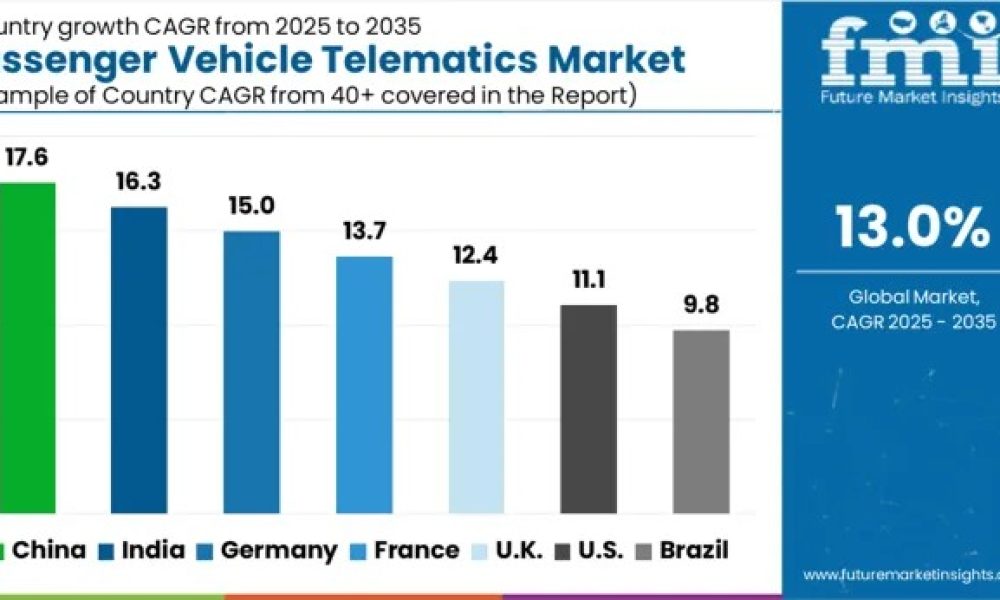
The global passenger vehicle telematics market is entering a decade of accelerated expansion, driven by the automotive industry’s shift toward connectivity, data-centric vehicle architectures, and intelligent mobility systems. The market is projected to grow from USD 33.8 billion in 2025 to USD 114.9 billion by 2035, registering a robust compound annual growth rate (CAGR) of 13.0% over the forecast period. This growth trajectory underscores the transformation of telematics from a value-added feature into a foundational component of modern passenger vehicles.
Market data indicates steady and sustained momentum in the early years of the forecast. The market is expected to rise from USD 38.2 billion in 2026 to USD 43.2 billion in 2027, reaching USD 48.8 billion by 2028. This consistent progression reflects growing demand for real-time vehicle data, enhanced in-vehicle experiences, and advanced safety and navigation capabilities. By 2030, the market is forecast to reach USD 62.3 billion, before accelerating further to USD 70.4 billion in 2031 and USD 79.6 billion in 2033, highlighting telematics’ expanding role across both consumer and commercial passenger vehicle segments.
The final phase of the forecast period marks a sharp inflection point. Market value is projected to climb to USD 90.0 billion in 2034, culminating at USD 114.9 billion by 2035. This acceleration reflects the deeper integration of telematics with electric vehicles (EVs), autonomous driving systems, and connected infrastructure, positioning telematics as a critical enabler of next-generation automotive ecosystems.
Get access to comprehensive data tables and detailed market insights — request your sample report today!
https://www.futuremarketinsights.com/reports/sample/rep-gb-25281
Telematics as a Strategic Pillar of the Automotive Technology Stack
Passenger vehicle telematics currently accounts for an estimated 35% of the overall automotive telematics market, approximately 27% of the connected vehicle market, and nearly 22% of the in-vehicle infotainment market. Its influence also extends into adjacent domains, contributing close to 18% of the vehicle electronics market and around 10% of the automotive safety systems market. These overlapping contributions illustrate the central role telematics plays in unifying connectivity, safety, and user experience within modern vehicle platforms.
The integration of telematics systems enables real-time data transmission, navigation, remote diagnostics, emergency response, and infotainment services, delivering measurable improvements in operational efficiency, driving safety, and customer engagement. As vehicles evolve into software-defined platforms, telematics is increasingly viewed as the backbone that supports over-the-air updates, advanced driver-assistance systems (ADAS), predictive maintenance, and vehicle-to-everything (V2X) communication.
Embedded Technology Leads Market Adoption
By technology type, embedded telematics systems are projected to account for 44.7% of total market revenue in 2025, making them the leading segment. Embedded solutions are integrated directly into vehicles during manufacturing, ensuring continuous connectivity, higher data security, and seamless compatibility with ADAS and safety-critical applications. Unlike tethered or aftermarket solutions, embedded systems operate independently of external devices, providing uninterrupted access to services such as emergency assistance, real-time diagnostics, and navigation.
Automakers are increasingly prioritizing embedded telematics to deliver consistent performance, meet regulatory requirements, and maintain control over data ecosystems. The ability of embedded platforms to leverage emerging communication technologies, particularly 5G, further reinforces their long-term dominance.
Cellular Connectivity Emerges as the Communication Backbone
In terms of communication technology, cellular telematics is expected to capture 62.8% of market revenue in 2025, establishing itself as the dominant connectivity mode. The widespread availability of 4G LTE networks, combined with the rapid rollout of 5G, is enabling faster data transfer, lower latency, and support for high-bandwidth applications such as advanced navigation, remote diagnostics, and in-car digital services.
Cellular telematics offers scalable, future-ready connectivity across diverse geographic regions, making it essential for over-the-air software updates, safety systems, and connected mobility services. As autonomous and connected vehicle initiatives expand globally, cellular networks are expected to remain the primary infrastructure supporting real-time vehicle communication.
Safety and Security Drive Service-Level Demand
By service offering, the safety and security segment is projected to account for 36.7% of market revenue in 2025, making it the largest service category. Regulatory mandates, heightened road safety awareness, and consumer demand for vehicle protection are driving adoption of services such as automatic crash notification, stolen vehicle tracking, and emergency response systems.
Telematics providers are increasingly enhancing safety offerings with AI-driven predictive alerts, real-time monitoring, and advanced analytics, further strengthening their value proposition. Insurance-linked telematics solutions and usage-based insurance models are also contributing to demand, as safety-focused features become directly linked to cost savings and risk reduction.
Drive Your Business Growth Strategy: Checkout the Report for Key Insights
https://www.futuremarketinsights.com/checkout/25281
Regional Growth Reflects Global Adoption Momentum
Growth prospects vary by region, with China leading at a CAGR of 17.6%, followed by India at 16.3%, Germany at 15.0%, and France at 13.7%. The United Kingdom (12.4%) and United States (11.1%) continue to demonstrate strong adoption, driven by connected vehicle penetration, EV growth, and advanced safety requirements. Asia is expected to lead in volume expansion, while Europe and North America focus on premium features, regulatory compliance, and service-based telematics models.
Competitive Landscape and Market Outlook
The competitive landscape is shaped by global technology providers and automotive suppliers offering integrated telematics platforms. Key players including Agero Inc., Continental AG, Fleet Complete, Geotab Inc., LG Electronics, MiX Telematics, Octo Telematics, OnStar Corporation, Qualcomm Incorporated, and Verizon Connect compete on platform reliability, software sophistication, data security, and compatibility with EV and autonomous vehicle architectures.
Looking ahead, the passenger vehicle telematics market is positioned as a core growth engine within the automotive technology sector. As connectivity, data intelligence, and safety converge, telematics will play a decisive role in shaping vehicle design, mobility services, and digital user experiences. The market’s strong growth outlook reflects its transition from optional connectivity to an essential pillar of future-ready passenger vehicles, creating substantial opportunities across the global automotive value chain.
Why Choose FMI: Empowering Decisions that Drive Real-World Outcomes: https://www.futuremarketinsights.com/why-fmi
About Future Market Insights (FMI)
Future Market Insights, Inc. (FMI) is an ESOMAR-certified, ISO 9001:2015 market research and consulting organization, trusted by Fortune 500 clients and global enterprises. With operations in the U.S., UK, India, and Dubai, FMI provides data-backed insights and strategic intelligence across 30+ industries and 1200 markets worldwide.



