
Global Paraffin Wax Market Projected to Reach $12 Billion by 2036 Amid Surge in Specialized Industrial and Cosmetic Applications
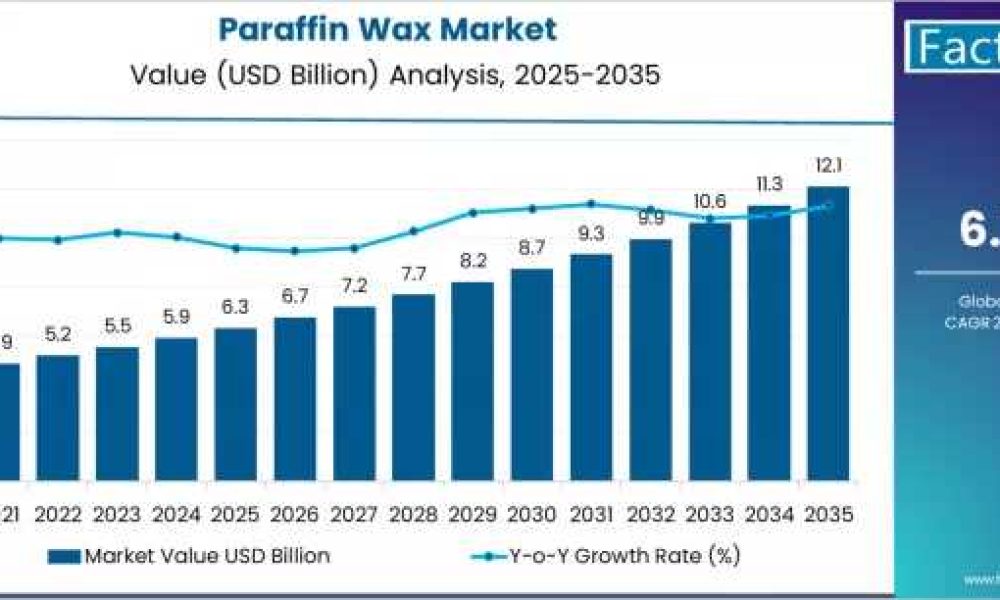
The global paraffin wax market is entering a decade of significant transformation. According to new industry data spanning the 2026–2036 forecast period, the market is projected to grow from its current valuation of approximately $6.13 billion to over $12 billion by 2036. This growth is driven by a Compound Annual Growth Rate (CAGR) of approximately 5.7%, fueled by the dual forces of e-commerce packaging demands and the rapid expansion of the luxury aromatherapy sector.
Request for Sample Report | Customize Report |purchase Full Report – https://www.factmr.com/connectus/sample?flag=S&rep_id=12179
Geographic concentration demonstrates dynamic growth patterns with India and China leading expansion, supported by rising packaging manufacturing capacity, consumer goods production expansion among industrial populations, and refining infrastructure establishment programs in petrochemical centers.
Saudi Arabia, Brazil, and USA demonstrate robust development through established petrochemical production ecosystems, downstream processing maturity for wax derivatives, and standardized acceptance of paraffin utilization procedures. Competitive advantage is consolidating around melting point profiles, refining purity documentation, application compatibility versatility, and integrated product portfolios rather than commodity-grade wax formulations alone.
The first half of the decade will witness the market climbing from USD 6.3 billion to approximately USD 8.5 billion, adding USD 2.2 billion in value, which constitutes 38% of the total forecast growth period. This phase will be characterized by the continued dominance of packaging coating methodologies in food processing settings, combined with accelerating adoption of premium cosmetic-grade formulations in personal care applications where purity validation and specialty blending create favorable product quality outcomes.
The 2026–2036 Outlook: Strategic Market Drivers
As of early 2026, the industry is pivoting from high-volume commodity sales toward high-margin specialized grades. While traditional candle manufacturing remains the largest application segment—accounting for roughly 40% of global consumption—the why behind the market’s resilience lies in its technical versatility.
Key factors propelling the market through 2036 include:
E-commerce and Flexible Packaging: The rise of moisture-resistant, wax-coated paperboard for last-mile delivery and frozen food logistics has solidified paraffin’s role in global supply chains.
Aromatherapy and Wellness: A shifting consumer lifestyle toward home ambiance and stress relief has increased the demand for scented candles, which favor paraffin for its superior fragrance throw and consistent burn rates.
Cosmetic and Pharmaceutical Integration: High-purity, fully refined paraffin wax is increasingly utilized in skincare (emollients) and as a crucial component in medical ointments and dental waxes.
Regional Performance and Segment Analysis
The Asia-Pacific region continues to lead the global market, currently holding a dominant 46% revenue share. Driven by manufacturing powerhouses in China and India, the region benefits from massive domestic consumption and expanding petrochemical refining capacities.
| Segment | Growth Outlook (2026-2036) | Primary Driver |
| Fully Refined Wax | Dominant Market Share | Regulatory compliance in food & pharma |
| Semi-Refined Wax | Fastest Volume Growth | Cost-effective industrial applications |
| Liquid Paraffin | High-Margin Growth | Specialized cosmetics and lubricants |
In North America and Europe, the market is evolving through sustainability. While petroleum-based, the industry is adapting by developing hybrid formulations that blend traditional paraffin with bio-based waxes to meet stringent environmental standards while maintaining performance.
Industry Challenges and Innovation
The path to 2036 is not without obstacles. Manufacturers face volatility in crude oil feedstock prices and a structural shift in global refining. As Group I base oil production declines, industry leaders like ExxonMobil, Sinopec, and Sasol are investing in hydrocracking technologies and synthetic Fischer-Tropsch (FT) waxes to ensure supply stability.
Furthermore, the industry is witnessing a green evolution. Leading players are now introducing biodegradable paraffin alternatives and carbon-neutral production processes to align with global ESG (Environmental, Social, and Governance) goals.
About the Paraffin Wax Industry Report
This 2026–2036 forecast provides a comprehensive analysis of the global paraffin wax landscape, offering data-backed insights for investors, analysts, and industrial stakeholders. It covers the complete value chain from crude oil dewaxing to end-user applications in rubber, hot-melt adhesives, and thermal energy storage.
Contact Us –
11140 Rockville Pike, Suite 400, Rockville,
MD 20852, United States
Tel: +1 (628) 251-1583 | [email protected]
About Fact.MR
Fact.MR is a global market research and consulting firm, trusted by Fortune 500 companies and emerging businesses for reliable insights and strategic intelligence. With a presence across the U.S., UK, India, and Dubai, we deliver data-driven research and tailored consulting solutions across 30+ industries and 1,000+ markets. Backed by deep expertise and advanced analytics, Fact.MR helps organizations uncover opportunities, reduce risks, and make informed decisions for sustainable growth.



