
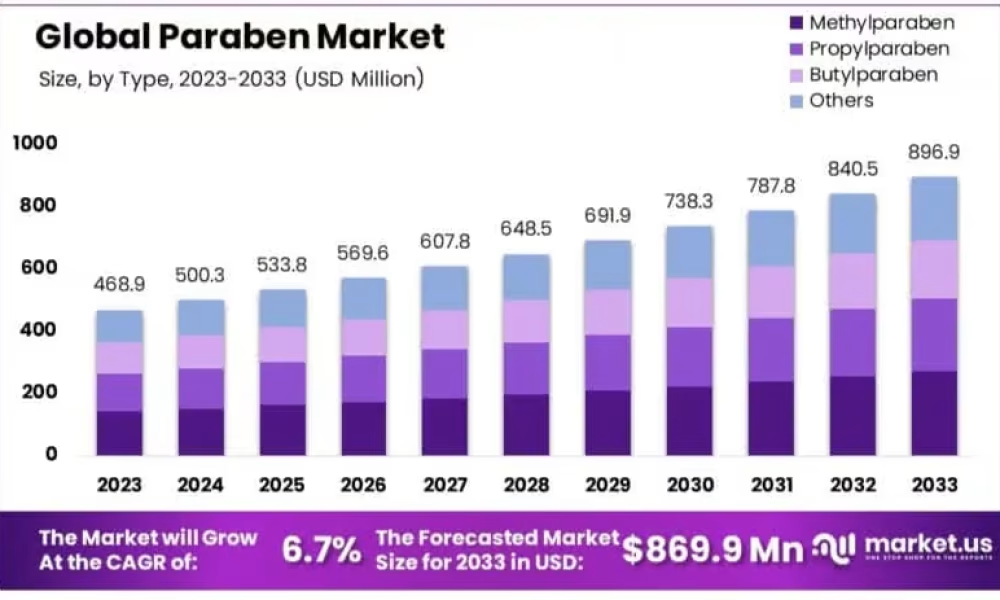
According to market.us, the global paraben market is projected to reach approximately USD 869.9 million by 2033, rising from USD 468.9 million in 2023, at a steady CAGR of 6.7% over the forecast period from 2024 to 2033. Parabens are extensively used as preservatives in cosmetics, pharmaceuticals, and food due to their cost-effectiveness and strong antimicrobial properties, which help extend product shelf life.
Despite their commercial utility, growing consumer awareness of potential health risks linked to long-term paraben exposure has prompted reformulations across industries and a shift toward safer alternatives. Regulatory authorities have responded with clear usage limits to ensure consumer safety. For instance, the U.S. FDA permits methylparaben and propylparaben concentrations up to 0.1% in food, with similar restrictions enforced by the European Food Safety Authority (EFSA).
Global trade data also reflects the continued relevance of parabens. In 2023, the United States imported roughly 3,500 metric tons—mostly from China and India—while the European Union exported nearly 2,000 metric tons, signaling robust cross-border demand and compliance with safety standards.
Key Takeaways
- Paraben Market was valued at USD 468.9 million in 2023, and is expected to reach USD 869.9 million by 2033, with a CAGR of 6.7%.
- Methylparaben dominates the type segment with 30.2% due to its widespread use in cosmetics and pharmaceuticals.
- Food & Beverages lead the application segment with 48.2% owing to the growing demand for preservatives in the food industry.
- North America holds the largest market share at 33.6%, attributed to significant consumption in personal care and cosmetic products.
Access a Complimentary Sample of This Premium Report: https://market.us/report/paraben-market/request-sample/
Factors Affecting the Growth of the Paraben Market
Rising Demand in Cosmetics and Personal Care Products: Parabens are widely used as preservatives in lotions, shampoos, makeup, and skincare products. Their effectiveness in preventing microbial contamination has sustained demand from the global cosmetics industry, especially with the growth in personal grooming and beauty awareness.
Regulatory Oversight and Safety Guidelines: Government regulations in regions such as North America and the European Union play a crucial role in shaping the paraben market. Safety limits on specific parabens and ongoing reviews of their potential health risks have influenced product formulations and usage patterns.
Consumer Awareness and Health Concerns: Increasing public concern about the potential endocrine-disrupting effects of parabens has prompted shifts in consumer preferences. Many brands have responded by offering paraben-free alternatives, which has redirected demand within the market.
Availability of Alternatives and Innovation in Preservatives: The development of alternative preservatives with cleaner labels and natural profiles is affecting paraben usage. Companies are investing in research to find effective substitutes that meet both consumer safety expectations and regulatory standards.
International Trade and Production Hubs: The market is heavily influenced by manufacturing trends and global trade dynamics. Major production bases in countries like China and India play a key role in the global supply chain, while import-export policies affect the availability and pricing of parabens in various regions.
Key Market Segmentation
By Type Analysis
In the paraben market, Methylparaben holds the dominant position with a market share of 30.2%, driven by its widespread use across industries for its strong preservative capabilities. Its popularity stems from a proven safety profile and high effectiveness in inhibiting microbial growth, particularly in personal care and pharmaceutical products. It is also valued for its compatibility with other preservatives, enhancing its utility in complex formulations.
Other notable segments include Propylparaben and Butylparaben. Propylparaben is commonly used in food and pharmaceutical applications for its antimicrobial action, while Butylparaben is favored in cosmetics for its potent fungicidal and bactericidal properties.
The ‘Others’ segment, including Ethylparaben and Isobutylparaben, caters to more specific or niche product formulations. Despite the contributions of these other types, Methylparaben remains the market leader due to its balance of efficacy, safety, and versatility.
By Application Analysis
The Food & Beverages sector leads the paraben market with a 48.2% share, driven by the rising need for extended shelf life and safety in food products. Parabens are widely used in this segment to prevent microbial contamination, ensuring product freshness without affecting taste or appearance. Their application spans beverages, dairy products, and processed foods, supported by regulatory approvals affirming their safety as food additives.
Beyond food, pharmaceuticals also represent a key application area where parabens help maintain the microbiological stability and efficacy of medications. Similarly, the personal care and cosmetics industry uses parabens extensively to preserve the integrity of products such as creams, lotions, and makeup.
The ‘Others’ category, which includes pet food, agriculture, and textiles, also leverages parabens for their antimicrobial effectiveness. While multiple industries contribute to overall demand, the Food & Beverages sector remains the dominant application segment due to its critical reliance on effective preservation.
Key Market Segments
By Type
- Methylparaben
- Propylparaben
- Butylparaben
- Others
By Application
- Food & Beverages
- Pharmaceuticals
- Personal Care & Cosmetics
- Others
Regional Analysis
North America leads the global paraben market with a 33.6% share, valued at USD 157.55 billion, driven by a strong cosmetics and pharmaceutical base, alongside stringent regulatory oversight ensuring product safety and efficacy. Despite concerns over paraben safety, their antimicrobial effectiveness sustains demand across various formulations.
Europe holds a 28.4% market share, equivalent to USD 133.21 billion, shaped by strict EU regulations and a health-conscious consumer base that influences formulation standards in cosmetics and pharmaceuticals.
Asia Pacific accounts for 26.0%, valued at USD 121.68 billion, propelled by expanding cosmetic and healthcare industries in countries like China and India, along with rising consumer spending.
Latin America holds 8.0% of the market, totaling USD 37.44 billion, supported by increasing production capabilities and a growing demand for personal care products.
The Middle East & Africa region contributes a 4.0% share, amounting to USD 18.72 billion, with growth underpinned by rising industrial activity and an expanding personal care sector.
Market Key Players
- BASF SE
- Dow Chemical Company
- Lonza Group
- AkzoNobel N.V.
- Symrise AG
- Ashland Global Holdings Inc.
- Merck KGaA
- Sharon Laboratories
- Kumar Organic Products Limited
- Spectrum Chemical Mfg. Corp.
- Symex Holdings Limited
- Clariant AG
Get in Touch with Us:
Market.us (Powered By Prudour Pvt. Ltd.)
Address: 420 Lexington Avenue, Suite 300 New York City, NY 10170, United States
Send Email: [email protected]
Refer More Related Reports:



