
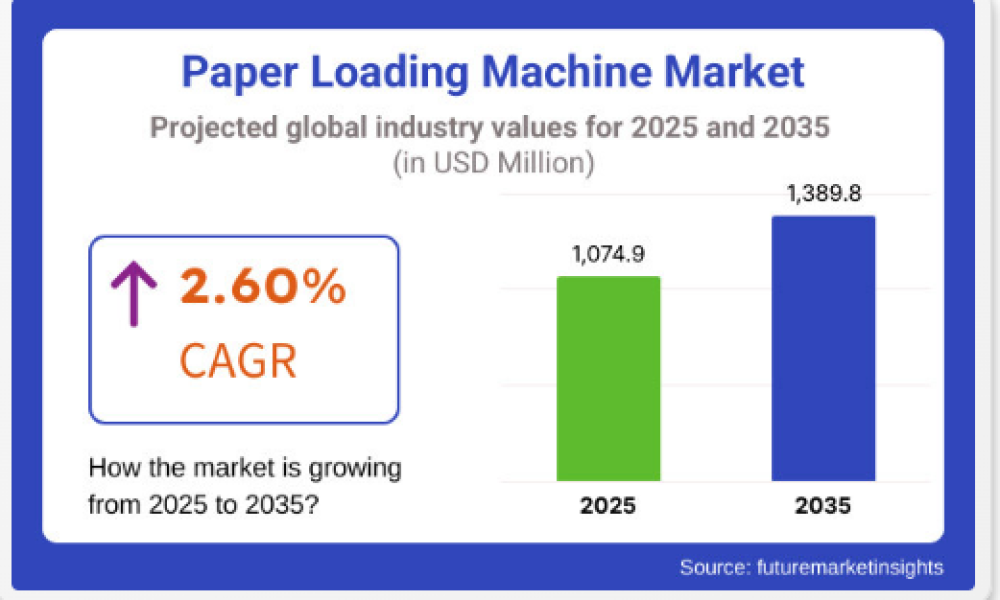
The global paper-loading machine market is on track to exceed a valuation of USD 1,389.8 million by 2035, growing from an estimated USD 1,074.9 million in 2025 at a compound annual growth rate (CAGR) of approximately 2.6% over the decade. This growth is shaped by rising demand in packaging, printing and logistics industries and a strong push toward smart automation and Industry 4.0 integration.
Key Market Insights at a Glance
- Market size is projected to grow from USD 1,074.9 million in 2025 to USD 1,389.8 million by 2035 (CAGR ~2.6%).
- Roll-loading machines currently capture ~29% of market share and book-binding end-use ~24%.
- Regional CAGRs: India leads at ~3.3%, China at ~3.1%, Germany ~2.3%, United Kingdom ~2.2%.
- Automation, digital connectivity and sustainability conversion are major growth levers.
- Energy-efficient and human-centric design machines are gaining traction.
Regional Value & Momentum
Asia-Pacific stands out as the fastest-growing region, with India recording a projected CAGR of ~3.3% between 2025 and 2035. The region’s booming e-commerce, expanding print & packaging sectors, and government incentives for digital and green manufacturing support this growth. Europe remains a mature, high-efficiency market: Germany expects ~2.3% CAGR, while the UK’s growth hovers around ~2.2%. China also remains a key growth engine (~3.1% CAGR) powered by its robust industrial base, investment in automation, and sustainability mandates. The United States, meanwhile, is gradually adopting cloud-connected loading systems, advancing toward predictive maintenance and performance analytics.
Segment Overview
By Product Type: Roll-loading machines dominate, thanks to high‐volume processing demands in printing and packaging. Semi-automatic and automatic variants are increasingly adopted as manufacturers aim to minimise labour dependency and downtime.
By End Use: The book-binding segment captured about 24% of the market in 2024, while packaging and print industries remain key demand drivers.
By Automation Level: Rising integration of IoT, cloud monitoring and human-centric design technologies is reshaping the value proposition of loading machines—from traditional manual to smart, connected systems offering lifecycle service advantages.
Competitive Landscape
Manufacturers in the paper-loading machine market are competing on automation sophistication, operator ergonomics, sustainability and lifecycle services. Key strategies include R&D investment, strategic partnerships and expansion into emerging economies. Leading firms aim to deliver solutions that support Industry 4.0, offering remote monitoring, digital twin capabilities and energy-efficient performance to meet both productivity and ESG goals. Maintenance packages, up-time guarantees and modular upgrades are becoming standard differentiators.
Market Outlook: Powering the Next Decade
As manufacturers and converters grapple with rising labour costs, heightened sustainability expectations and supply-chain pressures, the paper-loading machine market is positioned for steady advancement. Automation and connectivity will become baseline requirements. Machines will increasingly serve not just as loading equipment but as integrated hubs within data-driven production ecosystems—providing real-time analytics, asset health monitoring and adaptive workflows. The decade ahead will see a shift from purely mechanical devices to intelligent, service-enabled platforms. Sustainability imperatives—such as energy efficiency, waste reduction and human-centric design—will further define winners and laggards in the field.
Key Players of the Sustainable Loading-Machine Industry
Prominent vendors are those combining robust machine hardware with digital services and sustainable design credentials. Many are already launching next-gen machine platforms that reduce power consumption, support remote diagnostics and integrate with broader manufacturing execution systems (MES). These companies are securing long-term contracts, aligning with major packaging and print houses that prioritise uptime, flexibility and green credentials.
Recent Strategic Developments
Recent years have seen several strategic moves: launches of AI-enabled loading machines with predictive maintenance; retrofit programmes that upgrade legacy equipment to network-connected status; mergers and alliances to penetrate high-growth geographies such as APAC; and service-contracts bundling spare parts, predictive monitoring and lifecycle upgrades. These developments underscore the shift from transactional machine sales to outcome-based, service-oriented business models.
To access the complete data tables and in-depth insights, request a sample report here: https://www.futuremarketinsights.com/reports/sample/rep-gb-18376
Subscribe for Year-Round Insights → Stay ahead with quarterly and annual data updates : https://www.futuremarketinsights.com/checkout/18376
Have a specific Requirements and Need Assistant on Report Pricing or Limited Budget please contact us – [email protected]
About Future Market Insights (FMI)
Future Market Insights, Inc. (FMI) is an ESOMAR-certified, ISO 9001:2015 market research and consulting organization, trusted by Fortune 500 clients and global enterprises. With operations in the U.S., UK, India, and Dubai, FMI provides data-backed insights and strategic intelligence across 30+ industries and 1200 markets worldwide.



