
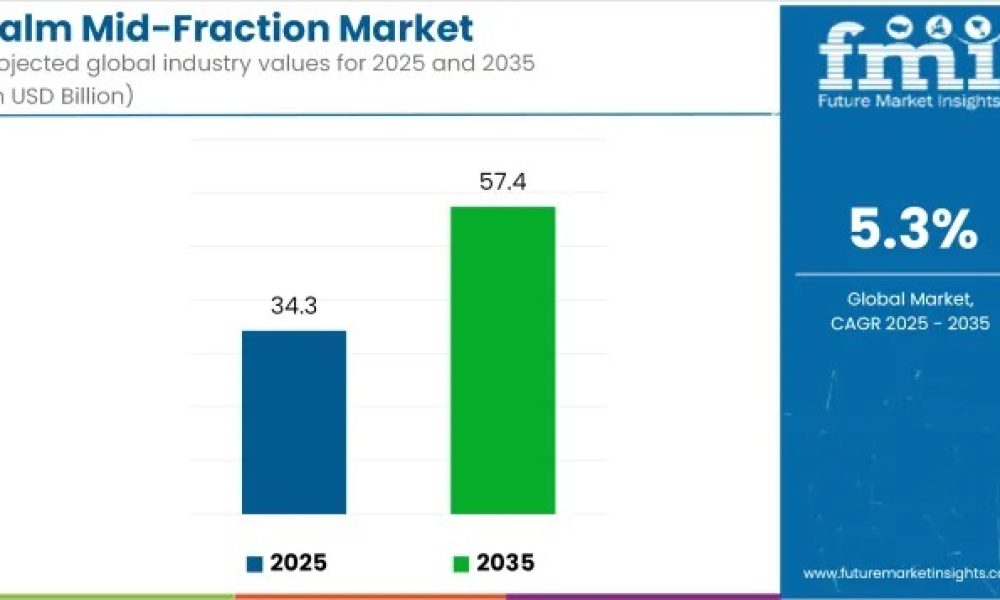
With increasing adoption in bakery, confectionery, and food manufacturing, the Palm Mid-Fraction Market is projected to rise from USD 34.25 billion in 2025 to USD 57.40 billion by 2035, registering a CAGR of 5.3%.
Palm mid-fraction has evolved into a vital ingredient in structured lipids and specialty fats, largely due to its ideal melting profile and compatibility with cocoa butter equivalents (CBEs). From 2020 to 2024, the market advanced at a CAGR of 4.2%, setting a strong foundation for continued innovation across processed food applications.
Explore trends before investing – request a sample report today! https://www.futuremarketinsights.com/reports/sample/rep-gb-8580
Palm Mid-Fraction Market Overview
Increasing demand for cocoa butter alternatives, stability-enhancing fats in bakery, and dairy fat substitutes continues to drive growth. Manufacturers are optimizing formulations to enhance texture and mouthfeel while maintaining supply stability.
However, sustainability concerns around palm sourcing have prompted widespread adoption of RSPO certifications and traceability frameworks. Leading producers are investing in enzymatic interesterification and advanced fractionation technologies to achieve greater customization and purity in their fat systems.
Global Value Analysis
| Attributes | Description |
| Estimated Global Industry Size (2025E) | USD 34.25 Billion |
| Projected Global Industry Value (2035F) | USD 57.40 Billion |
| CAGR (2025–2035) | 5.3% |
By 2035, PMF demand will become more specialized but essential, with manufacturers prioritizing clean-label and sustainable fractions offering enhanced crystallization, neutral flavor, and oxidation stability.
Top Investment Segments
Infant Nutrition Formulations Expand Functional Boundaries
Market Share: 6.8% (2025)
Palm mid-fractions rich in 1,3-dioleoyl-2-palmitoyl-glycerol (OPO) are increasingly used to mimic human milk fat in infant formula. Key producers like Bunge Loders Croklaan and IOI Loders Croklaan are expanding their OPO-rich portfolios across Asia and Europe.
- EU and EFSA fat composition mandates are pushing adoption of fractionated PMFs.
- Companies such as AAK and FrieslandCampina have invested in enzymatic lipid processing to improve yield and compliance.
- RSPO-certified fractions are prioritized for infant-grade formulations, driving value growth despite limited volumes.
This segment is expected to gain traction through 2035 as premium, science-backed lipid formulations dominate the infant nutrition landscape.
Cosmetic Emollient Applications Gain Momentum
Market Share: 4.3% (2025)
PMFs are increasingly used in skincare and haircare as structured emollients due to their oxidative stability and smooth texture. Industry players such as KLK OLEO and BASF Care Creations are leveraging PMF-derived esters like isopropyl palmitate and glyceryl stearate to enhance texture, stability, and sensory performance in clean-label cosmetics.
- Recognized under ISO 16128 as natural-origin ingredients
- Growing relevance in high-SPF, biodegradable, and plant-based formulations
- Increased sourcing from RSPO-MB and segregated supply chains for sustainability compliance
Key Industry Highlights
- Rising Bakery Demand: PMF’s ability to extend shelf life and serve as a base for CBEs is fueling use in confectionery and bakery sectors.
- Cosmetics Expansion: Natural and organic personal care trends are boosting PMF demand in creams, soaps, and lotions.
- Pharma Integration: PMF’s solubility and stability make it suitable for topical drug formulations.
- Technological Progress: Innovations in supercritical fluid extraction and dry fractionation are improving production efficiency and purity.
Market Concentration Overview
- Tier 1 (20% Share): Global leaders with strong technological capabilities, broad portfolios, and RSPO compliance.
- Tier 2 (30% Share): Mid-scale firms with solid regional influence and regulatory reliability.
- Tier 3 (50% Share): Localized processors catering to niche markets, forming the unorganized sector of the PMF industry.
Regional Insights
| Countries | CAGR (2025–2035) |
| USA | 3.4% |
| Italy | 4.5% |
| India | 7.8% |
USA Dominates North America
Growing demand for bakery, confectionery, and ready-to-eat products underpins PMF expansion. Increasing consumer spending and lifestyle shifts favor convenient and indulgent food options, while large-scale retail penetration accelerates adoption.
India Drives Asia-Pacific Market
India stands as a leading processing hub for palm mid-fractions, exporting globally. Strong domestic consumption and manufacturing capabilities are expected to boost the region’s CAGR to 7.8% by 2035.
Italy Leads European Market
The Italian market benefits from high consumption of specialty fats and chocolates, where PMF’s melting properties enhance product texture and quality.
Saudi Arabia Emerges as a Key Import Market
The nation’s growing food processing sector and halal-certified product expansion are expected to support consistent demand for RSPO-certified PMFs.
Buy Report Now – Click Here to Purchase the Report! https://www.futuremarketinsights.com/checkout/8580
Competition Outlook
Global PMF producers are focusing on sustainability, certification, and technological innovation to maintain competitive advantage.
Leading Companies Include:
- Mewah Group
- Felda Iffco Sdn. Bhd.
- Intercontinental Specialty Fats Sdn. Bhd.
- Pavlos N. Pettas S.A.
About Future Market Insights (FMI)
Future Market Insights, Inc. (FMI) is an ESOMAR-certified, ISO 9001:2015 market research and consulting organization, trusted by Fortune 500 clients and global enterprises. With operations in the U.S., UK, India, and Dubai, FMI provides data-backed insights and strategic intelligence across 30+ industries and 1200 markets worldwide.



