
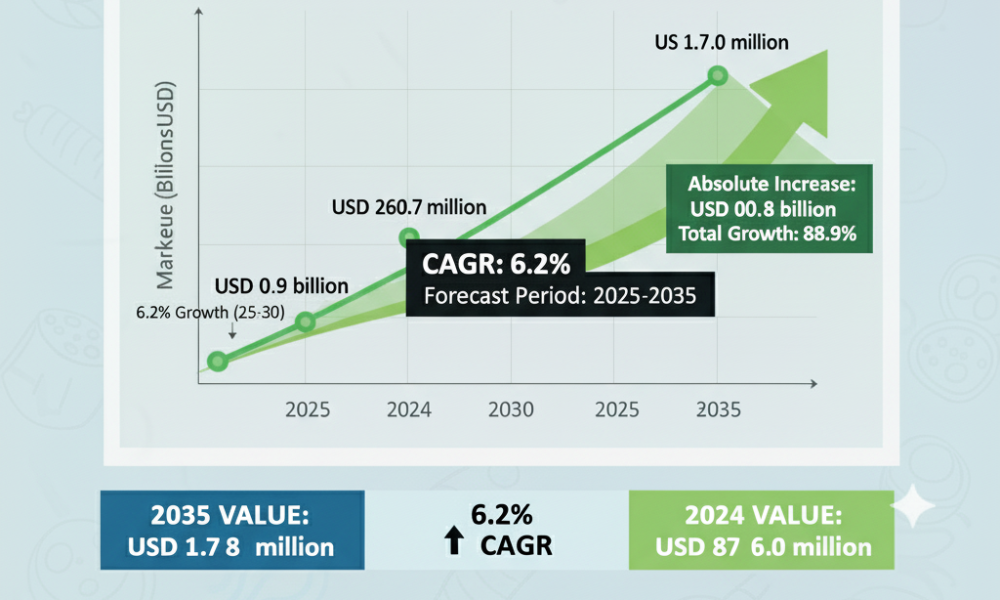
The Oilfield Scale Inhibitor Market is estimated to be valued at USD 0.9 billion in 2025 and is projected to reach USD 1.7 billion by 2035, registering a compound annual growth rate (CAGR) of 6.2% over the forecast period.
Operators now prioritize formulations that deliver thermal stability and eco-compliance. Real-time monitoring optimizes dosing. These shifts turn scale management into a reliability edge.
The oilfield scale inhibitor market is experiencing robust growth driven by increasing demand for efficient scale prevention in upstream and midstream operations. Rising oil and gas exploration activities, along with enhanced recovery techniques, are contributing to higher consumption of chemical inhibitors across production facilities. The current market scenario reflects a shift toward more sustainable and high-performance formulations that minimize environmental impact while maintaining operational efficiency.
Technological advancements in water treatment and scale monitoring systems are improving inhibitor performance and optimizing dosing precision. Future outlook indicates strong growth potential as aging oilfields and deeper wells require advanced scale control solutions to sustain production rates and reduce equipment maintenance costs.
Growth rationale is based on the industry’s emphasis on operational reliability, cost reduction, and compliance with environmental regulations Expanding investment in oilfield infrastructure and chemical innovation is expected to reinforce market expansion and ensure consistent adoption across global oil-producing regions.
Fast Facts:
– Market size 2025: USD 0.9 billion
– Market size 2035: USD 1.7 billion
– CAGR: 6.2%
– Top type segment: Phosphonates (46.7%)
– Top application segment: Oil & gas industry (58.4%)
– Key growth regions: North America, Asia-Pacific, Europe
What is winning, and why:
Phosphonates lead because they excel in high-pressure, high-temperature wells. They chelate effectively and integrate with other chemicals. Oil & gas applications dominate as exploration ramps in unconventional reserves and water-intensive recovery.
– Phosphonates win with superior stability and cost-effectiveness in injection systems.
– Oil & gas leads by integrating inhibitors into flow assurance to minimize downtime.
– North America, Asia-Pacific, Europe accelerate via shale booms, offshore projects, and infrastructure investments.
Where to play:
Convenience in application channels rises with digital delivery systems. E-commerce grows for tailored solutions.
– United States (6.8% CAGR): Shale operations in Permian and Bakken drive demand.
– South Korea (9% CAGR): Imported hydrocarbon facilities prioritize efficiency in refineries and LNG terminals.
– Japan (8.1% CAGR): Offshore platforms in Sea of Japan need subsea scale control.
– China (7.3% CAGR): Production in Tarim and Bohai Bay basins expands inhibitor use.
– United Kingdom (7.7% CAGR): North Sea aging fields rely on inhibitors for asset integrity.
What teams should do next:
R&D
– Develop biodegradable phosphonates for eco-regulations.
– Test formulations in simulated deepwater conditions.
– Integrate AI for predictive dosing accuracy.
Marketing & Sales
– Target shale operators with downtime reduction case studies.
– Bundle inhibitors with monitoring tech for upsell.
– Launch campaigns on thermal stability in high-temp wells.
Regulatory & QA
– Certify products for low environmental impact.
– Audit compatibility with fracturing fluids.
– Track compliance in water injection programs.
Sourcing
– Secure phosphonate raw materials from multiple suppliers.
– Evaluate local production in Asia-Pacific hubs.
– Negotiate long-term contracts with BASF, DowDupont.
Three quick plays this quarter
– Prototype eco-friendly inhibitor for Q1 field trials.
– Pitch integrated solutions to Permian operators.
– Update compliance dossiers for EU markets.
Subscribe for Year-Round Insights → Stay ahead with quarterly and annual data updates: https://www.futuremarketinsights.com/reports/brochure/rep-gb-19177
Request for Discount: https://www.futuremarketinsights.com/reports/sample/rep-gb-19177
The take:
Scale inhibitors shift from fix to foundation. Operators who master phosphonates and real-time application lock in production uptime. This builds resilient operations as global energy demand pushes deeper and tougher reservoirs.
For analyst briefings or custom cuts by type, application, and country, contact Future Market Insights.
About Future Market Insights (FMI)
Future Market Insights, Inc. (FMI) is an ESOMAR-certified, ISO 9001:2015 market research and consulting organization, trusted by Fortune 500 clients and global enterprises. With operations in the U.S., UK, India, and Dubai, FMI provides data-backed insights and strategic intelligence across 30+ industries and 1200 markets worldwide.
Why FMI: Decisions that Change Outcomes- https://www.futuremarketinsights.com/why-fmi
Contact Us:
Future Market Insights Inc.
Christiana Corporate, 200 Continental Drive,
Suite 401, Newark, Delaware – 19713, USA
T: +1-347-918-3531
Website: https://www.futuremarketinsights.com
LinkedIn| Twitter| Blogs | YouTube
Have a specific Requirements and Need Assistant on Report Pricing or Limited Budget please contact us – [email protected]



