
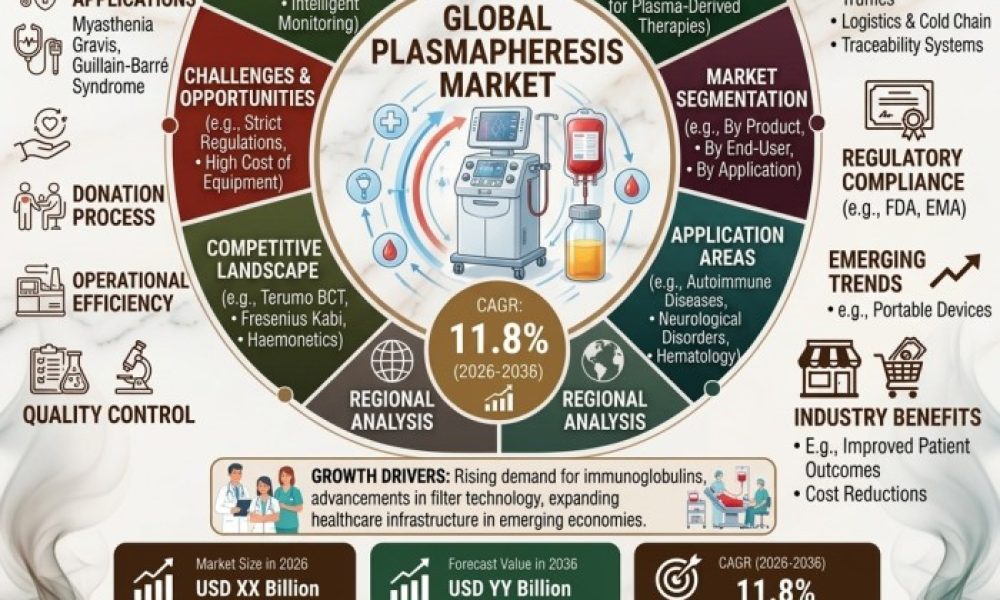
Rockville, Maryland — September 29, 2026 — The global plasmapheresis market is estimated at USD 1.7 billion in 2026 and is projected to reach USD 3.7 billion by 2036, expanding at a CAGR of 8.1% during the forecast period. Fact.MR analysis indicates that the market could create an incremental opportunity of approximately USD 2 billion between 2026 and 2036 as therapeutic plasma exchange gains wider clinical use and plasma collection infrastructure expands.
Get detailed market forecasts, competitive benchmarking, and pricing trends: https://www.factmr.com/connectus/sample?flag=S&rep_id=351
Expanding Therapeutic Plasma Exchange Supports Market Growth
Growing use of therapeutic plasma exchange for autoimmune and neurological conditions is supporting procedure volumes across hospital neurology departments. Conditions including Guillain-Barre syndrome, myasthenia gravis, and chronic inflammatory demyelinating polyneuropathy are contributing to demand for apheresis systems capable of efficient plasma separation.
A second growth channel is emerging from rising global demand for immunoglobulin products. Plasma collection centers are expanding procurement of donor apheresis equipment to increase source plasma availability, while automated systems are being adopted for improved collection efficiency, donor comfort, and throughput. These developments are strengthening demand across both therapeutic and donor applications.
Therapeutic Plasmapheresis Systems Maintain Leading Product Share
Therapeutic plasmapheresis systems are expected to account for 48.3% of product segment value in 2026, making them the leading product category in the market. Their position is supported by the expanding clinical indication base for therapeutic plasma exchange across neurological, autoimmune, and hematologic conditions, along with the relatively high capital value of automated apheresis platforms.
At the application level, neurological disorder applications represent 36.4% of market value in 2026. Therapeutic plasma exchange protocols associated with Guillain-Barre syndrome, myasthenia gravis, chronic inflammatory demyelinating polyneuropathy, and neuromyelitis optica spectrum disorder contribute substantially to procedure demand. Hospitals remain the largest end-user category, accounting for 57.2% share, supported by established institutional apheresis programs and specialist neurology and nephrology infrastructure.
China and India Record Strong Growth as Healthcare Infrastructure Expands
China is projected to record the highest CAGR among the countries covered in the Fact.MR analysis, at 9.1% through 2036. Expansion of hospital neurology and nephrology departments, development of plasma collection infrastructure, and domestic apheresis device manufacturing are broadening access to plasmapheresis services. Expansion in Tier 2 and Tier 3 cities is also increasing access to specialist treatment, while centralized procurement programs are influencing equipment selection across hospital networks.
India is expected to expand at an 8.8% CAGR through 2036. Expansion of specialist treatment access through Ayushman Bharat, together with private healthcare investment, is supporting therapeutic plasma exchange adoption. Metropolitan hospitals are developing additional neurology treatment capacity, while cost-conscious procurement is influencing adoption of apheresis systems in resource-limited settings.
Germany is projected to grow at a 7.5% CAGR during the forecast period. Established university hospital therapeutic plasma exchange programs provide a mature clinical base, while GKV reimbursement decisions influence institutional equipment and consumable procurement. At the same time, EU MDR compliance requirements remain an important consideration for manufacturers seeking access to the German market.
Connected Apheresis Technology Creates New Opportunities
Technology development is introducing new possibilities for delivering plasmapheresis services. Connected apheresis monitoring systems can enable real-time procedure oversight, standardized protocols, and structured quality data collection. Fact.MR identifies the potential development of hub-and-spoke treatment models, in which specialist centers remotely supervise procedures performed at community hospitals with trained staff.
Double filtration plasmapheresis also represents an opportunity area because selective removal of pathogenic proteins can reduce the need for albumin replacement compared with conventional plasma exchange in relevant applications. Meanwhile, high capital costs, recurring disposable-kit expenses, shortages of trained apheresis nursing personnel, and regulatory complexity can constrain adoption, particularly in resource-limited healthcare settings.
Leading Companies Strengthen Apheresis Technology Portfolios
The competitive landscape includes Terumo BCT, Fresenius Medical Care/Fresenius Kabi, Haemonetics Corporation, Asahi Kasei Medical, and B. Braun Melsungen, among other participants. Terumo BCT has an established presence across therapeutic and donor applications through its Optia and Trima apheresis platforms. Fresenius combines apheresis equipment capabilities with dialysis and plasma collection operations, while Haemonetics has increased its focus on apheresis technology following its 2025 whole-blood asset divestiture.
As healthcare systems expand specialist treatment access and plasma collection capacity, manufacturers are focusing on separation efficiency, connected monitoring, donor experience, and application-specific technologies. These developments are expected to influence purchasing decisions across hospitals, plasma collection centers, and other specialist healthcare settings through 2036.
For detailed market sizing, country-level forecasts, segment analysis, competitive benchmarking, and technology trends, refer to the full Fact.MR Plasmapheresis Market report.
Explore More Related Studies Published by Fact.MR Research
Cryopreservation & Fertilization Media Market
About Fact.MR
Fact.MR is a global market research and consulting firm, trusted by Fortune 500 companies and emerging businesses for reliable insights and strategic intelligence. With a presence across the U.S., UK, India, and Dubai, we deliver data-driven research and tailored consulting solutions across 30+ industries and 1,000+ markets. Backed by deep expertise and advanced analytics, Fact.MR helps organizations uncover opportunities, reduce risks, and make informed decisions for sustainable growth.
– Contact Us –
11140 Rockville Pike, Suite 400, Rockville,
MD 20852, United States
Tel: +1 (628) 251-1583 | [email protected]



