
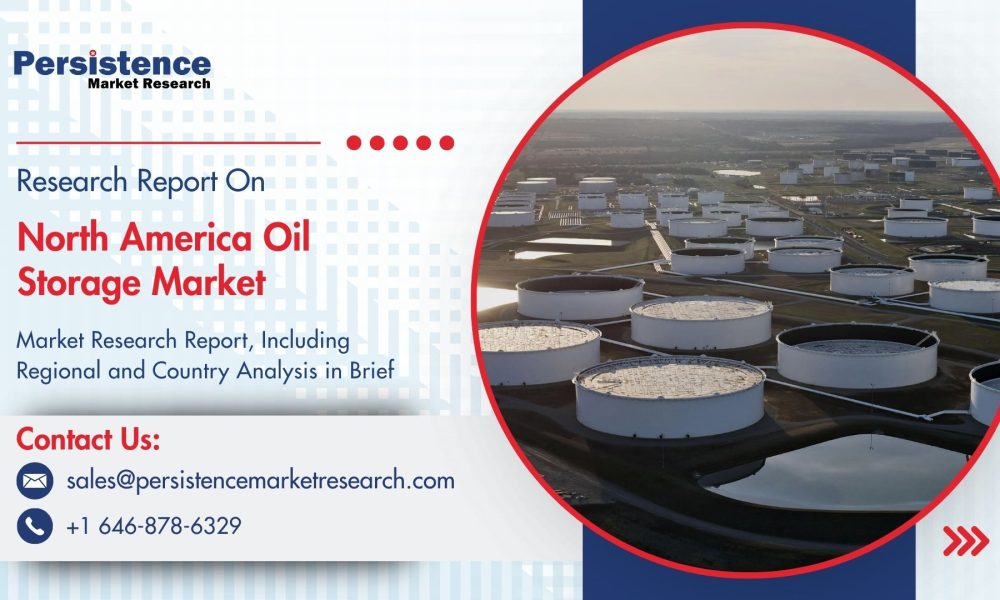
The North America oil storage market is witnessing steady growth, driven by increasing crude oil production, growing energy consumption, and strategic efforts to expand storage infrastructure across the United States, Canada, and Mexico. Oil storage facilities serve as crucial assets for managing supply-demand fluctuations, ensuring energy security, and supporting refinery and distribution operations. With the growing emphasis on energy resilience, as well as the continued volatility in global oil prices, the region’s oil storage capacity is becoming increasingly vital for both commercial and strategic purposes.
According to the latest study by Persistence Market Research, the North America oil storage market size is projected to increase from US$ 816.0 Mn in 2025 to US$ 1,118.0 Mn by 2032, reflecting a CAGR of 4.6% between 2025 and 2032. The growth of this market is primarily attributed to rising oil production, expanding refinery capacities, and increasing investments in strategic petroleum reserves (SPRs). Moreover, the ongoing energy transition, coupled with geopolitical uncertainties and fluctuating oil demand patterns, is encouraging both public and private players to strengthen their oil storage capabilities.
Get a Sample PDF Brochure of the Report (Use Corporate Email ID for a Quick Response): https://www.persistencemarketresearch.com/samples/35444
Rising Crude Oil Production and Demand Fuel Market Expansion
North America has remained one of the world’s leading oil-producing regions, led by the United States and Canada. The U.S., in particular, has experienced a significant surge in crude oil output over the past decade, largely due to advancements in shale extraction technologies and hydraulic fracturing. These developments have transformed the country into a net exporter of oil and petroleum products, creating heightened demand for efficient storage infrastructure.
Oil storage facilities, including tanks, terminals, and underground caverns, play a vital role in managing the balance between supply and demand. They provide flexibility for refineries, traders, and distributors to store crude oil and refined products during periods of excess supply, and to release them when market demand rises.
Additionally, with fluctuating crude oil prices and periodic disruptions in global supply chains, the importance of maintaining strategic reserves has grown significantly. Countries in North America are investing in expanding their Strategic Petroleum Reserves (SPRs) to ensure energy security and price stability during geopolitical or market disturbances.
Strategic Importance of Oil Storage Infrastructure
Oil storage facilities serve multiple purposes beyond simple inventory holding. They are integral to supply chain optimization, trading operations, and emergency preparedness. The flexibility provided by storage systems allows stakeholders to capitalize on pricing differentials, particularly during market volatility.
In North America, major storage hubs—such as Cushing, Oklahoma, and Hardisty, Alberta—have evolved into critical global benchmarks for crude oil trading. Cushing, for instance, is recognized as the primary delivery point for West Texas Intermediate (WTI) crude futures contracts and acts as a barometer for global oil price movements.
Furthermore, the ongoing expansion of midstream infrastructure—including pipelines, rail terminals, and marine export facilities—is complementing the growth of storage capacities. Companies are increasingly focusing on integrating digital monitoring systems, automated controls, and IoT-based analytics to enhance operational safety, reduce losses, and optimize capacity utilization.
Expansion of Strategic Petroleum Reserves (SPRs)
The strategic petroleum reserves maintained by North American governments have gained renewed attention amid growing energy security concerns and market volatility. The United States Strategic Petroleum Reserve, the world’s largest government-owned emergency crude oil supply, continues to undergo modernization and capacity enhancement to address potential supply shocks.
Similarly, Canada is expanding its oil storage and logistics infrastructure to support both domestic needs and export commitments, particularly to the Asia-Pacific region. Mexico, under its energy reform initiatives, has also started investing in modernizing storage facilities to reduce its dependence on imported fuels and strengthen domestic energy resilience.
These collective efforts highlight the increasing importance of energy independence and crisis preparedness, especially in light of recent global events such as supply chain disruptions, natural disasters, and geopolitical conflicts affecting oil markets.
Technological Advancements Enhancing Efficiency and Safety
The oil storage market is undergoing a transformation fueled by technological advancements and digital innovations. Operators are investing in automation, real-time monitoring, and predictive maintenance systems to improve storage efficiency and minimize operational risks.
Modern oil storage facilities now employ advanced tank gauging systems, leak detection technologies, and corrosion-resistant materials to ensure safety and extend asset lifespans. Additionally, smart sensors and IoT-based analytics platforms enable continuous monitoring of pressure, temperature, and liquid levels, ensuring compliance with safety and environmental regulations.
The adoption of cloud-based management systems allows operators to track inventory, manage logistics, and analyze market trends in real time. This integration of digital technology not only enhances operational efficiency but also supports better decision-making and cost optimization across the oil storage value chain.
Environmental Regulations and Sustainability Initiatives
As environmental awareness continues to grow, the North American oil storage market faces increasing pressure to adopt sustainable and eco-friendly practices. Regulatory frameworks such as the U.S. Environmental Protection Agency’s (EPA) standards and Canada’s environmental compliance laws mandate stringent measures for spill prevention, emissions control, and safe handling of petroleum products.
In response, companies are investing in secondary containment systems, double-walled tanks, and vapor recovery units (VRUs) to minimize environmental risks. Furthermore, the development of renewable fuel storage infrastructure—including biodiesel, ethanol, and hydrogen—is gradually reshaping the landscape of traditional oil storage operations.
The integration of green technologies and carbon capture systems is expected to play a key role in ensuring the sustainability of oil storage facilities while aligning with broader regional goals for net-zero emissions.
Growing Trade and Export Opportunities
The rising export of crude oil and refined petroleum products from North America to global markets is another major driver of oil storage expansion. The U.S. Gulf Coast, in particular, has emerged as a leading hub for oil exports, with significant investments in marine terminals and tank farms to accommodate increasing volumes.
As global demand for North American crude continues to rise, particularly in Asia and Europe, companies are building new storage and blending facilities to meet export requirements. This trend is expected to continue as geopolitical shifts and energy diversification efforts reshape global oil trade flows.
For Customized Insights on Segments, Regions, or Competitors, Request Personalized Purchase Options: https://www.persistencemarketresearch.com/request-customization/35444
Regional Insights
- United States: The U.S. dominates the North American oil storage market due to its extensive infrastructure, large refining capacity, and expanding shale oil production. Major storage hubs such as Cushing, Houston, and Louisiana play key roles in both domestic and international oil trade.
- Canada: Canada’s oil storage market is driven by its vast crude reserves in Alberta and ongoing investments in midstream infrastructure. The country is focusing on optimizing pipeline and terminal capacities to support exports, particularly to Asian markets via the Pacific coast.
- Mexico: Mexico’s market is gradually expanding as part of broader energy reforms aimed at strengthening domestic fuel supply chains. Modernization of existing storage facilities and the development of new terminals are expected to enhance the country’s energy independence.
Company Insights
The North America oil storage market features a competitive landscape with several established players and new entrants focusing on expanding capacity, technological innovation, and strategic partnerships. Key companies operating in the market include:
✦ Royal Vopak N.V.
✦ Kinder Morgan, Inc.
✦ Oiltanking GmbH
✦ Magellan Midstream Partners, L.P.
✦ Buckeye Partners L.P.
✦ NuStar Energy L.P.
✦ Horizon Terminal Services, LLC
✦ Enbridge Inc.
✦ Crestwood Equity Partners LP
✦ Plains All American Pipeline, L.P.
These companies are focusing on capacity expansion, digitalization, and sustainability initiatives to strengthen their market position. Investments in automated storage systems, tank modernization projects, and renewable fuel storage capabilities are expected to define the next phase of market growth.
Future Outlook
The North America oil storage market is poised for steady expansion through 2032, driven by rising oil production, strategic reserve development, and the integration of advanced technologies. The increasing role of oil storage in ensuring energy security, price stability, and supply chain resilience will continue to propel investment across the region.
Looking ahead, sustainability and digital transformation will be key focus areas for industry stakeholders. As governments and private operators emphasize environmental compliance and operational efficiency, the adoption of smart storage systems, green technologies, and renewable energy integration will redefine the competitive landscape.
In conclusion, with the market projected to grow from US$ 816.0 Mn in 2025 to US$ 1,118.0 Mn by 2032, the North America oil storage market is set to play a pivotal role in shaping the future of the region’s energy infrastructure—balancing the dual goals of energy security and sustainability in an evolving global landscape.
Explore the Latest Trending Research Reports:
About Persistence Market Research:
At Persistence Market Research, we specialize in creating research studies that serve as strategic tools for driving business growth. Established as a proprietary firm in 2012, we have evolved into a registered company in England and Wales in 2023 under the name Persistence Research & Consultancy Services Ltd. With a solid foundation, we have completed over 3600 custom and syndicate market research projects, and delivered more than 2700 projects for other leading market research companies’ clients.
Our approach combines traditional market research methods with modern tools to offer comprehensive research solutions. With a decade of experience, we pride ourselves on deriving actionable insights from data to help businesses stay ahead of the competition. Our client base spans multinational corporations, leading consulting firms, investment funds, and government departments. A significant portion of our sales comes from repeat clients, a testament to the value and trust we’ve built over the years.
Contact Us:
Persistence Market Research
G04 Golden Mile House, Clayponds Lane
Brentford, London, TW8 0GU UK
USA Phone: +1 646-878-6329
UK Phone: +44 203-837-5656
Email: [email protected]
Web: https://www.persistencemarketresearch.com




