
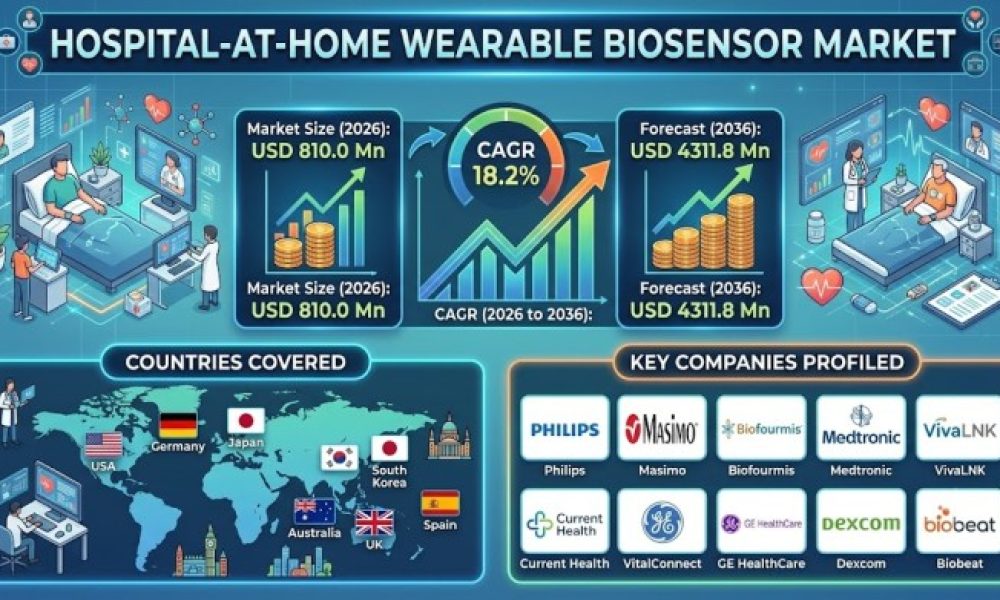
The global hospital-at-home wearable biosensor market is projected to increase from USD 810.0 million in 2026 to USD 4.31 billion by 2036, expanding at a compound annual growth rate (CAGR) of 18.2%, according to Future Market Insights (FMI). The market was valued at USD 685.3 million in 2025, with an estimated incremental revenue opportunity of USD 3.50 billion between 2026 and 2036.
The expansion of hospital-level treatment at home is increasing the need for reliable monitoring between clinical visits. Wearable biosensors can collect measurements such as heart rate, respiratory rate, oxygen saturation and temperature, transmitting readings to healthcare teams for review. Adoption, however, depends on more than device availability: providers need clear escalation procedures, dependable connectivity and staff who can respond to alerts.
Multi-parameter wearable patches are projected to account for 51.0% of product-type revenue in 2026. Hospitals and health systems are expected to generate 55.8% of end-user revenue, reflecting their responsibility for patient eligibility, clinical oversight and escalation during hospital-at-home episodes.
👉 Get Detailed Market Forecasts, Competitive Benchmarking, and Pricing Trends:
https://www.futuremarketinsights.com/reports/sample/rep-gb-35771
Where Growth Is Fastest
FMI’s country-level projections show strong expected growth across the United States, Europe and Asia-Pacific between 2026 and 2036.
- United States – CAGR 17.5%: The federal Acute Hospital Care at Home waiver has been extended through September 30, 2030, providing a longer planning horizon for participating hospitals. Continued program reporting and monitoring requirements support demand for connected devices.
- Germany – CAGR 16.6%: Established heart-failure telemonitoring pathways create opportunities for connected physiological monitoring, with implementation dependent on professional qualifications, compatible systems and defined clinical responsibilities.
- Japan – CAGR 16.2%: Home medical care providers are exploring wearable vital-sign monitoring to support earlier assessment of patient deterioration. Manageable alert volumes and integration into visiting-care routines remain important.
- South Korea – CAGR 15.9%: Expansion of home medical care centers and coordinated medical-nursing services is creating additional settings where supervised patient observations may be used.
- Australia – CAGR 15.1%: Hospital-in-the-Home programs are incorporating wearable monitoring across regional care pathways, including the Southern New South Wales rollout.
- United Kingdom – CAGR 14.2%: Virtual wards provide an established setting for supervised care at home, with wearable monitoring used where local service pathways require it.
- Spain – CAGR 13.8%: Supervised early-discharge and home-hospitalization models create potential demand for monitoring between clinical visits.
These figures are FMI’s market forecasts, not measurements of current device adoption or guaranteed growth.
What Leads the Market
FMI’s 2026 estimates identify several categories shaping demand:
- Product type: Multi-parameter wearable patches are projected to hold 51.0% of revenue.
- Parameters monitored: Cardiac and respiratory vital signs are expected to account for 45.9% of parameter-monitored revenue.
- Care pathway: Acute hospital-level care at home is projected to represent 48.0% of care-pathway demand.
- End user: Hospitals and health systems are expected to account for 55.8% of end-user revenue.
A multi-parameter patch can consolidate several observations into one wearable configuration, reducing the need to manage multiple separate devices. Performance depends on wear time, skin tolerance, battery life, connectivity and the reliability of individual measurements. Clinical teams must also distinguish actionable changes from false or non-urgent alerts.
The Hurdle
Monitoring accuracy and clinical workload remain significant adoption challenges. Variations in sensor performance can affect the reliability of readings, while repeated alerts can overwhelm teams if thresholds are poorly matched to local response procedures.
Pulse oximetry illustrates the importance of performance validation. In January 2025, the US Food and Drug Administration issued draft recommendations addressing testing, labeling and premarket submissions for medical pulse oximeters, including performance across different skin pigmentation. Manufacturers must substantiate relevant performance claims and meet applicable regulatory requirements.
Hospitals also need to determine who reviews incoming observations, how quickly concerning readings are escalated and what happens when connectivity fails. These operational requirements influence purchasing decisions alongside price, device usability and integration with patient records.
👉 Access the Complete Report in PDF Format:
https://www.futuremarketinsights.com/reports/brochure/rep-gb-35771
Industry Investment and Recent Developments
Recent company announcements point to continuing investment in connected monitoring, wearable sensing and care-at-home infrastructure.
- August 2026 – VitalConnect: iRhythm announced an agreement to acquire VitalConnect, expanding its cardiac-monitoring platform across ambulatory, inpatient and hospital-to-home care.
- August 2026 – Philips: Philips announced an expansion of its open patient-monitoring system to help health systems monitor patients beyond the bedside.
- June 2026 – Masimo: The company received FDA 510(k) clearance for AI-enabled opioid-induced respiratory-depression detection on its Radius VSM platform.
- March 2026 – Current Health: The company announced a collaboration with Cardinal Health to scale hospital-at-home services.
- September 2025 – Masimo and Philips: The companies expanded their strategic partnership, including planned Radius PPG integration and next-generation wearable multiparameter monitoring.
- January 2025 – Biofourmis and AdventHealth: AdventHealth selected Biofourmis to support an acute-care-at-home program beginning at AdventHealth Winter Park.
These announcements concern connected monitoring and care-at-home infrastructure broadly; they should not be interpreted as evidence that every product is included in FMI’s defined market or is cleared for every home-care use.
Analyst Perspective
“Hospital-at-home programs will increase wearable demand where clinical teams can review readings without adding unmanageable alert workload. Suppliers combining reliable sensors with replacement supply and after-hours support will receive stronger adoption across hospital systems.”
— Anurag Sharma, Principal Consultant, Future Market Insights.
What This Means for Healthcare Providers and Manufacturers
For healthcare providers, wearable biosensors can support hospital-level care at home when monitoring is integrated into a defined clinical pathway. Procurement teams should assess measurement performance, patient comfort, connectivity, battery life, data integration and the staffing required to review alerts.
For manufacturers, opportunities extend beyond sensor hardware. Replacement consumables, device recovery, interoperable data connections and support for clinical escalation can influence repeat purchasing. Products designed for use across acute care, post-discharge monitoring and chronic disease pathways may also appeal to health systems seeking consistent equipment and workflows.
The market’s growth will ultimately depend on whether wearable systems provide reliable observations while fitting the clinical and operational requirements of supervised care at home.
Read the full report: https://www.futuremarketinsights.com/reports/hospital-at-home-wearable-biosensor-market
Hospital-at-Home Wearable Biosensor Market – Report Scope
The FMI report examines market revenue from wearable biosensor hardware and replacement consumables used in supervised home-care pathways. Clinical services and standalone software are excluded from the stated market definition.
- Segments covered: Product type, parameter monitored, care pathway, end user and region.
- Product types: Multi-parameter wearable patches, wrist-worn monitors, implantable and ingestible sensors, and ambient and bedside sensors.
- Parameters monitored: Cardiac and respiratory vital signs, temperature and activity, blood pressure and hemodynamics, and metabolic parameters.
- Care pathways: Acute hospital-level care at home, post-discharge transitional care, chronic disease escalation prevention and oncology at home.
- Key companies profiled: Philips, Masimo, Biofourmis, Medtronic, VivaLNK, Current Health, VitalConnect, GE HealthCare, Dexcom and Biobeat.
- Forecast period: 2026–2036.
About Future Market Insights
Future Market Insights, Inc. (FMI) is an ESOMAR-certified market research and consulting firm headquartered in Delaware, USA, with offices in the United Kingdom, the United Arab Emirates and India. FMI delivers syndicated and custom research across food and beverage, healthcare, chemicals, technology, packaging, consumer goods and industrial sectors.
Media Contact
Future Market Insights, Inc.
Phone: +1-347-918-3531



