
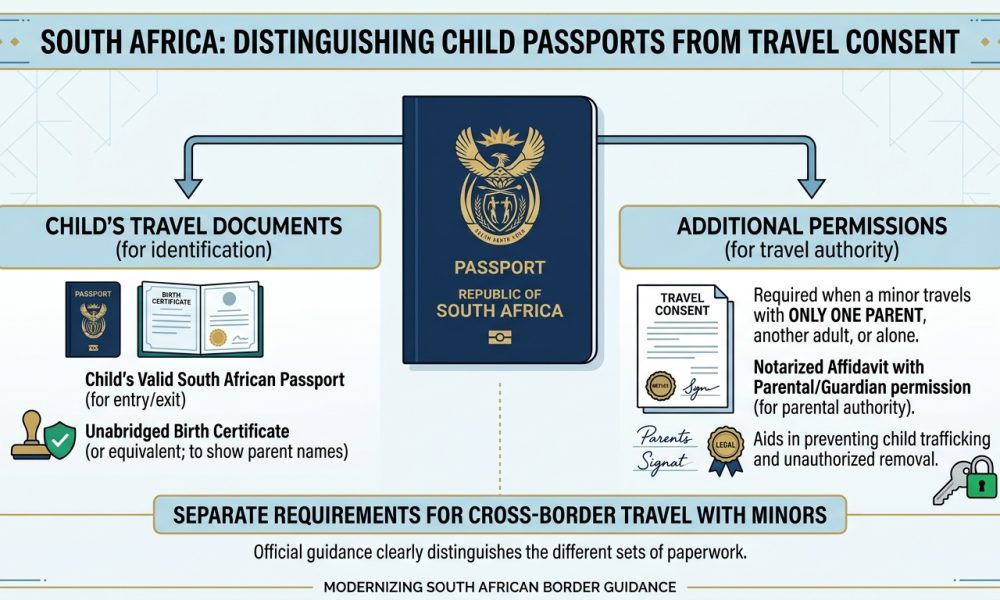
Official guidance separates passport and birth certificate requirements from the permissions that may apply when children travel with one parent or another adult.
WASHINGTON, DC, October 14, 2026 — South Africa’s approach to international travel involving minors illustrates an important distinction within modern border security, recognizing that possession of a valid passport establishes a foundation for international Identification but does not necessarily demonstrate that an accompanying adult possesses the legal authority required to travel with a child.
The country’s immigration framework addresses several related but legally distinct questions, including whether a child possesses valid travel documentation, whether the accompanying adult can demonstrate a parental or guardianship relationship, and whether the circumstances of the journey require additional evidence of consent from another legally responsible person.
Although South Africa has relaxed documentation requirements for many foreign children visiting the country, particularly after changes introduced in November 2019, its child Protection framework still distinguishes nationality, travel authorization, family relationships, and the legal responsibilities of transporting minors across international borders.
The resulting system offers a useful example for governments, passport authorities, immigration professionals, and internationally mobile families seeking to understand why a passport, birth certificate, parental consent declaration, and judicial custody order serve different functions when assessing a child’s international journey.
South Africa Separates Three Important Travel Requirements
South African immigration guidance identifies three categories of Information that may be relevant when a child travels internationally: a passport establishing identity and nationality, documentation identifying parental relationships, and, where applicable, evidence of consent or legal authority.
A valid passport remains the essential international travel document because it provides standardized Information about the holder, including nationality, identity, a photograph, and validity, and supports the inspection and security procedures used by immigration authorities and transportation operators.
A birth certificate or equivalent parentage document serves a different purpose because it records the connection between a child and the parents identified in official civil registration records, Information that may not otherwise appear within the passport itself.
Parental consent documentation addresses a third question by showing that a parent or guardian has authorized specific travel arrangements. However, the acceptable form of authorization depends on the applicable rules, citizenship, custody circumstances, and the identity of the accompanying adult.
These distinctions matter because a passport may remain valid after a family’s legal circumstances change. At the same time, a birth certificate generally records parentage rather than resolving subsequent disputes involving custody, guardianship, or international relocation.
Consequently, officials assessing a minor’s travel circumstances may need to consider several records before determining whether the journey meets relevant legal requirements, even when the passport is authentic and belongs to the child.
The 2019 Waiver Changed Requirements for Foreign Children
South Africa significantly adjusted its child travel documentation rules on November 8, 2019, when the Department of Home Affairs implemented a waiver that removed routine requirements for foreign children to present certain supporting documents when entering or leaving the country.
The measure followed years of discussion concerning the practical effects of the country’s child travel regulations, particularly concerns that documentary requirements could complicate legitimate family tourism and create difficulties for travelers unfamiliar with South Africa’s administrative procedures.
Under the waiver, foreign children from visa-exempt countries traveling with adults generally no longer need to present birth certificates, parental consent letters, or comparable supporting documentation solely to satisfy the previously applicable routine requirements at South African ports of entry.
However, the changes did not abolish legal protections concerning parental authority, nor did they remove the separate documentation requirements applying to South African minors, unaccompanied children, and foreign children whose visa applications require supporting family Information.
The distinction matters because older government advisories and consular webpages remain online, sometimes describing requirements that were later modified, so families must consider both the original regulations and later exemptions.
Families planning international travel should therefore assess the rules that apply to their specific circumstances instead of assuming all children entering South Africa must carry the same documents or that the 2019 waiver eliminated every possible consent requirement.
South African Children Remain Subject to Separate Safeguards
The Department of Home Affairs has maintained additional documentary safeguards for South African children traveling internationally, reflecting the country’s legal framework governing parental responsibilities and protecting minors from unauthorized international movement.
For South African minors, proof of parentage and parental consent can remain relevant when entering or leaving the country, particularly where a child travels with only one parent, another relative, a legal guardian, or an unrelated accompanying adult.
These requirements reflect the Children’s Act, 2005, which addresses parental responsibilities and rights, including when a guardian’s consent is required for a child’s departure or removal from South Africa.
The law also recognizes that family arrangements vary considerably, so legally significant documentation may include court orders, evidence of exclusive guardianship, adoption records, or death certificates, where the circumstances make them relevant.
Where a South African child travels on a passport containing the identifying particulars of the parents, applicable Home Affairs guidance recognizes that the passport Information may substitute for a separate birth certificate when establishing the relevant parental relationship.
Nevertheless, using a passport to establish parentage does not automatically eliminate the separate question of whether consent is required for the journey, particularly where the child is traveling without an individual who exercises parental responsibilities and rights.
Why Birth Certificates and Passports Serve Different Purposes
A passport establishes the identity and nationality of its holder for international travel. In contrast, a birth certificate ordinarily records Information concerning birth registration and parentage, making the documents complementary rather than interchangeable in every legal situation.
The difference becomes particularly important where a child’s surname does not match that of an accompanying parent, since a valid passport may confirm the child’s identity without independently explaining the relationship between the two individuals.
Birth certificates that include parental details can help clarify these circumstances. However, they do not necessarily establish that the individuals identified continue to exercise all relevant guardianship rights or possess exclusive authority over international travel decisions.
South African guidance also recognizes equivalent parentage documents issued by competent authorities in jurisdictions where conventional birth certificates may not contain the Information necessary to establish parental relationships for immigration purposes.
This accommodation illustrates an important principle of international identity documentation: governments must sometimes accept different official records that perform comparable functions, even though their appearance, terminology, and administrative origins differ.
A child’s passport may consequently establish the individual’s identity. At the same time, a separate civil registration document or equivalent official record supplies the family relationship Information needed for a particular legal or immigration examination.
Passports Containing Parental Details Can Replace Some Supporting Evidence
South African immigration guidance recognizes that passports containing a child’s parents’ identifying particulars can serve as acceptable evidence of parentage, potentially removing the need to present a separate birth certificate for that purpose.
This approach acknowledges that national passport authorities organize family Information differently, with some countries placing parental names or identifying particulars directly in children’s travel documents rather than keeping that Information exclusively in civil registration certificates.
Mexico’s electronic passport system offers a relevant example of this alternative design: passports issued to minors include additional parental or guardian Information, expanding the identifying details in the physical booklet beyond those ordinarily associated with the child.
As explained in Mexico’s Children’s Passports Include Parents’ Photos to Strengthen Travel Security, including parental photographs and identifying Information creates an additional documentary reference that may help authorities examine the relationship between a minor and the adults connected with passport issuance.
South Africa’s recognition of passports containing parental details shows how one country’s travel document design can influence the supporting evidence another country may accept during an immigration examination.
However, a passport’s ability to substitute for a birth certificate raises questions about establishing parentage. It should not be confused with automatic authorization to travel without another parent’s consent where that consent is legally required.
Parental Consent Is a Separate Legal Question
The distinction between identifying a parent and establishing permission to travel is central to South Africa’s child Protection framework, particularly when a child is accompanied by only one parent or another adult exercising limited guardianship responsibilities.
A birth certificate may identify both parents, and a passport may include parental details. Still, neither document necessarily shows that all legally responsible individuals have approved the child’s intended international journey.
When consent is required, South African authorities may recognize a parental consent affidavit, an appropriate judicial order, or another legally accepted document that establishes the traveling adult’s authority under the circumstances.
The country’s Department of Home Affairs guidance on children traveling internationally distinguishes requirements for South African children, visa-exempt foreign children, visa-required foreign children, and unaccompanied minors, reflecting differences in their legal and administrative circumstances.
For parents who share guardianship responsibilities, this distinction matters because one parent’s physical possession of the child’s passport does not necessarily extinguish the other parent’s legal rights regarding international travel.
Accordingly, families should establish whether consent is required before arranging international travel, rather than treating the passport’s validity, the presence of parental Information, or an existing relationship as conclusive authorization.
Traveling With One Parent May Require Additional Evidence
When a South African minor travels internationally with only one parent, the documentary assessment may extend beyond Identification to include evidence that the non-traveling parent has provided the necessary consent or that an applicable legal exception exists.
A parental consent affidavit can demonstrate authorization where required, while supporting Identification documents allow officials to link the consenting individual to the parent or guardian identified in the child’s civil registration records.
In circumstances involving exclusive parental responsibilities, a court order may provide the necessary legal evidence. However, the precise effect of the order must be assessed according to its terms and the statutory requirements governing international travel.
Where a parent has died, a death certificate may explain why consent cannot be obtained from that individual, subject to the applicable documentation rules and the legal position of any other person exercising guardianship.
These alternatives recognize that families experience separation, divorce, bereavement, and changes in legal responsibilities, making it inappropriate to assume that every legitimate journey must involve identical parental participation or supporting paperwork.
At the same time, families traveling under the foreign visa-exempt waiver should not automatically apply the more extensive South African citizen requirements to their own circumstances, because the rules distinguish between different categories of travelers.
Travel With Grandparents, Relatives, or Unrelated Adults
International journeys involving grandparents, extended family members, teachers, coaches, or family friends may raise additional Identification questions because the accompanying adult’s relationship to the child is not always apparent from the passport or a standard travel reservation.
Where South African child travel rules require supporting evidence, documentation may include proof of parentage, authorization from the appropriate parent or guardian, and Identification Information concerning the adults responsible for granting permission.
School travel arrangements may involve specialized procedures that recognize the administrative role of educational institutions, including situations in which an authorized school representative confirms that the necessary parental permissions have been obtained.
These arrangements should not be interpreted as removing the responsibility to obtain lawful authorization, since an administrative concession concerning which documents must be presented does not necessarily eliminate the underlying legal requirements.
For foreign children covered by the 2019 waiver, routine presentation of parental consent documentation is generally not required merely because the accompanying adult is someone other than a parent. However, other legal obligations may still arise.
The appropriate approach is therefore to identify the child’s nationality, immigration status, accompanying adult, and relevant legal circumstances before determining which supporting documents may be necessary for departure, transit, or arrival.
Unaccompanied Minors Face Additional Requirements
Children traveling without an accompanying adult fall into a distinct category under South Africa’s immigration framework because authorities may need additional Information about both the individuals authorizing the journey and the person responsible for receiving the minor.
The country’s 2019 relaxation of documentation requirements did not eliminate the separate safeguards applying to unaccompanied foreign children, whose travel arrangements can require evidence of parental consent and Information concerning their reception in South Africa.
Depending on the circumstances, relevant documentation may include a birth certificate or equivalent record, parental or guardian authorization, Identification copies, contact Information, and a letter identifying the adult who will receive the child.
These requirements serve purposes beyond passport Authentication because they let authorities assess the arrangements for a child who may be unable to explain the legal and practical circumstances of international travel independently.
Airlines may impose additional unaccompanied minor service conditions, including age restrictions, advance arrangements, and procedures for identifying the person authorized to collect the child upon arrival at the destination airport.
These transportation requirements work alongside immigration regulations rather than replacing them, so families should establish both the applicable government documentation rules and the carrier’s procedures before confirming an unaccompanied minor’s itinerary.
Visa Applications Can Move Family Verification to an Earlier Stage
South Africa also distinguishes between foreign children exempt from visa requirements and those who must obtain a visa before traveling, which can affect when supporting family documentation is reviewed.
For children requiring South African visas, authorities may assess relevant birth certificates, parental authorization records, and supporting Identification documents during the visa Application process instead of routinely requesting them again at the port of entry.
This approach shows how immigration authorities can conduct certain family relationship and authorization checks before departure, allowing the resulting visa to be included in the documentation examined during the subsequent journey.
The distinction matters for families comparing the experiences of travelers from different countries, because a child from a visa-exempt jurisdiction may face different documentary procedures than a child whose nationality requires advance authorization.
Having an issued visa does not necessarily resolve every possible legal dispute over parental authority, particularly when circumstances change after issuance or another jurisdiction imposes additional conditions governing departure.
Nevertheless, separating predeparture visa assessment from border inspection can reduce unnecessary duplication while preserving the government’s ability to review relevant Information at the stage it deems appropriate under its immigration procedures.
Custody Orders and Guardianship Arrangements Require Careful Interpretation
International custody arrangements can become especially complex when parents reside in different countries, hold different nationalities, or operate under judicial decisions that allocate parental responsibilities without necessarily transferring every aspect of legal guardianship.
A court order awarding primary residence to one parent does not automatically give that parent unrestricted authority to relocate the child internationally, since residence, guardianship, and consent to departure can involve different legal rights.
South African child travel guidance recognizes judicial orders as potentially relevant alternatives to parental consent documentation. Still, their significance depends on the authority granted and the particular legal question the immigration officer must address.
Families affected by international custody disputes should therefore seek appropriate legal advice on the operative court orders and applicable legislation, especially before arranging travel that could affect another parent’s legally protected rights.
This requirement is not unique to South Africa, since international parental child abduction disputes frequently involve disagreements over habitual residence, custody rights, and whether a child was lawfully removed from a particular jurisdiction.
Reliable child Protection depends on respecting these legal distinctions while ensuring that ordinary family travel is not unnecessarily disrupted merely because a household’s circumstances differ from traditional assumptions about parental relationships.
The Relationship Between Passport Security and Child Protection
Modern passports increasingly incorporate sophisticated physical and electronic security technologies to protect against alteration, counterfeiting, and unauthorized use. Still, these capabilities primarily address the Authenticity of documents and the identity of their holders.
Electronic chips, digitally signed identity records, secure personalization techniques, and biometric comparisons can help authorities determine whether a passport appears genuine and whether the individual presenting it matches the recorded identity.
These capabilities cannot independently establish whether the accompanying adult has permission to travel with the child, because parental authority and legal consent concern relationships and circumstances that extend beyond biometric identity verification.
South Africa’s approach shows why child Protection procedures sometimes require additional legal or civil registration Information, even when the passport itself meets recognized international standards for document security.
The system also shows the value of accepting parental details already included in official passports, since this Information may prevent unnecessary duplication when its documentary purpose has already been fulfilled.
However, the ultimate objective remains the lawful and secure movement of children, rather than simply increasing the number of documents families must carry or the volume of Information collected during routine travel.
The Importance of Accurate and Current Government Guidance
South Africa’s evolving child travel rules illustrate the difficulties that can arise when outdated government advisories, consular instructions, airline guidance, and third-party travel websites continue circulating alongside newer immigration exemptions and administrative practices.
The Department of Home Affairs has issued several key announcements since introducing the original child travel requirements, including the 2019 waiver that substantially changed routine documentary expectations for foreign children traveling with adults.
In its official announcement concerning the November 2019 waiver, the South African government confirmed that foreign children could enter and depart without routinely providing supporting proof of parentage, while expressly preserving separate requirements for South African and unaccompanied children.
Travelers relying exclusively on historical explanations may therefore misunderstand the applicable requirements, potentially carrying unnecessary paperwork or overlooking documentation that remains essential for their nationality and specific travel arrangements.
The safest administrative approach is to review current official government requirements, relevant airline instructions, and the rules of any additional countries involved in the itinerary, particularly when international custody or guardianship circumstances apply.
If official guidance appears inconsistent, families should seek clarification from the responsible authority rather than assuming the most restrictive or most permissive published statement governs their particular journey.
What South Africa’s System Means for International Families
South Africa’s distinction between passports, birth certificates, and parental travel consent offers a broader lesson for internationally mobile families because each category of documentation establishes a different fact that may matter during border examination.
A passport identifies the child as an international traveler, a birth certificate or equivalent document can establish recorded parentage, and a consent affidavit or relevant judicial order may demonstrate legal authorization for a particular journey.
For families with multiple citizenships, these distinctions matter especially because different governments may set different requirements for which passport a citizen must use and what authorization a minor needs before leaving the country.
Including parental details in certain national passports may simplify proof of family relationships. Still, it should never be treated as universal permission for international travel or as a substitute for legal requirements elsewhere.
Parents organizing international travel should consider each child’s legal circumstances, including guardianship arrangements, accompanying adults, nationality, and any existing court orders that could affect the proposed journey.
Careful preparation can reduce unnecessary travel disruption while supporting the underlying purpose of child Protection rules: facilitating legitimate international movement without disregarding minors’ legal rights and welfare.
A Broader International Lesson in Travel Documentation
South Africa’s approach shows that effective child travel security requires more than examining a passport’s physical or electronic characteristics, because minors’ lawful movement also depends on the legal relationships and permissions surrounding their journeys.
Its recognition of passports containing parental Information illustrates how different national Identification systems can provide comparable evidence of family relationships. At the same time, its consent requirements preserve the distinction between identifying a parent and establishing authority to travel.
The 2019 relaxation of routine documentation requirements for many foreign children further demonstrates how governments can revise border procedures to accommodate legitimate family travel while maintaining additional safeguards for categories considered legally distinct.
For international families, immigration professionals, and travel document specialists, the essential lesson is that Authenticity, parentage, and consent remain separate considerations, each requiring different evidence depending on the traveler’s nationality and circumstances.
Ultimately, South Africa’s framework reinforces the principle that secure international travel for children depends on reliable identity documentation, appropriate recognition of family relationships, and respect for the legal authority required to authorize a minor’s international journey.




