
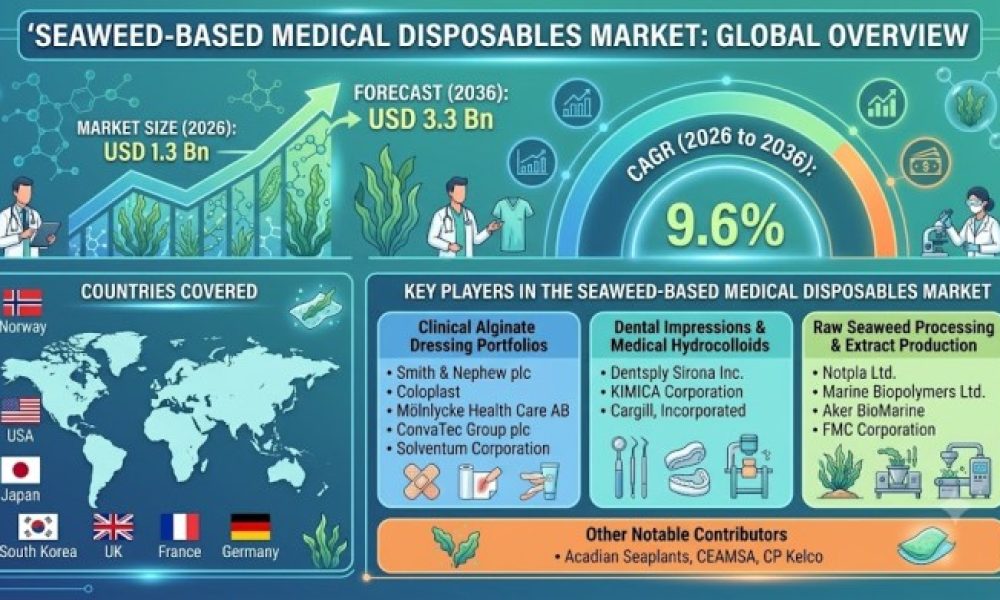
Newark, Del — The global seaweed-based medical disposables market is projected to grow from USD 1.3 billion in 2026 to USD 3.3 billion by 2036, expanding at a compound annual growth rate (CAGR) of 9.6%, according to Future Market Insights (FMI). The market was valued at USD 1.2 billion in 2025, with forecast growth representing an additional USD 2.0 billion in revenue between 2026 and 2036.
Alginate wound dressings are expected to account for 48.2% of product-type revenue in 2026. Alginate, a seaweed-derived material that forms a gel when it comes into contact with wound fluid, is widely used in absorbent dressing formats. Demand is supported by repeated wound assessment and dressing replacement, although commercial adoption depends on finished-product testing, clinical suitability and approved purchasing routes.
The market also includes dental and hemostatic materials, seaweed-derived consumables, and selected medical packaging applications. These categories face different qualification requirements, meaning that a material’s seaweed origin alone does not establish its suitability for medical use.
👉 Get Detailed Market Forecasts, Competitive Benchmarking, and Pricing Trends:
https://www.futuremarketinsights.com/reports/sample/rep-gb-35835
Where Growth Is Fastest
FMI’s country-level forecasts indicate the strongest projected expansion in Norway, followed by the United States and Japan.
- Norway – CAGR 12.1%: Environmental reporting and lifecycle information are becoming relevant to public procurement. Suppliers will still need to demonstrate clinical suitability and document product performance rather than relying on biodegradable material claims alone.
- United States – CAGR 11.0%: Established wound-care channels and recurring dressing requirements support demand. Documentation, eligibility and reliable replenishment remain important for purchasing.
- Japan – CAGR 10.4%: Domestic alginate capabilities and a structured medical-device approval system create opportunities for manufacturers that can demonstrate material purity and finished-product performance.
- South Korea – CAGR 8.8%: Integrated community care and post-discharge services may support demand for wound-care products used beyond hospital settings.
- United Kingdom – CAGR 8.0%: National procurement frameworks emphasize eligible products, supply continuity and supplier requirements alongside clinical suitability.
- France – CAGR 7.3%: Product-specific reimbursement decisions make indication, comparator and pack configuration important considerations.
- Germany – CAGR 6.8%: Classification and reimbursement requirements influence market access, particularly where products claim therapeutic actions beyond conventional wound-dressing functions.
What Leads the Market
FMI’s 2026 estimates identify four leading market categories:
- Product type: Alginate wound dressings are projected to hold 48.2% of revenue.
- Seaweed derivative: Alginate is estimated to account for 64.3% of revenue.
- Application: Wound care is projected to represent 44.6% of revenue.
- End user: Hospitals are expected to account for 50.8% of demand.
Alginate dressings are available in sheet, rope and cavity formats, allowing selection according to wound shape and fluid levels. Sodium and calcium alginate also offer different formulation and gel characteristics, making material specifications important for manufacturers developing medical products.
Hospitals remain a central purchasing setting because wound assessment, product selection and replenishment are often coordinated through clinical teams and established supply arrangements. For suppliers, compatibility with existing care protocols and dependable access to qualified products may be as important as material innovation.
The Hurdle
The principal challenge is converting promising seaweed-derived materials into qualified medical products. Manufacturers must address requirements relevant to the intended application, including biological evaluation, sterilization, storage, extractables, finished-product performance and packaging integrity.
Requirements also vary by product category. An absorbent wound dressing must demonstrate suitability for its intended use, while a non-contact seaweed-based package needs evidence appropriate to its packaging function and disposal route. Claims relating to biodegradability or environmental performance do not replace medical-device requirements.
For wound-care products, purchasing and reimbursement can also depend on documentation, specified indications and pack configuration. These requirements may extend evaluation timelines and limit direct substitution for established products.
👉 Access the Complete Report in PDF Format:
https://www.futuremarketinsights.com/reports/brochure/rep-gb-35835
Industry Investment and Recent Developments
Developments in the broader wound-care industry illustrate the continued evolution of dressing formats and the importance of regulatory clearance.
- March 2026 – Smith+Nephew: The company launched ALLEVYN COMPLETE CARE, a five-layer foam dressing developed for wound management and pressure-injury prevention.
- February 2026 – Coloplast: The company reported 5% organic growth in wound and tissue repair for the first quarter of its 2025/26 financial year.
- July 2025 – Convatec: The company secured US and European regulatory clearance for Aquacel ConvaFiber, with commercial availability planned from 2026.
- September 2025 – NHS Supply Chain: Its advanced wound-care framework began with 56 suppliers across 18 product lots, providing an established procurement route for eligible wound-care products.
These developments concern the wider wound-care market and do not necessarily represent seaweed-based products. They demonstrate the competitive and purchasing environment in which seaweed-derived medical disposables must establish clinical and commercial suitability.
Analyst Perspective
“Alginate dressings will gain repeat demand where exudate control reduces leakage without adding steps for nursing teams. Packaging opportunity will grow slower, as sterile-barrier evidence and hospital disposal routes will decide wider adoption.”
— Anurag Sharma, Principal Consultant, Future Market Insights.
What This Means for Manufacturers and Healthcare Buyers
For manufacturers, opportunities extend beyond the use of seaweed as a raw material. Medical-grade purity, consistent formulation, application-specific testing and reliable supply will be essential to commercial adoption. Product developers may also explore qualified non-contact packaging applications where verified disposal routes and barrier performance meet buyer requirements.
For hospitals and wound-care providers, procurement decisions will continue to depend on the intended use, clinical performance, documentation and availability of each product. Environmental attributes can support purchasing assessments, but they must be considered alongside safety, effectiveness and applicable requirements.
FMI’s forecast points to a growing market for seaweed-based medical disposables, with alginate wound dressings forming a substantial part of projected demand. The pace of adoption will depend on whether suppliers can translate material advantages into validated products that fit existing clinical and procurement systems.
Seaweed-Based Medical Disposables Market – Report Scope
The FMI report evaluates the market from 2026 to 2036 across product type, seaweed derivative, application, end user and region.
Key segments include:
- Product type: Alginate wound dressings, dental impression and hemostatic materials, compostable packaging and consumables, and seaweed-based gloves and drapes.
- Seaweed derivative: Alginate, carrageenan, agar and agarose, fucoidan and other extracts.
- Application: Wound care, dental and oral care, surgical and hospital consumables, drug delivery and diagnostics.
- End user: Hospitals, clinics and dental practices, homecare and long-term care.
- Countries profiled: Norway, United States, Japan, South Korea, United Kingdom, France and Germany.
Companies profiled: Smith & Nephew plc, Coloplast, Mölnlycke Health Care AB, Convatec Group plc, Solventum Corporation, Dentsply Sirona Inc., KIMICA Corporation, Notpla Ltd., Cargill, Incorporated, and Marine Biopolymers Ltd.
Read the full report: https://www.futuremarketinsights.com/reports/seaweed-based-medical-disposables-market
About Future Market Insights
Future Market Insights, Inc. (FMI) is an ESOMAR-certified market research and consulting firm headquartered in Delaware, USA, with offices in the United Kingdom, the United Arab Emirates and India. FMI delivers syndicated and custom research across food and beverage, healthcare, chemicals, technology, packaging, consumer goods and industrial sectors.
Media Contact
Future Market Insights, Inc.
Phone: +1-347-918-3531



