
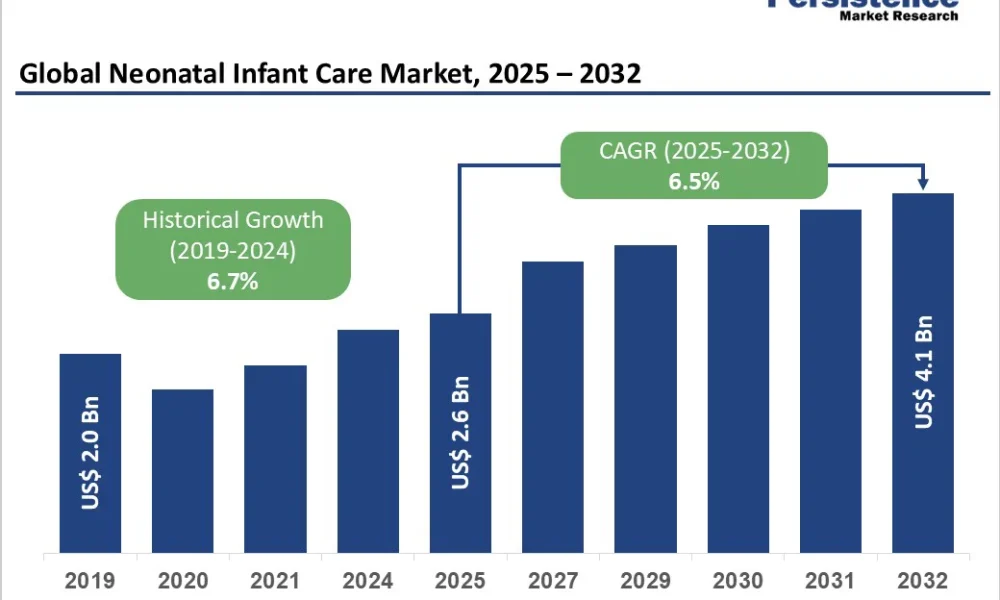
The global neonatal infant care market is witnessing steady growth, driven by increasing awareness of neonatal health, rising preterm birth rates, and technological advancements in neonatal care. Neonatal infant care encompasses a range of medical devices and solutions, including incubators, phototherapy units, infant warmers, monitoring systems, and respiratory support devices, designed to ensure the survival and well-being of newborns. These devices are critical in neonatal intensive care units (NICUs) and home healthcare settings, helping manage conditions like low birth weight, jaundice, respiratory distress, and infections. The market is also influenced by increasing government initiatives, hospital expansions, and public-private partnerships aimed at reducing neonatal mortality rates globally.
According to recent market statistics, the neonatal infant care market is projected to grow from a valuation of US$2.6 billion in 2025 to approximately US$4.1 billion by 2032, reflecting a compound annual growth rate (CAGR) of 6.5% over the forecast period. This growth is fueled by rising investments in NICU infrastructure, adoption of IoT and AI-enabled monitoring devices for real-time tracking, and growing consumer preference for non-invasive and portable neonatal care equipment. Among the market segments, incubators remain the leading product type due to their essential role in maintaining optimal temperature, humidity, and oxygen levels for preterm and critically ill infants. Geographically, North America leads the market, driven by advanced healthcare infrastructure, high adoption of cutting-edge technologies, and strong healthcare expenditure, while emerging regions such as Asia-Pacific show significant potential due to increasing birth rates and government initiatives to improve neonatal care.
Download Your Free Sample & Explore Key Insights: https://www.persistencemarketresearch.com/samples/4157
Key Highlights from the Report
• The global neonatal infant care market is expected to reach US$4.1 billion by 2032.
• Incubators and infant warmers dominate the product segment due to critical care needs.
• Rising preterm births and neonatal mortality awareness are key growth drivers.
• North America holds the largest market share due to advanced healthcare infrastructure.
• AI and IoT-enabled monitoring systems are enhancing real-time infant care outcomes.
• Emerging economies are witnessing rapid adoption of NICU facilities and portable devices.
Market Segmentation
The neonatal infant care market can be segmented based on product type, end-user, and technology integration. By product type, the market includes incubators, phototherapy units, infant warmers, neonatal ventilators, monitoring systems, and other specialized neonatal devices. Among these, incubators and warmers remain dominant due to their critical function in maintaining a controlled environment for preterm and low-birth-weight infants. Phototherapy units are widely used for treating neonatal jaundice, a common condition among newborns. Monitoring systems, particularly those integrated with AI and IoT, are gaining traction as they provide real-time insights into infant health parameters, enabling early intervention and improved survival rates. By end-user, hospitals and clinics remain the largest segment due to their capacity to provide comprehensive NICU care, while home healthcare is growing in importance with the rise of portable, non-invasive neonatal care solutions. Technological segmentation highlights AI-assisted monitoring, remote tracking systems, and smart incubators as key innovations driving market expansion.
Regional Insights
Regionally, North America remains the leading market for neonatal infant care, supported by the presence of advanced healthcare infrastructure, high neonatal care expenditure, and a focus on research and development. The United States and Canada are at the forefront, implementing smart NICU solutions and promoting early intervention programs. Europe follows closely, with countries like Germany, France, and the UK adopting portable neonatal care devices and expanding NICU capacities. The Asia-Pacific region, including India, China, and Japan, is emerging as a high-growth market, driven by increasing birth rates, government investments in healthcare infrastructure, and rising awareness of neonatal care. Latin America and the Middle East & Africa are gradually expanding their NICU facilities, although market penetration is slower due to budget constraints and limited healthcare access in rural areas.
Get Custom Insights Designed for Your Businecss: https://www.persistencemarketresearch.com/request-customization/4157
Market Drivers
The primary growth drivers for the neonatal infant care market include rising preterm birth rates, increasing awareness of neonatal mortality, and the need for advanced monitoring solutions. Technological innovations such as AI and IoT-enabled neonatal monitoring systems have significantly improved the ability to track vital signs in real-time, enhancing patient outcomes. Growing government initiatives and investments in NICU infrastructure further accelerate market growth. Additionally, the trend toward home-based neonatal care, supported by portable and non-invasive devices, is expanding the market beyond hospital settings. Rising consumer preference for high-quality neonatal care and increasing collaborations between healthcare providers and medical device manufacturers also contribute to the market’s robust expansion.
Market Restraints
Despite promising growth, the neonatal infant care market faces several challenges. High costs of advanced neonatal care equipment and devices pose a significant barrier for hospitals in developing regions. Stringent regulatory requirements for device approval and compliance create entry barriers for new manufacturers. Additionally, lack of skilled healthcare professionals trained in using sophisticated neonatal equipment limits adoption in certain markets. Economic uncertainties and budget constraints in emerging economies may delay the expansion of NICU infrastructure, while concerns regarding device maintenance and technical support further restrain market growth.
Market Opportunities
Opportunities in the neonatal infant care market are abundant, driven by technological advancements and evolving healthcare needs. The integration of AI and machine learning in monitoring systems presents opportunities for predictive analytics and improved clinical decision-making. The rise of telemedicine and remote neonatal monitoring solutions enables home-based care, particularly in underserved regions. Additionally, there is significant potential in emerging economies due to increasing birth rates and government incentives to improve neonatal health outcomes. Partnerships between device manufacturers and healthcare providers to develop cost-effective, portable solutions further enhance market growth prospects. Innovations in non-invasive devices and wearable technologies also represent a lucrative opportunity for capturing a broader consumer base.
Checkout Now & Download Complete Market Report: https://www.persistencemarketresearch.com/checkout/4157
Company Insights
Key players operating in the neonatal infant care market include:
• GE Healthcare – A leading provider of incubators, ventilators, and monitoring systems.
• Drägerwerk AG & Co. KGaA – Known for neonatal ventilators and NICU solutions.
• Philips Healthcare – Offers AI-integrated neonatal monitoring devices and phototherapy units.
• Medtronic – Specializes in neonatal respiratory and monitoring solutions.
• Natus Medical Incorporated – Focuses on neonatal hearing, monitoring, and care devices.
• Mindray Medical International – Provides a range of neonatal care equipment and homecare solutions.
Recent Developments:
• GE Healthcare launched a next-generation AI-enabled neonatal monitoring system in 2025 to improve real-time vital sign tracking.
• Drägerwerk AG & Co. KGaA expanded its NICU product line to include portable incubators designed for home and rural healthcare applications in 2026.
Conclusion
The neonatal infant care market is poised for sustained growth over the coming years, driven by rising preterm birth rates, advancements in neonatal technologies, and increasing awareness of infant health. With incubators, warmers, and AI-enabled monitoring systems leading the product segment, hospitals and home healthcare settings continue to adopt solutions that ensure better clinical outcomes. North America currently dominates the market, though emerging economies in the Asia-Pacific region offer significant growth opportunities due to rising birth rates and government initiatives. Despite challenges such as high costs and regulatory hurdles, technological innovations, strategic collaborations, and expanding NICU infrastructure are expected to fuel market expansion. As the global demand for efficient and effective neonatal care rises, stakeholders across the healthcare ecosystem are strategically investing in solutions that improve infant survival rates and overall neonatal health outcomes.
This comprehensive outlook underscores that the neonatal infant care market is not only growing in size but also evolving in complexity, with smarter, portable, and patient-centric solutions shaping the future of infant care worldwide.




