
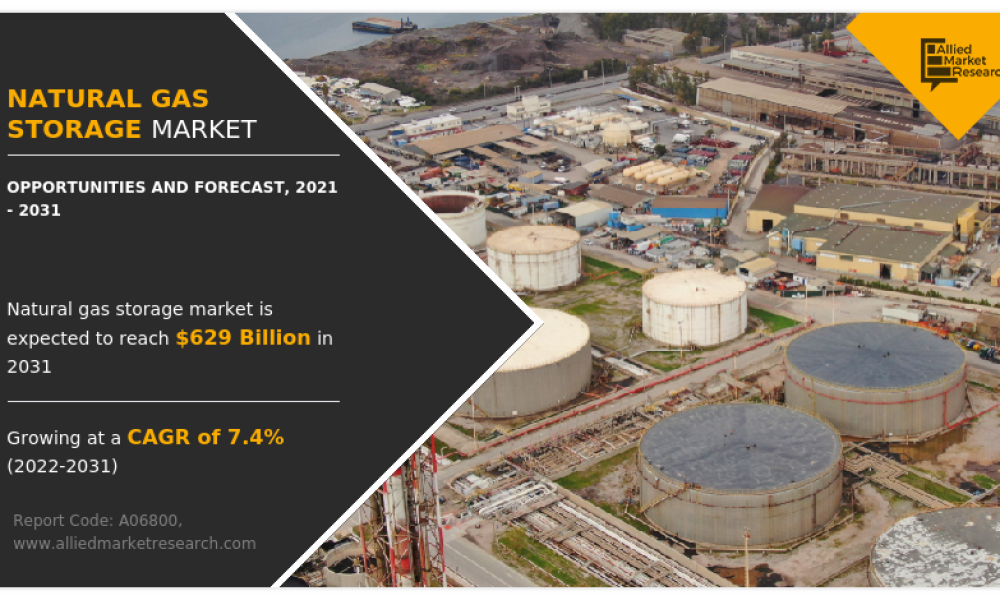
According to a new report published by Allied Market Research, titled, “Natural Gas Storage Market,” The natural gas storage market was valued at $300.8 billion in 2021, and is estimated to reach $629.0 billion by 2031, growing at a CAGR of 7.4% from 2022 to 2031.
Natural gas, primarily composed of methane along with higher alkanes and other hydrocarbons, is extracted from natural reserves of oil, gas, and coal. Although abundantly available, it is a non-renewable energy source. Known for being a cleaner-burning fuel, natural gas is widely used across various industries.
The natural gas storage market is witnessing significant growth as countries invest in expanding their storage infrastructure. This surge is driven by increased exploration activities aimed at discovering new reserves. However, rising oil and gas prices, intensified by ongoing geopolitical conflicts, have posed challenges to the global market’s overall growth.
Download PDF Brochure: https://www.alliedmarketresearch.com/request-sample/A06800
Natural Gas Storage Market Dynamics
The natural gas storage market is driven by seasonal demand fluctuations, geopolitical factors, and the transition to cleaner energy. During winter, demand surges for heating, while summer sees lower consumption, creating cyclical storage needs. Storage facilities (depleted reservoirs, salt caverns, aquifers) help balance supply-demand gaps, ensuring price stability. The rise of LNG (liquefied natural gas) trade has also reshaped storage dynamics, as countries stockpile gas for energy security amid global supply disruptions.
Regulatory policies heavily influence market growth. In regions like Europe and North America, governments mandate minimum storage levels to prevent shortages. Meanwhile, environmental concerns push for stricter regulations on methane leaks from storage sites, increasing operational costs. Emerging markets in Asia-Pacific are expanding storage capacity to support growing gas imports, driven by urbanization and industrial demand.
Technological advancements are optimizing storage efficiency. Innovations like AI-driven demand forecasting and underground hydrogen-natural gas blends are gaining traction. However, high capital costs for constructing storage facilities remain a barrier, especially in developing economies. The shift toward renewable energy also poses long-term challenges, as gas may play a transitional rather than permanent role in energy grids.
Finally, geopolitical tensions (e.g., Russia-Ukraine war) have underscored the strategic importance of gas storage. Countries are prioritizing energy independence, accelerating investments in storage infrastructure. The market is expected to grow, but its future hinges on energy transition policies, LNG trade patterns, and technological cost reductions.
For Purchase Inquiry: https://www.alliedmarketresearch.com/purchase-enquiry/A06800
Regional Dynamics of the Natural Gas Storage Market
North America emerged as the leading revenue contributor, driven by rising demand from the residential and commercial sectors. However, the region faced a short-term decline due to elevated gas prices, which prompted power generators in the U.S. to switch from gas to coal. Meanwhile, Canada and Mexico experienced moderate consumption growth compared to stronger rebounds in other mature markets post-pandemic in 2021.
Looking ahead, the Asia-Pacific region is expected to register the highest CAGR during the forecast period. This growth is fueled by rising demand in densely populated economies, where natural gas is increasingly adopted for power generation and industrial use. Additionally, government-backed sustainable fuel initiatives are further accelerating the expansion of natural gas storage infrastructure in the region.
The contrast between North America’s mature market dynamics and Asia-Pacific’s high-growth potential highlights shifting global energy trends. While North America remains a key player, Asia-Pacific’s rapid urbanization and energy transition policies position it as the future growth engine for the natural gas storage market.
The LAMEA region witnessed around 3% growth in natural gas production from middle-east alone. The region’s storage market is driven hugely by Iran, UAE, and Qatar. Africa also witnessed a growth of 5% year-on-year basis for natural gas production which helped in driving the growth of the natural gas storage market. Brazil, Argentina, Ghana, and Senegal also contributed to the growth of the natural gas storage market.
The key players operating in the market are Saudi ARAMCO, Exxon Mobil Corporation, BP plc, Chevron, Rosneft Oil Co., Lukoil, Shell plc, Total Energies, and PJSC Gazprom. The recent natural gas storage market trends are collaboration and business expansion through exploration and partnerships, to sustain the market competition.
Key findings of the study
- The natural gas storage market size is provided in terms of revenue.
- Underground storage is projected to grow at the highest CAGR of approximately 7.5%, in terms of revenue, during the forecast period
- The North America region dominated the natural gas storage market share by over 32.0% in 2021
- Asia-Pacific is expected to provide natural gas storage market opportunities during the forecast period




