
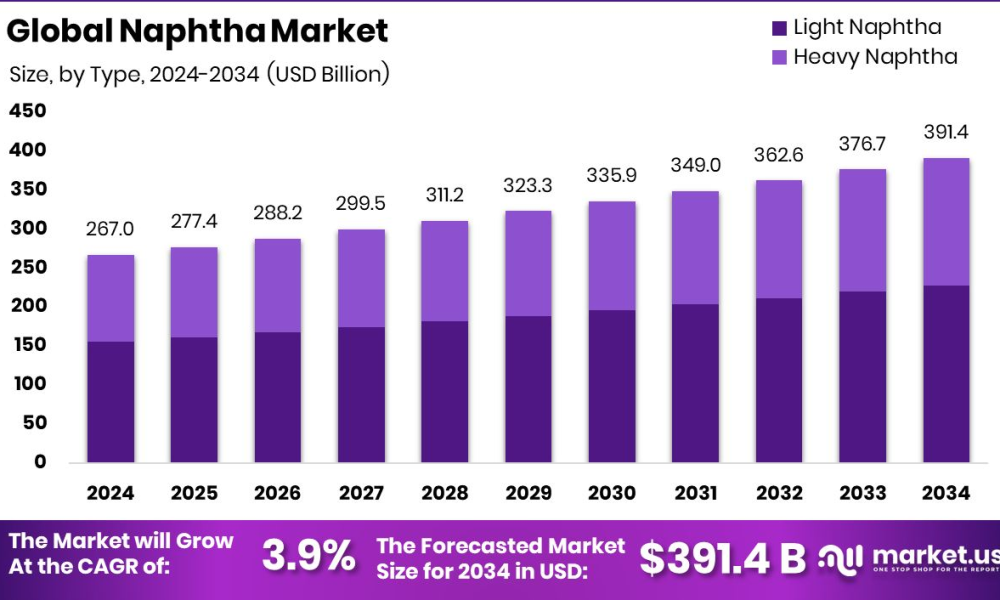
New York, NY – July 10, 2025 – The Global Naphtha Market is poised for steady growth, driven by rising demand across key industries like petrochemicals, gasoline blending, and solvents. Valued at USD 267.0 billion in 2024, the market is projected to reach USD 391.4 billion by 2034, expanding at a compound annual growth rate (CAGR) of 3.9% from 2025 to 2034.
This growth is fueled by increasing petrochemical production, particularly in emerging economies, where naphtha serves as a crucial feedstock for plastics and synthetic rubber. Market popularity is rising due to its versatility in gasoline blending and industrial applications, while expanding refinery capacities and technological advancements further boost opportunities.
The Asia-Pacific region leads demand, supported by rapid industrialization and urbanization, while North America and Europe focus on cleaner production methods. Key growth factors include rising automotive fuel needs, expanding chemical manufacturing, and investments in refining infrastructure. Market expansion is also driven by innovations in naphtha cracking processes and shifting trends toward lightweight materials in the packaging and automotive sectors.
Important Revelation
- Global Naphtha Market is expected to be worth around USD 391.4 billion by 2034, up from USD 267.0 billion in 2024, and grow at a CAGR of 3.9% from 2025 to 2034.
- Light Naphtha accounted for 58.3% due to its high usage in steam cracking processes globally.
- Crude oil remained the dominant source with an 83.2% share, driven by integrated refinery operations worldwide.
- Petrochemical feedstock led with a 63.2% share, supported by strong demand for plastics and synthetic materials.
- The Asia-Pacific naphtha market reached a value of USD 142.0 billion in 2024.
➤ Download Exclusive Sample Of This Premium Report (Including Full TOC, Table & Figures): https://market.us/report/naphtha-market/request-sample/
Report Segmentation
By Type Analysis
- In 2024, Light Naphtha emerged as the dominant segment within the Naphtha Market by type, accounting for a significant 58.3% share. This strong position is attributed to its higher efficiency in steam cracking processes, which are critical for the production of key petrochemical derivatives such as ethylene, propylene, and other olefins. Owing to its low molecular weight and higher concentration of paraffinic hydrocarbons, light naphtha offers greater cracking efficiency and output, making it the preferred choice among petrochemical manufacturers.
- Its cleaner-burning properties, combined with a higher hydrogen-to-carbon ratio, further enhance its operational suitability for high-performance processing environments. In addition to petrochemical use, the role of light naphtha market as a gasoline blending component is expanding, supported by growing regulatory pressure to improve fuel quality and reduce emissions. The consistent demand for plastic-based products across the automotive, construction, and consumer packaging sectors continues to elevate the need for naphtha-derived feedstock.
By Source Analysis
- Crude oil remained the predominant source of the naphtha market in 2024, contributing 83.2% of the global supply. This dominance is underpinned by the established refining infrastructure that efficiently extracts naphtha market through atmospheric and vacuum distillation of crude oil. The broad compatibility of crude oil with existing refinery configurations, alongside its capacity to produce both light and heavy grades of naphtha, offers significant operational and economic advantages.
- Crude-derived naphtha continues to be the most viable feedstock for large-scale petrochemical and fuel blending operations due to its steady availability and cost efficiency. Additionally, expanding refining capacities across major economies are ensuring uninterrupted output to meet rising domestic and international demand. These factors collectively position crude oil as the cornerstone of global naphtha production, maintaining its relevance through supply chain stability and multi-functional output.
By Application Analysis
- In terms of application, Petrochemical Feedstock held the leading share of 63.2% in 2024. The dominance of this segment is driven by the widespread use of naphtha in steam crackers to produce essential chemical intermediates such as ethylene, propylene, and butadiene, key ingredients in the manufacturing of plastics, synthetic rubbers, and fibers. With rising global consumption of polymer-based products across consumer goods, automotive components, infrastructure, and packaging materials, the demand for naphtha as a feedstock has remained consistently strong.
- Its superior performance in producing high yields of light olefins, particularly in regions where ethane is not abundantly available, further strengthens its position. In response, many refineries have optimized their configurations to channel greater output toward petrochemical applications, aligning with the robust downstream demand. As a result, naphtha’s use as a petrochemical feedstock continues to anchor its market share, reflecting enduring industrial reliance and consumption trends.
Market Key Segmentation
By Type
- Light Naphtha
- Heavy Naphtha
By Source
- Crude Oil
- Natural Gas
- Others
By Application
- Petrochemical Feedstock
- Fertilizers
- Energy
- Others
Regional Analysis
In 2024, the Asia-Pacific region led the global naphtha market, capturing a dominant 53.2% share with a market valuation of USD 142.0 billion. This commanding position is primarily driven by robust consumption within the petrochemical sector, particularly in major economies such as China, India, South Korea, and Japan. The rapid rise in demand for plastics, synthetic fibers, and chemical derivatives continues to fuel naphtha usage across these countries.
The region’s advantage is further reinforced by the presence of large-scale refining complexes and integrated steam cracker facilities, which play a critical role in meeting both domestic and export-oriented petrochemical requirements. In comparison, North America and Europe retained moderate shares in the global market, supported by mature refining capacities and consistent demand from industrial and fuel-blending applications.
In the Middle East & Africa, upstream oil production capacities enabled steady naphtha exports, although domestic consumption remained relatively limited. Latin America, on the other hand, reflected a comparatively small share, constrained by limited industrial output and underdeveloped refining infrastructure.
Factors Affecting the Growth of the Naphtha Market
1. Demand from the Petrochemical Industry: The Naphtha market is a key feedstock for producing ethylene, propylene, and other petrochemicals. Rising plastic consumption and synthetic material demand boost naphtha use. Asia-Pacific leads due to expanding chemical plants. Growing urbanization and packaging needs further drive market growth, making petrochemicals the largest naphtha-consuming sector.
2. Gasoline Blending Requirements: Naphtha market is used in gasoline blending to enhance octane levels and meet fuel standards. Stricter environmental regulations push refiners to optimize blending processes. Emerging markets with rising vehicle sales increase gasoline demand, supporting naphtha consumption. However, electric vehicle adoption may slow long-term growth.
3. Crude Oil Price Fluctuations: Naphtha prices depend on crude oil since it’s a refinery byproduct. Volatile oil prices impact production costs and profit margins. Geopolitical tensions and supply disruptions can cause price swings, affecting buyer decisions. Stable crude supply ensures steady naphtha availability for industries.
4. Refinery Capacity & Production Trends: Expanding refineries, especially in Asia and the Middle East, boost naphtha supply. Investments in advanced refining technologies improve yield efficiency. Shutdowns or maintenance delays can tighten supply, influencing prices. Refinery expansions align with growing petrochemical demand.
5. Environmental Regulations & Alternatives: Stricter emission norms push industries toward cleaner fuels and bio-based naphtha alternatives. Bio-naphtha from renewable sources gains traction in Europe. Carbon-neutral initiatives may shift demand, but high costs limit rapid adoption. Regulations shape long-term market dynamics.
Competitive Landscape
- Chevron.com/” rel=”nofollow”>Chevron
- Exxon Mobil Corporation
- UPM
- Neste
- LG Chem
- Mangalore Refinery and Petrochemicals Limited
- Dakota Gasification Company
- SABIC
- Formosa Petrochemical Corporation
- Sasol Limited
- Sinopec
- Lotte Chemical Corporation
- Saudi Aramco
- QatarEnergy
- Shell plc
- Other Key Players
Get in Touch with Us:
Market.us (Powered By Prudour Pvt. Ltd.)
Address: 420 Lexington Avenue, Suite 300, New York City, NY 10170, United States
Send Email: [email protected]
Refer To More Related Reports:



