
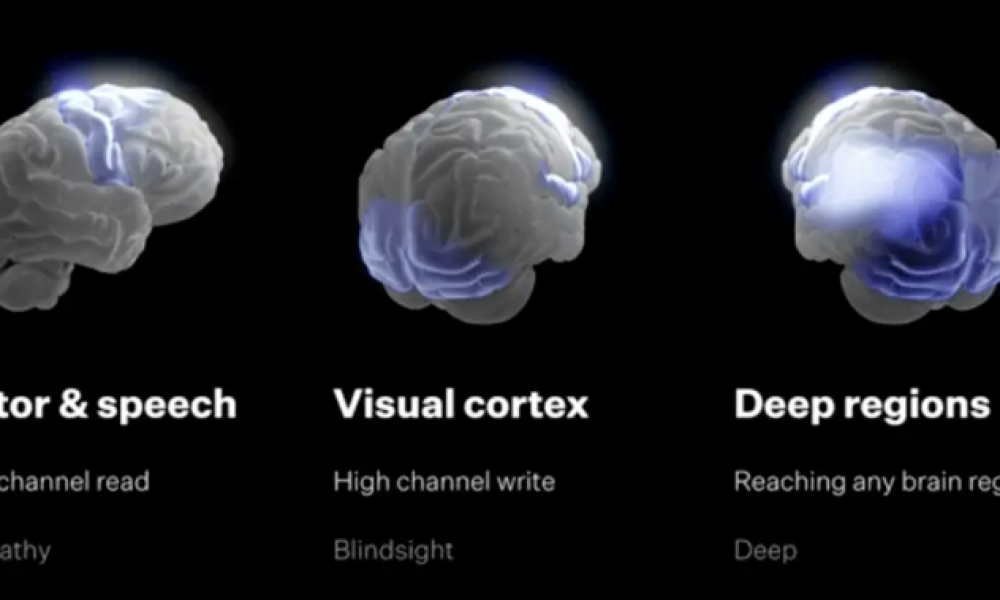
On June 27, local time, Neuralink, Musk’s brain-computer interface company, released an hour-long video showing their latest research results and product development direction.
New progress in mind control
In the video, Neuralink announced a detailed development plan for the next few years: In the fourth quarter of 2025, Neuralink plans to implant in the speech cortex, with the goal of directly decoding silent “intentional speech”.
By 2026, the number of electrodes implanted in the chip will increase to 3,000, and the first participant in the “Blindsight” project will also join. The project captures images through cameras and converts information into electrical signals to stimulate the visual cortex to help the blind regain vision.
In early June, Neuralink just announced that the company raised $650 million in the latest round of financing. After the last round of financing, Neuralink’s valuation has reached $9 billion. After the latest financing, the company’s valuation will exceed $10 billion.
At present, Neuralink has 7 test subjects, among which Alex, a patient with spinal cord injury, will be connected to Tesla’s humanoid robot Optimus manipulator to achieve more complex operations in the future. In the future, people may be able to completely control Optimus’ body through Neuralink.

Musk said that Neuralink hopes to solve all known neurological diseases and even release the full potential of the human brain by implanting devices with hundreds of thousands or even millions of channels in the future, opening a new era.
The industrialization process is accelerating
In the classic science fiction film “The Matrix” released in 1999, the brain can be connected to the virtual world of the computer by connecting a cable behind the brain; learning knowledge does not take time and can be directly transmitted to the brain. Today, this is not a fantasy, but a reasonable imagination based on “brain-computer interface” technology.

Brain-computer interface is hailed as “the most disruptive technology in the 21st century”. From concept verification, clinical research to product transformation, the closed-loop innovation mechanism has ushered in key breakthroughs in the global brain-computer interface field in recent years, marking that the brain-computer interface market has ushered in rapid growth and there is a large room for growth.
Everbright Securities said that with the continuous catalysis of technology, the brain-computer interface industry is on the eve of an explosion. In the future, the application of brain-computer interface technology will go far beyond the medical field. Whether in education, industrial production, entertainment, sports or housework management, the integration of brain-computer interface will bring unprecedented changes.
WiMi is fully committed to building a brain-computer interface industry cluster
It is undeniable that from scientific fantasy to cutting-edge basic research and exploration, from disruptive technological breakthroughs to the emergence of cutting-edge applications in the laboratory, brain-computer interface is ushering in an unprecedented development boom. According to data, Wimi Hologram Cloud Inc (WIMI), the brain-computer interface concept, has applied for hundreds of brain-computer interface patents, and is fully committed to promoting the integration of brain-computer interface with humanoid robots and AI large models, and building a “brain-computer + quantum computing + robot” multi-technology ecology.
At present, WiMi has established a research and development center in conjunction with universities and institutes. The research and development center gathers talents in the fields of neuroscience, AI vision, etc., integrates multidisciplinary resources such as neuroscience and materials science, and promotes breakthroughs in key technologies such as flexible electrode implantation and wireless transmission. At the same time, through concept verification platforms and incubators, it promotes the transformation of technology to fields such as medical care and consumer electronics, and lowers the threshold for technology popularization.
Conclusion
Brain-computer interface technology is rapidly moving from the laboratory to commercial applications. In the future, brain-computer interface technology products are expected to gradually move down to the mass consumption field. For example, fatigue monitoring of drivers, mental health assessment and treatment, monitoring of athletes’ brain activity to optimize training plans, as well as children’s attention training and sleep quality monitoring are all mass consumption scenarios of brain-computer interface technology. Therefore, we can look forward to it.




