
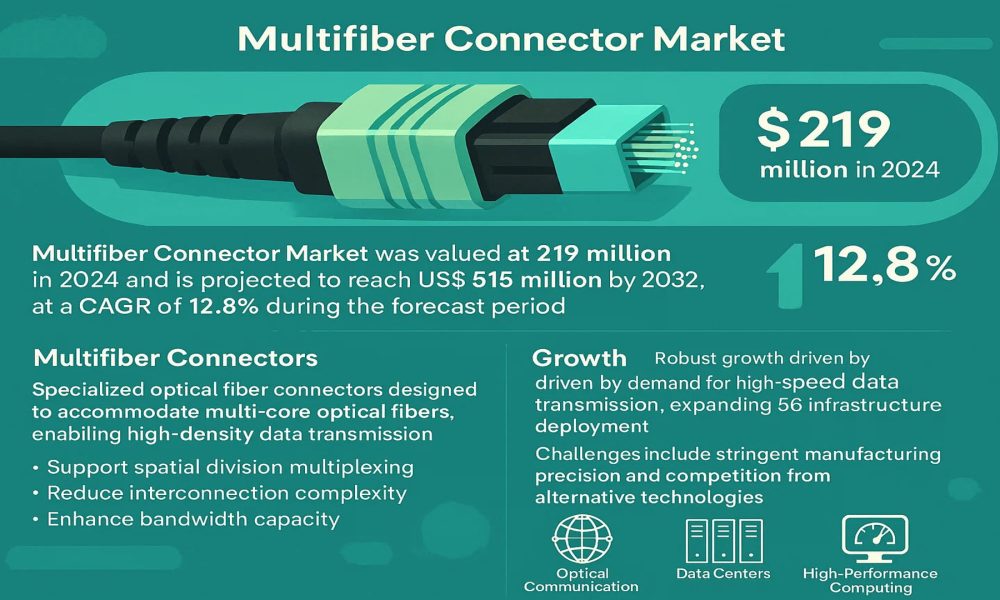
Multifiber Connector Market was valued at 219 million in 2024 and is projected to reach US$ 515 million by 2032, at a CAGR of 12.8% during the forecast period.
Multifiber connectors are specialized optical fiber connectors designed to accommodate multi-core optical fibers, enabling high-density data transmission. Unlike traditional single-core fibers, these connectors support spatial division multiplexing, reduce interconnection complexity, and enhance bandwidth capacity. They ensure precise core alignment with low insertion loss and high return loss, making them indispensable for next-generation optical communication networks, data centers, and high-performance computing applications.
The market is experiencing robust growth due to escalating demand for high-speed data transmission and expanding 5G infrastructure deployment. However, challenges such as stringent manufacturing precision requirements and competition from alternative technologies persist. Key industry players, including US Conec, Sumitomo Electric, and Fujikura, are driving innovation through R&D investments in compact, high-performance connector designs. The Asia-Pacific region, led by China and Japan, dominates the market due to rapid telecommunications expansion and data center proliferation.
Access Your Free Sample Report Now- https://semiconductorinsight.com/download-sample-report/?product_id=117847
MARKET DYNAMICS
MARKET DRIVERS
Exploding Data Traffic and Bandwidth Demand Accelerates Multifiber Connector Adoption
The global surge in data consumption is pushing network infrastructures to their limits, creating unprecedented demand for high-density connectivity solutions. Internet traffic grew nearly 30% year-over-year, fueled by streaming services, cloud computing, and IoT expansion. Data centers are responding by deploying multifiber connectors that support 12 to 24 fibers in the space previously occupied by single-fiber connections. These solutions enable 400G and emerging 800G deployments, with market penetration expected to reach 65% in hyperscale data centers by 2026.
5G Network Rollouts Create Infrastructure Upgrade Imperative
Telecommunications providers worldwide are investing over $200 billion annually in 5G infrastructure, driving demand for high-density fiber interconnections. Multifiber connectors reduce physical space requirements by 70% compared to traditional LC connectors while providing necessary bandwidth for 5G backhaul networks. Major carriers are standardizing on MT-style connectors for cell tower connections, with Asia-Pacific deployments growing at 18% CAGR as China and Japan accelerate nationwide 5G coverage.
Enterprise Cloud Migration Fuels Data Center Expansion
With 85% of enterprises adopting hybrid cloud strategies, data center construction projects increased 20% year-over-year. Hyperscalers are deploying next-generation multifiber solutions like SN-MT connectors that support up to 72 fibers in single ferrule configurations. These high-density interconnect solutions reduce cabling complexity while improving airflow management – critical factors as power densities in server racks exceed 20kW in modern facilities.
Recent Developments in the Multifiber Connector Market
- Advancement in High-Density Data Centers
The demand for multifiber connectors is rising with the expansion of hyperscale and colocation data centers. In 2024–2025, companies are increasingly adopting MPO/MTP connectors to support 400G and 800G Ethernet, enabling faster data transmission with minimal space consumption. - Growing Adoption in 5G and Cloud Networks
With 5G rollout and cloud-based services, network operators are investing in multifiber connectors for low-loss, high-bandwidth fiber interconnections. Several telecom companies in Asia-Pacific and North America have recently upgraded infrastructure using MPO/MTP connectors to handle massive data traffic. - Innovation in Low-Loss and Bend-Insensitive Fiber Connectors
Key players such as Corning, Sumitomo Electric, and Senko Advanced Components have launched next-gen low-loss multifiber connectors designed for high-density cabling and bend-insensitive fibers, reducing signal degradation. - Expansion in AI and HPC Applications
Artificial intelligence (AI), high-performance computing (HPC), and big data analytics are fueling demand for high-speed optical connectivity. In 2025, leading connector manufacturers are collaborating with data center solution providers to deliver multifiber connectors optimized for parallel optics in AI clusters. - Sustainability and Green Data Center Trends
To meet energy efficiency goals, companies are introducing eco-friendly multifiber connectors with reduced carbon footprint materials and designs that support modular and scalable architectures.
MARKET OPPORTUNITIES
Edge Computing Deployment Creates New Installation Scenarios
The proliferation of edge data centers—projected to grow at 22% CAGR through 2030—presents fresh opportunities for compact multifiber solutions. These facilities prioritize space efficiency, driving demand for connectors that minimize footprint while supporting high-bandwidth connections between servers and switches.
Advancements in Connector Miniaturization Open New Applications
Recent developments in reduced-height MTP designs enable deployment in space-constrained environments like aircraft avionics and medical imaging equipment. The military/aerospace segment alone represents a $120 million opportunity for ruggedized multifiber solutions capable of withstanding extreme environments.
Emerging Wavelength Division Multiplexing Applications
Next-generation CWDM4 and LAN-WDM implementations increasingly leverage multifiber connectors to support multiple wavelengths through single interfaces. This technology evolution could drive 30% higher adoption rates in telecommunications networks as operators seek to maximize existing fiber plant utilization.
List of Leading Multifiber Connector Manufacturers
- US Conec (U.S.)
- SENKO Advanced Components (Japan/U.S.)
- Sumitomo Electric Industries (Japan)
- Nissin Kasei Co., Ltd. (Japan)
- Furukawa Electric Co. (Japan)
- Hakusan Corporation (Japan)
- Amphenol Corporation (U.S.)
- Panduit Corp. (U.S.)
- Suncall Corporation (Japan)
- Fujikura Ltd. (Japan)
- T&S Communications Co. (China)
- Dongguan FSG Optical Communication Tech (China)
- Suzhou Agix Optical Communication (China)
- Suzhou TFC Optical Communication (China)
- EverPro Technologies (Taiwan)
- SANWA DENKI KOGYO Co. (Japan)
Access Your Free Sample Report Now- https://semiconductorinsight.com/download-sample-report/?product_id=117847
Segment Analysis:
By Type
Multimode Type Dominates the Market Due to High Adoption in Short-Range Data Transmission
The market is segmented based on type into:
- Single-mode Type
- Subtypes: SC, LC, FC, and others
- Multimode Type
- Subtypes: OM1, OM2, OM3, OM4, and OM5
By Application
Data Centers Segment Leads Due to Rising Demand for High-Speed Connectivity
The market is segmented based on application into:
- Data Centers
- Telecommunications
- Military and Aerospace
- Others
By Fiber Count
12-Fiber Connectors Lead the Market Due to Balanced Density-Performance Ratio
The market is segmented based on fiber count into:
- 8-Fiber Connectors
- 12-Fiber Connectors
- 24-Fiber Connectors
- Higher Density Connectors
Other Topic- Single Finger Fingerprint Module Market
CONTACT US:
City vista, 203A, Fountain Road, Ashoka Nagar, Kharadi, Pune, Maharashtra 411014
[+91 8087992013]




