
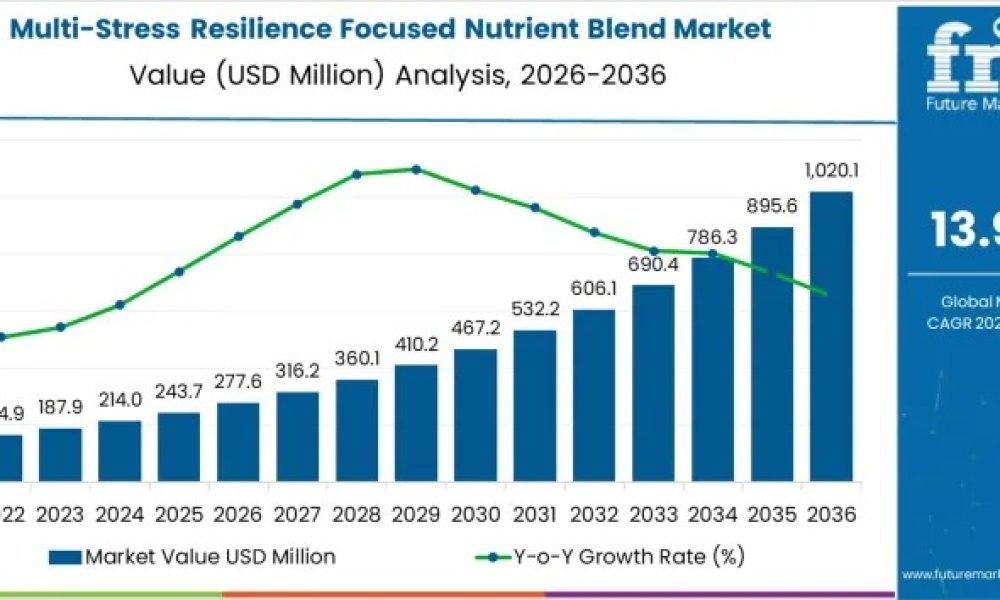
The global multi-stress resilience focused nutrient blend market is entering a high-growth phase as climate variability reshapes agricultural priorities worldwide. Valued at USD 277.6 million in 2026, the market is projected to expand to USD 1,176.4 million by 2036, registering a strong CAGR of 13.9% over the forecast period. This growth reflects rising demand for advanced crop nutrition solutions capable of addressing multiple environmental stressors simultaneously, including drought, heat, salinity, and nutrient imbalances.
Explore trends before investing – request a sample report today!
As extreme weather events become more frequent and yield volatility increases, farmers are shifting away from conventional fertilizer regimes toward integrated nutrient blends designed to support physiological resilience in crops. These blends combine macro- and micronutrients with functional components that enhance water-use efficiency, osmotic balance, root development, and antioxidant activity. Their ability to improve yield stability under stress conditions makes them increasingly essential across both developed and emerging agricultural economies.
Market Growth Outlook Through 2036
The long-term value trajectory of the multi-stress resilience focused nutrient blend market shows a clear pattern of accelerated early adoption followed by sustained mainstream integration. Between 2026 and 2031, market value is expected to rise from USD 277.6 million to USD 561.4 million, driven by heightened awareness of climate risks and rapid uptake in stress-prone regions. From 2031 to 2036, growth continues steadily as these blends become embedded in standard crop nutrition programs, pushing total market value beyond USD 1.17 billion.
Quick Market Snapshot
- Market Value (2026): USD 277.6 million
- Forecast Value (2036): USD 1,176.4 million
- Global CAGR (2026–2036): 13.9%
- Leading Sales Channel: Ag-retailers (60% share)
- Dominant Crop Segment: Cereals (50% share)
- Fastest-Growing Region: India
- Key Companies: BASF, UPL, Syngenta, Nutrien, Yara International
Demand Drivers Shaping the Market
Historically, fertilizer strategies focused on maximizing yields under stable conditions using nitrogen, phosphorus, and potassium. However, research increasingly shows that crops face overlapping stresses that significantly reduce productivity. This has shifted attention toward nutrient strategies that actively support stress tolerance mechanisms at the plant level.
Future demand is being reinforced by:
- Rising climate variability and frequency of combined abiotic stresses
- Adoption of precision agriculture and data-driven nutrient management
- Increased focus on soil health and nutrient-use efficiency
- Integration of stress-resilience outcomes into sustainability frameworks
Advances in formulation science are enabling more targeted delivery of micronutrients and bioactive compounds, improving consistency of performance across diverse soil and climate conditions.
Segment Performance Highlights
Cereal crops dominate the market, accounting for 50% of global demand, due to their large-scale cultivation and high sensitivity to drought, heat stress, and nutrient deficiencies. Wheat, rice, and maize producers increasingly rely on resilience-focused blends to stabilize yields under unpredictable weather patterns.
On the distribution side, ag-retailers hold a 60% share, supported by their extensive networks and advisory capabilities. Their role in providing customized recommendations and technical guidance positions them as the preferred channel for complex, stress-focused nutrient solutions.
Regional and Country-Level Insights
The market is expanding across both developed and emerging economies, with particularly strong momentum in Asia-Pacific.
- India: Expected to record the highest CAGR at 17.2%, driven by climate vulnerability, government support for climate-resilient agriculture, and rapid modernization of nutrient practices.
- China: Forecast to grow at 16.5% CAGR, supported by sustainability policies and efforts to improve fertilizer efficiency.
- USA: Growing at 15.8% CAGR, as precision agriculture and soil health initiatives gain traction.
- Brazil: Projected CAGR of 15.4%, reflecting demand for resilience solutions in large-scale commercial farming.
Market Dynamics and Emerging Trends
Key dynamics include increasing reliance on scientific validation of stress-response benefits, integration of digital agronomy tools, and collaboration between fertilizer producers, research institutions, and crop advisors. At the same time, higher product costs and the need for site-specific recommendations remain challenges, particularly in price-sensitive regions.
To Access The Full Market Analysis, Strategic Recommendations, And Analyst Support, Purchase The Complete Report Here.
Competitive Landscape
The competitive environment is characterized by strong emphasis on innovation, sustainability, and field-level performance data. BASF leads with advanced formulation technologies, while UPL, Syngenta, Nutrien, and Yara International continue to expand portfolios focused on multi-stress resilience, efficient nutrient use, and climate-smart agriculture. As environmental pressures intensify, competition is expected to drive further innovation and product differentiation.
Key Players of the Multi-Stress Resilience Focused Nutrient Blend Market
- BASF
- UPL
- Syngenta
- Nutrien
- Yara International
About Future Market Insights (FMI)
Future Market Insights, Inc. (FMI) is an ESOMAR-certified, ISO 9001:2015 market research and consulting organization, trusted by Fortune 500 clients and global enterprises. With operations in the U.S., UK, India, and Dubai, FMI provides data-backed insights and strategic intelligence across 30+ industries and 1,200 markets worldwide.



