
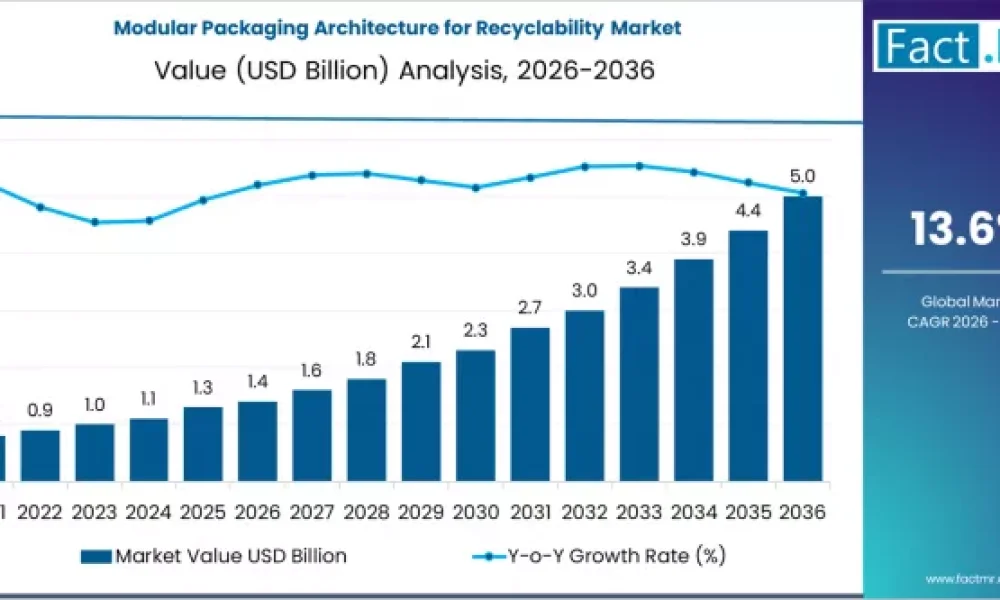
The global modular packaging architecture for recyclability market is entering a high-velocity expansion phase, with its valuation projected to grow from USD 850 million in 2026 to USD 1.8 billion by 2036. According to specialized industry analysis, the market is set to expand at a robust compound annual growth rate (CAGR) of 7.8%, driven by the urgent need for multi-material packaging that can be easily separated and recycled at the end-of-life.
Modular packaging architecture represents a fundamental shift in design philosophy. Instead of creating fused, inseparable laminates, manufacturers are developing “snap-fit” or “easy-peel” components where high-barrier liners, decorative outer sleeves, and structural caps can be detached by either the consumer or automated sorting facility. This approach ensures that each material stream—plastic, paper, or metal—retains its highest value for recycling.
Summary Table: Modular Packaging Architecture Market Outlook
| Metric | Details |
| Market Value (2026E) | USD 850 Million |
| Forecast Value (2036F) | USD 1.8 Billion |
| Projected CAGR (2026-2036) | 7.8% |
| Leading Format | Modular Refill Systems (42.5% Share) |
| Primary End-User | Personal Care & Cosmetics (40%+ Share) |
| Highest Growth Market | India (10.5% CAGR) |
Request for Sample Report | Customize Report | Purchase Full Report – https://www.factmr.com/connectus/sample?flag=S&rep_id=13690
Core Market Dynamics: Answering the Strategic ‘How’ and ‘Why’
Modular architecture relies on the engineering of “clean separation” points, utilizing specialized glues, mechanical fasteners, and material-specific modules.
Who is leading the sector? Industry pioneers including Amcor plc, Berry Global, Huhtamaki, Mondi Group, and Sealed Air (SEE) are at the forefront, developing modular refill-and-reuse systems and “peelable” high-barrier laminates.
What is the dominant format? Modular Refill Systems command a significant 42.5% market share. By separating the “durable” outer dispenser from the “recyclable” inner pouch or cartridge, brands are achieving a 70-80% reduction in plastic weight per consumer cycle.
Where is growth most accelerated? India is emerging as a global growth leader with a 10.5% CAGR, fueled by strict new Plastic Waste Management rules. China follows with a 9.8% CAGR, supported by a massive shift toward sustainable e-commerce and standardized logistics packaging.
Why is the technology shifting? The market is moving toward Universal Component Standardization. Modern modular designs are increasingly utilizing standardized sizes for caps and pumps, allowing them to be recovered and reused across different product lines, significantly lowering the “carbon-per-unit” for global FMCG (Fast-Moving Consumer Goods) brands.
Sector Insights: Personal Care and Food Packaging Lead Adoption
The Personal Care and Cosmetics segment remains the primary engine of growth, projected to hold over 40% of the market share by 2026. High-end beauty brands are utilizing modular “prestige” packaging where the outer shell is kept by the consumer for years, while only the inner aluminum or glass module is recycled. Simultaneously, the Food and Beverage segment is seeing a surge in “hybrid” modules—such as paper-based tubs with thin, easily removable plastic liners—to meet the demand for high-barrier protection with paper-stream recyclability.
“Modularity is the bridge to a true circular economy,” the analysis states. “We are seeing a major trend where ‘Ease of Disassembly’ is the primary metric for packaging ROI. If a consumer has to use a tool to separate the components, the system fails. The next generation of modular packaging uses ‘Smart Adhesives’ that lose their bond during the wash-cycle of a recycling plant, enabling 100% material recovery without consumer effort.”
Key Market Trends and Strategic Outlook
1. Optimization through Mono-Material Modules
A significant absolute dollar opportunity lies in All-Polyethylene (PE) or All-Polypropylene (PP) Modular Units. By ensuring every component—from the trigger sprayer to the bottle—is made from the same polymer family, manufacturers eliminate the need for separation entirely, creating a high-purity recycling stream that commands a premium price.
2. The Rise of “Smart-Track” Modular Logistics
Innovation is focused on the B2B sector. Manufacturers are launching modular transport crates that can be reconfigured for different product sizes, reducing the “dead-space” in shipping. This is a primary growth engine in the United States (7.5% CAGR) and European Union (7.2% CAGR), where transportation emissions are under heavy regulatory scrutiny.
3. Regulatory Tailwinds: The EPR Effect
Growth is being accelerated by Extended Producer Responsibility (EPR) laws. As governments begin to tax brands based on the “recyclability score” of their packaging, modular designs that achieve a 100% recovery rate are becoming the most cost-effective solution for large-scale producers.
Investment Perspective: A High-Value Design Frontier
The modular packaging architecture market represents a robust opportunity for industrial designers and specialty material firms. As “Zero-Waste” mandates move from voluntary pledges to global law, the demand for scalable, modular systems that simplify the complex world of material recovery is expected to remain a primary growth engine through 2036.
Modular Packaging Architecture for Recyclability Market Key Segments
- End-use :
- FMCG and personal care
- Household and food packaging
- High-volume FMCG
- Dairy and FMCG
- Beverage packaging
- Architecture Type :
- Modular bottle-cap-label systems
- Modular rigid packaging
- Interchangeable packaging parts
- Reusable or modular bottles
- Others
- Material Strategy :
- Mono-material PP or PE
- PE or PP mono-structures
- Polyolefins
- PE-based systems
- Others
- Technology :
- Design-for-disassembly and snap-fit systems
- Tooling standardisation
- High-speed modular moulding
- Cost-optimised modular tooling
- Others
- Region :
- North America
- USA
- Canada
- Mexico
- Europe
- Germany
- UK
- France
- Italy
- Spain
- Nordic Countries
- BENELUX
- Rest of Europe
- Asia Pacific
- China
- Japan
- South Korea
- India
- Australia
- Rest of Asia Pacific
- Latin America
- Brazil
- Argentina
- Rest of Latin America
- Middle East and Africa
- Kingdom of Saudi Arabia
- United Arab Emirates
- South Africa
- Rest of Middle East and Africa
- Other Regions
- Oceania
- Central Asia
- Other Markets
- North America
Have specific requirements or need assistance on report pricing or have a limited budget? Please contact [email protected]
About Fact.MR:
Fact.MR is a global market research and consulting firm, trusted by Fortune 500 companies and emerging businesses for reliable insights and strategic intelligence. With a presence across the U.S., UK, India, and Dubai, we deliver data-driven research and tailored consulting solutions across 30+ industries and 1,000+ markets. Backed by deep expertise and advanced analytics, Fact.MR helps organizations uncover opportunities, reduce risks, and make informed decisions for sustainable growth



