
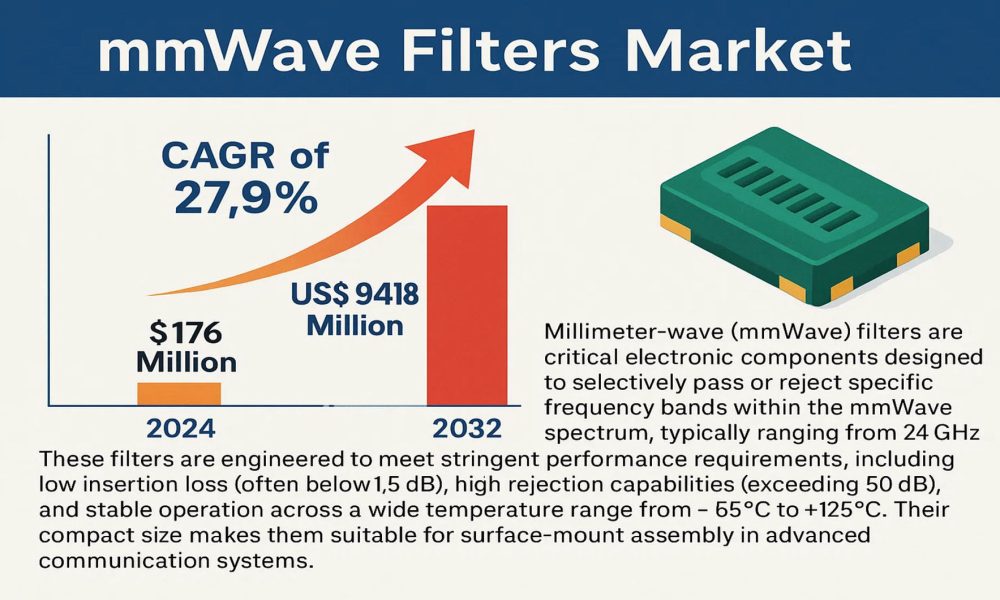
mmWave Filters Market was valued at 176 million in 2024 and is projected to reach US$ 948 million by 2032, at a CAGR of 27.9% during the forecast period.
Millimeter-wave (mmWave) filters are critical electronic components designed to selectively pass or reject specific frequency bands within the mmWave spectrum, typically ranging from 24 GHz to 100 GHz. These filters are engineered to meet stringent performance requirements, including low insertion loss (often below 1.5 dB), high rejection capabilities (exceeding 50 dB), and stable operation across a wide temperature range from -55°C to +125°C. Their compact size makes them suitable for surface-mount assembly in advanced communication systems.
The market is experiencing exponential growth, primarily driven by the global rollout of 5G infrastructure, particularly in the n257, n258, n260, and n261 frequency bands. The increasing demand for higher data rates and lower latency in mobile networks necessitates these sophisticated filters. Furthermore, adoption in military, VSAT, and satellite communication applications contributes significantly to market expansion. Key industry players, such as TDK Corporation and Knowles Precision Devices, are actively engaged in research and development to introduce more efficient and miniaturized filter solutions, further propelling the market forward.
Access Your Free Sample Report Now- https://semiconductorinsight.com/download-sample-report/?product_id=117542
MARKET DYNAMICS
MARKET DRIVERS
Accelerated Global 5G Network Deployments to Drive mmWave Filter Demand
The rapid expansion of 5G networks worldwide is significantly driving the mmWave filters market. With over 300 commercial 5G networks deployed globally and more than 1.5 billion 5G subscriptions active, the demand for high-frequency components continues to surge. mmWave spectrum bands between 24 GHz and 40 GHz are becoming increasingly critical for delivering the multi-gigabit speeds and ultra-low latency promised by 5G technology. These filters enable precise frequency selection and interference mitigation, allowing network operators to maximize spectral efficiency while maintaining signal integrity. The ongoing infrastructure investments exceeding $200 billion annually in 5G deployment create sustained demand for advanced filtering solutions that can handle the complex frequency arrangements and stringent performance requirements of modern wireless systems.
Growing Adoption of mmWave Technology in Consumer Electronics to Boost Market Growth
The integration of mmWave technology into consumer devices represents a major growth driver for the filter market. Smartphone manufacturers are increasingly incorporating mmWave capabilities into flagship devices, with over 45% of premium smartphones now supporting mmWave frequencies. This trend is driven by consumer demand for faster download speeds, improved streaming quality, and enhanced mobile gaming experiences. The miniaturization of mmWave filters has been crucial for their adoption in space-constrained mobile devices, where component size reduction of approximately 60% over the past three years has enabled seamless integration without compromising device aesthetics or functionality. The consumer electronics segment’s relentless pursuit of higher performance and connectivity features ensures continued filter innovation and market expansion.
Furthermore, the emergence of new applications such as augmented reality and virtual reality headsets that require high-bandwidth connectivity is creating additional demand for advanced filtering solutions. These applications typically require data rates exceeding 5 Gbps, which can only be achieved through mmWave technology and its associated filtering components.
➤ For instance, recent industry testing has demonstrated that mmWave-enabled devices can achieve peak download speeds of 4 Gbps in commercial networks, representing a 400% improvement over sub-6 GHz 5G implementations.
Moreover, the increasing number of regulatory approvals for mmWave spectrum usage across multiple countries provides additional momentum for market growth, as network operators and device manufacturers gain confidence in the long-term viability of mmWave technology.
Recent Developments in the mmWave Filters Market
- Advancements in 5G Integration
- Companies are increasingly developing mmWave filters specifically designed for 5G mobile networks, enabling faster data speeds and lower latency.
- Integration with 5G small cells and base stations has driven demand for compact, high-performance filters.
- Miniaturization and High-Frequency Performance
- Manufacturers are focusing on miniaturized mmWave filters that maintain high-frequency performance without signal loss.
- Development of multi-band and tunable filters allows devices to operate efficiently across multiple 5G frequency bands.
- New Product Launches
- Leading semiconductor and RF component companies have launched mmWave filters with enhanced power handling and low insertion loss.
- Examples include advanced surface acoustic wave (SAW) and bulk acoustic wave (BAW) mmWave filters for mobile and automotive applications.
- Automotive and Aerospace Applications
- Increasing adoption of mmWave technology in automotive radar and satellite communication systems is driving filter innovation.
- Filters are being developed for higher durability and environmental stability to suit harsh operational conditions.
- Strategic Collaborations and Partnerships
- Key players are forming partnerships to co-develop mmWave filter technologies, expand production capabilities, and enhance supply chain efficiency.
- Focus on IoT and Industrial Applications
- Beyond mobile networks, mmWave filters are finding applications in IoT devices, industrial automation, and wireless backhaul, creating new market growth opportunities.
MARKET OPPORTUNITIES
Emerging Applications in Automotive Radar and Satellite Communications to Create New Growth Avenues
The expansion of mmWave technology into automotive radar and satellite communication systems presents significant growth opportunities for filter manufacturers. The automotive industry’s increasing adoption of advanced driver assistance systems (ADAS) and autonomous driving technologies is driving demand for high-performance radar systems operating in the 77-81 GHz range. This segment is projected to grow at approximately 23% annually, creating substantial opportunities for specialized filter solutions that can meet the stringent automotive reliability requirements. Similarly, the satellite communication market is experiencing rapid growth with the deployment of low-earth orbit constellations requiring sophisticated mmWave filtering for inter-satellite links and ground station communications. These applications demand filters with exceptional performance characteristics, including very high rejection ratios exceeding 60 dB and excellent temperature stability, creating opportunities for premium filter solutions.
Additionally, the ongoing research and development in integrated filter technologies that combine multiple functions into single components is opening new market segments. The development of reconfigurable filters that can dynamically adjust their frequency response presents opportunities for more flexible and efficient system designs. These advanced filter technologies enable better spectrum utilization and adaptive interference management, particularly valuable in crowded radio frequency environments.
Furthermore, the increasing demand for high-capacity backhaul solutions for 5G networks creates additional opportunities for mmWave filter applications. The need for multi-gigabit wireless connections between base stations requires sophisticated filtering to manage interference and ensure reliable operation in licensed and unlicensed mmWave bands.
List of Key mmWave Filters Companies Profiled
- TDK Corporation (Japan)
- Knowles Precision Devices (Knowles Corporation) (U.S.)
- Mini-Circuits (U.S.)
- Johanson Technology, Inc. (U.S.)
- Kyocera AVX (U.S.)
- Wainwright Instruments GmbH (Germany)
- Anhui Yunta Electronic Technology Co Ltd (China)
- Pasternack (U.S.)
- Benchmark Lark Technology (U.S.)
- Mi-Wave (U.S.)
- TMY Technology Inc. (Taiwan)
Segment Analysis:
By Type
n258 Band Filters Lead the Market Due to Critical Role in High-Frequency 5G Deployments
The market is segmented based on type into:
- n258
- Subtypes: Bandpass, Bandstop, and others
- n257
- Subtypes: Bandpass, Bandstop, and others
- n260
- Subtypes: Bandpass, Bandstop, and others
- n261
- Subtypes: Bandpass, Bandstop, and others
By Application
5G mmWave Smart Phone Segment Dominates Owing to Massive Consumer Device Production
The market is segmented based on application into:
- 5G mmWave Smart Phone
- 5G mmWave Base Station
- Military, VSAT & Satellite
By Technology
Acoustic Wave Filters Hold Major Share Due to Superior Performance in Compact Form Factors
The market is segmented based on technology into:
- Acoustic Wave Filters
- Subtypes: Surface Acoustic Wave (SAW), Bulk Acoustic Wave (BAW)
- Electromagnetic Filters
- Subtypes: Waveguide, Cavity, Planar
- Integrated Passive Devices
By End User
Telecommunications Sector Commands Largest Market Share Driven by Global 5G Infrastructure Rollouts
The market is segmented based on end user into:
- Telecommunications
- Defense & Aerospace
- Satellite Communication
- Automotive
- Others
Other Topic- Global FPD Pellicle Market
CONTACT US:
City vista, 203A, Fountain Road, Ashoka Nagar, Kharadi, Pune, Maharashtra 411014
[+91 8087992013]




