
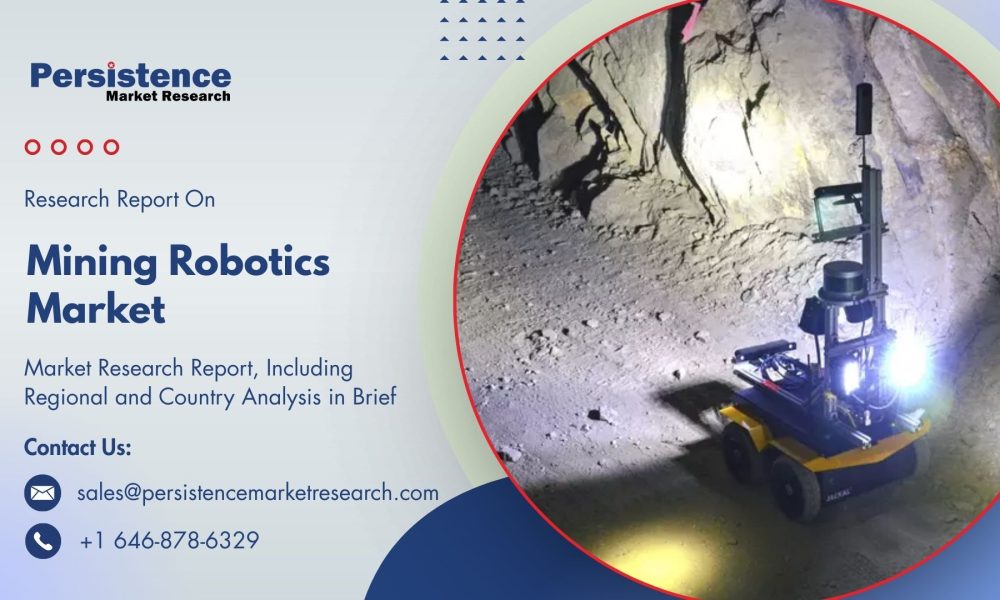
Market Overview
The mining robotics market is witnessing significant expansion as the industry embraces automation, digitalization, and advanced robotics to improve efficiency, safety, and sustainability in mining operations. According to the latest study by Persistence Market Research, the global mining robotics market is anticipated to rise from US$1.28 billion in 2023 to US$2.69 billion by the end of 2031. The market is forecasted to grow at an impressive CAGR of 9.8% between 2024 and 2031, reflecting the strong adoption of robotics across both surface and underground mining activities.
Mining robotics refers to the integration of autonomous or semi-autonomous robotic systems in critical mining processes such as drilling, blasting, hauling, material handling, and exploration. These systems not only enhance productivity but also reduce human exposure to hazardous working conditions. Increasing demand for raw materials and minerals, coupled with the pressing need to optimize mining operations, is fueling the adoption of robotics globally. Moreover, mining companies are under pressure to address labor shortages and environmental sustainability, making robotics an essential component of modern mining practices.
Get a Sample PDF Brochure of the Report (Use Corporate Email ID for a Quick Response): https://www.persistencemarketresearch.com/samples/34611
Key Market Drivers
One of the most influential drivers of the mining robotics market is the need to enhance worker safety in hazardous environments. Traditional mining often exposes workers to risks such as cave-ins, toxic gases, and machinery accidents. By replacing manual labor with robotics in high-risk areas, mining firms are significantly reducing accident rates and improving occupational safety.
Another major driver is the growing demand for efficiency and cost reduction. Mining robotics streamline processes such as drilling and ore transportation, improving accuracy and minimizing operational downtime. Autonomous haulage trucks, robotic drilling rigs, and automated loading systems are becoming standard in leading mining operations worldwide. These technologies optimize resource utilization while lowering labor costs and human error.
Technological advancements are further propelling market growth. The integration of artificial intelligence (AI), machine learning, Internet of Things (IoT), and remote sensing technologies has improved the capabilities of mining robots, making them more adaptive and intelligent. This enables predictive maintenance, real-time monitoring, and data-driven decision-making, enhancing operational output. Additionally, the rising global demand for rare earth minerals and critical resources used in electronics and renewable energy applications is pushing mining companies to adopt innovative solutions, where robotics plays a pivotal role.
Market Challenges
Despite the strong growth potential, the mining robotics market faces several challenges. High initial capital investments are a primary barrier, particularly for small and mid-sized mining companies. The costs associated with installing advanced robotic systems, training staff, and maintaining the infrastructure can be prohibitive.
Technical complexity is another challenge. Mining environments are unpredictable and harsh, requiring robots with high durability, adaptability, and precision. Developing and deploying robotics suitable for such conditions can be technologically demanding and resource-intensive.
Additionally, concerns regarding job displacement due to automation persist within the mining workforce. Although robotics improves safety and efficiency, it also reduces the need for manual labor, which has sparked resistance in certain regions. Regulatory frameworks around automation and mining practices also vary across countries, often slowing down large-scale adoption.
Market Opportunities
The mining robotics market presents ample opportunities, particularly with the global push toward sustainable and responsible mining practices. Robotics can help reduce energy consumption, minimize waste, and ensure precise extraction, aligning with sustainability goals and environmental regulations.
The increasing demand for deep-sea mining and exploration offers another growth avenue. Robotics and autonomous systems are expected to play a vital role in accessing difficult-to-reach mineral deposits under the ocean floor. Similarly, the growing interest in space mining could open entirely new frontiers for mining robotics in the long term.
Emerging economies such as India, Brazil, and South Africa are becoming important growth markets due to rapid industrialization, rising demand for minerals, and government initiatives to modernize mining practices. Collaboration between robotics technology providers and mining companies in these regions can create new revenue streams. Furthermore, continuous advancements in AI and autonomous navigation will enhance the scalability and affordability of robotics in mining.
Regional Insights
North America and Europe currently dominate the mining robotics market due to strong technological capabilities, robust investment in mining automation, and strict worker safety regulations. In North America, the United States and Canada are leading in the deployment of autonomous trucks, robotic drilling rigs, and real-time monitoring systems, making mining safer and more cost-efficient.
Europe’s mining industry is focusing heavily on sustainability and eco-friendly mining practices, with robotics playing a vital role in minimizing environmental impact. Countries such as Germany, Sweden, and Finland are actively investing in research and pilot projects involving mining automation.
The Asia-Pacific region is projected to be the fastest-growing market for mining robotics during the forecast period. With abundant mineral resources and rising industrial demand, countries like China, India, and Australia are rapidly adopting robotic systems to optimize mining output. Australia, in particular, has emerged as a leader in autonomous mining trucks and drilling operations, setting an example for the rest of the region.
Latin America and the Middle East & Africa are also emerging as promising regions. Increased exploration activities in Brazil, Chile, and South Africa, coupled with rising government support for modern mining practices, are likely to fuel demand for mining robotics in these areas.
For Customized Insights on Segments, Regions, or Competitors, Request Personalized Purchase Options @ https://www.persistencemarketresearch.com/request-customization/34611
Company Insights
The competitive landscape of the mining robotics market is characterized by the presence of global robotics manufacturers, mining technology providers, and automation specialists. These companies are focusing on product innovation, strategic partnerships, and expansion into emerging markets to gain a competitive edge.
✦ Caterpillar Inc.
✦ Komatsu Ltd.
✦ Sandvik AB
✦ Epiroc AB
✦ Hitachi Construction Machinery Co., Ltd.
✦ Liebherr Group
✦ Hexagon AB
✦ Rockwell Automation Inc.
✦ Autonomous Solutions Inc. (ASI)
✦ Exyn Technologies
Leading players are investing in the development of fully autonomous haulage systems, next-generation drilling rigs, and AI-driven monitoring solutions to enhance safety and efficiency. Strategic collaborations between robotics companies and mining operators are becoming increasingly common, enabling the customization of robotic solutions for specific mining environments. Additionally, companies are exploring advanced battery technologies and green energy solutions to power mining robotics, ensuring alignment with sustainability initiatives.
Future Outlook
The future of the mining robotics market looks promising, with automation set to become the backbone of global mining operations. Advancements in AI, machine vision, and sensor technologies will make mining robots more intelligent and adaptable, enabling fully autonomous mines in the near future. Digital twins and advanced simulation tools are expected to enhance planning and reduce risks, making robotic adoption more attractive for mining companies.
The increasing focus on sustainable mining, combined with the growing scarcity of skilled labor, will further accelerate the adoption of robotics. Moreover, as production costs decline due to technological innovations and economies of scale, smaller mining companies will also be able to leverage robotic solutions. The potential for robotics in deep-sea and space mining offers long-term opportunities that could reshape the industry’s future landscape.
Conclusion
In conclusion, the global mining robotics market is on a strong growth trajectory, expected to expand from US$1.28 billion in 2023 to US$2.69 billion by 2031, at a CAGR of 9.8% during 2024–2031. The market growth is driven by the demand for safer, more efficient, and sustainable mining practices, supported by rapid advancements in robotics, AI, and automation technologies. While high capital costs and technical challenges remain hurdles, the expanding applications of robotics in mining and rising opportunities in emerging regions and new frontiers such as deep-sea exploration present significant potential. With major players actively innovating and investing in the future, mining robotics is set to revolutionize the mining industry worldwide.
Explore the Latest Trending Research Reports:




