
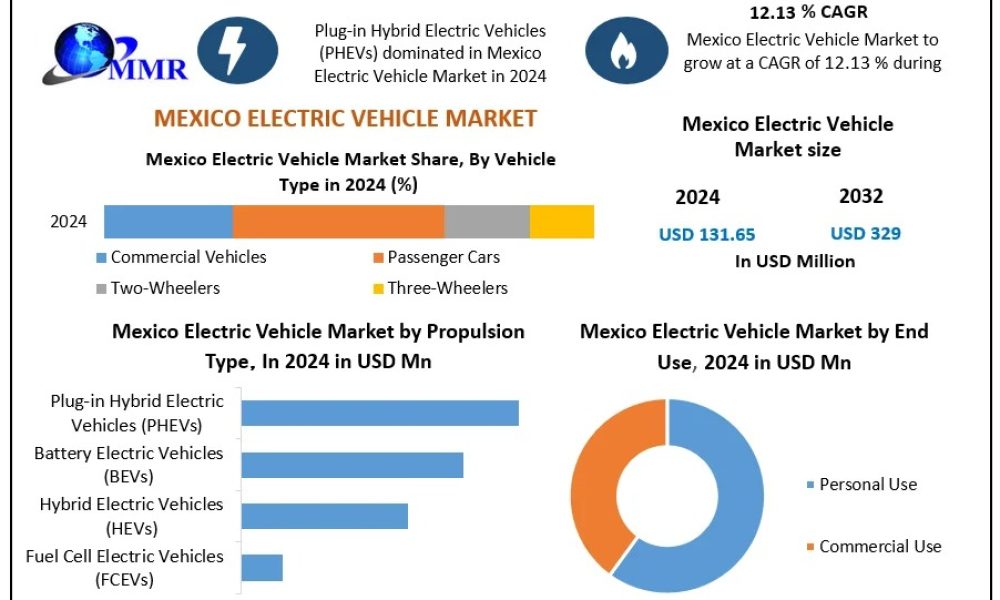
As per a recent study released by Maximize Market Research, titled, “Mexico Electric Vehicle Market,” The Mexico Electric Vehicle Market, size was valued at USD 131.65 Million in 2024, and the total Revenue is expected to grow at a CAGR of 12.13 % through 2025 to 2032, reaching nearly USD 329 Million.
Mexico Electric Vehicle Market Overview:
Mexico is increasingly positioning itself as a key player in the electric vehicle (EV) transition. Rising environmental concerns, urban pollution (especially in large cities like Mexico City), and growing fuel costs are pushing both consumers and government sectors toward cleaner mobility solutions. The Mexican government has introduced a variety of incentives and regulatory measures to support electric vehicle adoption, including tax exemptions, favorable electricity rates, and municipal incentives aimed at zero-emission vehicles. These efforts are complemented by public awareness campaigns and growing consumer preferences for sustainable transport options.
One major thrust in Mexico’s EV push has been the expansion of the needed ecosystem—especially charging infrastructure. Although public charging stations and connectors are still limited in many regions, investment is accelerating. Private and public investment is targeting highways and urban centers to build a more reliable network. Automakers are responding by introducing more EV and plug-in hybrid vehicle (PHEV) models, adapting offerings for local needs, and increasing availability through dealerships. Hybrid vehicles (HEVs), PHEVs, and battery electric vehicles (BEVs) are all part of the mix, with many consumers leaning toward dual-mode vehicles in places where charging infrastructure is not yet uniformly accessible.
Download a Free Sample Report Today :https://www.maximizemarketresearch.com/request-sample/64075/
Mexico Electric Vehicle Market Dynamics
A powerful driver for growth is government policy and environmental legislation. Mexico has committed to emissions reductions in its climate change law, aiming to cut greenhouse gas emissions significantly by 2050 and increase the share of renewable energy in power generation. These targets, alongside growing urban smog concerns and public health impacts, put pressure on both regulators and manufacturers to encourage EV adoption. Also, rising costs of conventional fuel and tighter fuel economy standards make electric or hybrid vehicles more economically attractive over time.
At the same time, there are challenges. Charging infrastructure remains unevenly distributed—major cities have better support, while rural and remote areas lag. Range anxiety, high upfront cost of EVs compared to traditional internal combustion engine (ICE) vehicles, and uncertainties around battery life and resale value are concerns among Mexican consumers. Tariffs and import rules also influence pricing significantly; local manufacturing or assembly is seen as a way to reduce costs, but requires investment and stable policy. Adoption by commercial fleets and public transport is helping to offset some of these challenges, given the operational cost savings of EVs in those use cases.
Mexico Electric Vehicle Market Outlook and Future Trends :
Looking ahead, growth in EVs in Mexico is likely to accelerate as infrastructure improves and vehicle options expand. Automakers are expected to bring more affordable EV models adapted to local conditions—smaller range BEVs, plug-in hybrids that can run on electricity or gasoline depending on route, and perhaps locally assembled models to reduce tariff and logistics costs. Charging station networks will likely see more public-private partnerships and involvement of energy companies, utilities, and even retail businesses. Fast charging along highways and in urban hubs will be essential to meet consumer expectations for reliability.
Another important trend is the evolution of policy and regulation to further support EV adoption. Tax credit programs, exemptions, or tariff reforms may be expanded. Mexico may intensify its incentives for domestic EV manufacturing, battery and powertrain component production to capture value in the supply chain. Also, there’s potential for deployment of EVs in commercial and fleet segments—delivery, shared mobility, buses—as these segments can lead in scale and help build confidence among general consumers. Sustainability, zero-emission zones in cities, integration with renewable energy sources, and improved energy grid capacity will also influence market growth.
Mexico Electric Vehicle Market Regional Insights:
In urban centers (e.g. Mexico City, Monterrey, Guadalajara), adoption is more advanced. These areas benefit from better charging infrastructure, higher incomes, greater environmental awareness, and more traffic congestion, which makes EVs more attractive for their lower operating costs, lack of tailpipe emissions, and regulatory incentives. Public transport policies in some cities are pushing to replace older ICE vehicles with electric or hybrid ones, enhancing visibility and acceptance of EVs among the public.
In contrast, less urbanized, rural, and remote regions remain behind, due to lower purchasing power, limited or no charging infrastructure, higher relative costs of EVs, and sometimes weaker regulatory enforcement. The success of EV expansion in Mexico will depend heavily on bridging this gap—through subsidies, localized charging, mobile or shared charging solutions, and possibly local assembly or import policies that reduce cost burdens. Also, infrastructural improvements (roads, grid electrification, renewable energy) in these regions will be important to ensure equitable adoption.
Mexico Electric Vehicle Market Segmentation
by Vehicle Type
Passenger Cars
Commercial Vehicles
Two-Wheelers
Three-Wheelers
by Propulsion Type
Battery Electric Vehicles (BEVs)
Plug-in Hybrid Electric Vehicles (PHEVs)
Hybrid Electric Vehicles (HEVs)
Fuel Cell Electric Vehicles (FCEVs)
by End Use
Personal Use
Commercial Use
Some of the current players in the Mexico Electric Vehicle Market are:
1. Tesla
2. ABB
3. Emerson Electric Co.
4. General Motors
5. Honeywell International Inc.
6. Schneider Electric
7. Rockwell Automation
8. JAC
9. Yokogawa Electric Corporation
10. Ford Motor Company
11. Daimler Truck North America LLC.
12. AUDI AG
13. Nissan Motor Co., Ltd.
14. Omron Corporation
15. Toyota Motor Sales, U.S.A., Inc.
About Maximize Market Research:
Maximize Market Research is one of the fastest-growing market research and business consulting firms serving clients globally. Our revenue impact and focused growth-driven research initiatives make us a proud partner of majority of the Fortune 500 companies. We have a diversified portfolio and serve a variety of industries such as IT & telecom, chemical, food & beverage, aerospace & defense, healthcare and others.
Contact Maximize Market Research:
MAXIMIZE MARKET RESEARCH PVT. LTD.
⮝ 3rd Floor, Navale IT park Phase 2,
Pune Banglore Highway, Narhe
Pune, Maharashtra 411041, India.
✆ +91 9607365656
🖂 [email protected]




