
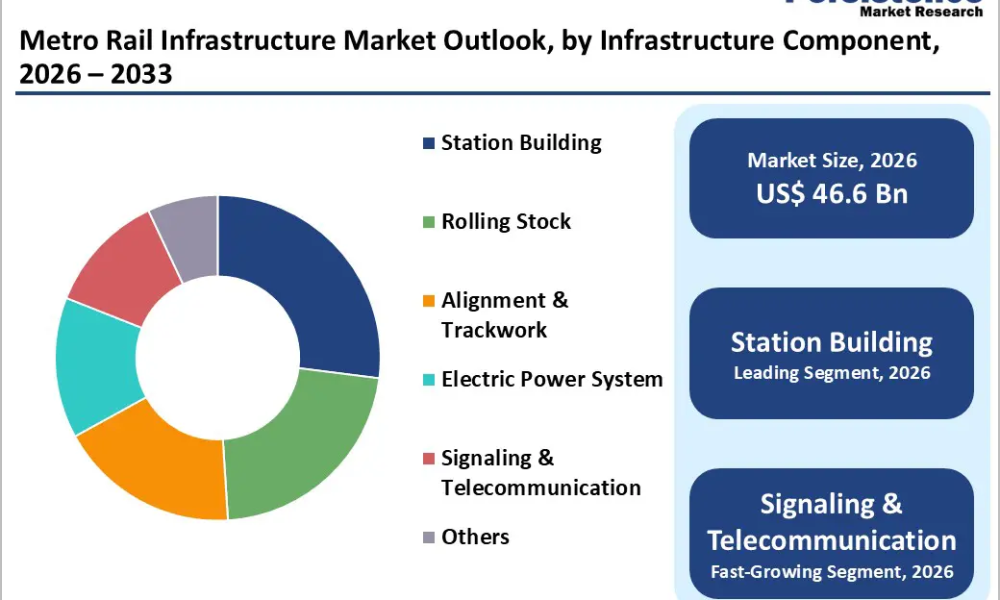
The global metro rail infrastructure market is entering a period of sustained expansion, driven by rising urban population density, increasing traffic congestion, and the urgent need for sustainable mass transit solutions. The market size is anticipated to reach US$ 46.6 billion in 2026 and is projected to grow significantly to US$ 78.3 billion by 2033, registering a compound annual growth rate (CAGR) of 7.7% during the forecast period from 2026 to 2033. This growth trajectory reflects strong government support, increasing public and private investments, and the growing prioritization of efficient urban mobility systems.
Metro rail infrastructure encompasses key components such as tracks, tunnels, signaling systems, stations, electrification systems, and rolling stock support infrastructure. Governments across emerging and developed economies are investing heavily in metro rail projects to reduce reliance on road transportation, lower carbon emissions, and improve urban mobility efficiency. Rapid urbanization in Asia-Pacific, Latin America, and the Middle East is accelerating the deployment of metro systems, while modernization initiatives in North America and Europe are further contributing to market growth.
Technological advancements, including automated train control systems, digital signaling, and integrated mobility platforms, are also playing a critical role in expanding the market. Additionally, growing environmental regulations aimed at reducing greenhouse gas emissions are encouraging cities to invest in metro rail systems as a sustainable alternative to conventional transport modes.
Get Your FREE Sample Report Instantly Click Now: https://www.persistencemarketresearch.com/samples/35120
Key Highlights from the Report
➤ The global metro rail infrastructure market is valued at US$ 46.6 billion in 2026 and is projected to reach US$ 78.3 billion by 2033, growing at a CAGR of 7.7% during the forecast period.
➤ Rapid urbanization and population growth in megacities are driving increased investments in metro rail systems to address congestion and mobility challenges.
➤ Government initiatives focused on sustainable transportation and carbon emission reduction are significantly boosting metro rail infrastructure development.
➤ Technological advancements such as automation, predictive maintenance, and digital signaling are enhancing operational efficiency and safety.
➤ Public-private partnerships and international funding support are accelerating large-scale metro infrastructure projects worldwide.
➤ Asia-Pacific remains the dominant regional market, while the Middle East and Africa are emerging as fast-growing regions due to major infrastructure investments.
Market Segmentation
By Structure Type
- Elevated
- Underground
- At-grade Level
By Infrastructure Component
- Station Building
- Rolling Stock
- Alignment & Trackwork
- Electric Power System
- Signaling & Telecommunication
- Others
By Region
- North America
- Europe
- East Asia
- South Asia and Oceania
- Latin America
- Middle East and Africa
Regional Insights
Asia-Pacific dominates the global metro rail infrastructure market, driven by large-scale metro expansion projects in countries such as China, India, Japan, and Southeast Asian nations. Rapid urbanization, growing population density, and government investments in smart city initiatives are key drivers in this region. China continues to lead globally in metro rail infrastructure development, supported by extensive government funding and infrastructure planning.
India is also emerging as a major market, with numerous metro rail projects under development and expansion in cities such as Delhi, Mumbai, Bangalore, and Pune. Government policies promoting sustainable transport and urban mobility modernization are accelerating metro infrastructure investments.
The Middle East and Africa represent the fastest-growing regional market due to increasing investments in modern transportation infrastructure. Cities such as Dubai, Riyadh, and Doha are expanding their metro networks to support economic diversification and urban growth. Europe and North America continue to invest in upgrading aging metro infrastructure, integrating digital technologies, and improving energy efficiency.
Customize This Report for Your Exact Requirements: https://www.persistencemarketresearch.com/request-customization/35120
Unique Features and Innovations in the Market
Modern metro rail infrastructure is characterized by advanced automation, digital integration, and sustainability-focused design. Artificial intelligence is being used to optimize train scheduling, predict maintenance requirements, and improve passenger flow management. IoT-enabled sensors are providing real-time monitoring of infrastructure components, reducing operational disruptions and enhancing system reliability.
5G connectivity is transforming metro operations by enabling faster communication between trains, control centers, and infrastructure systems. This enables real-time monitoring, improved safety protocols, and efficient incident management. Energy-efficient technologies, including regenerative braking systems and renewable energy integration, are further enhancing sustainability.
Smart station infrastructure featuring automated ticketing, facial recognition access systems, and integrated mobility platforms is improving passenger experience and operational efficiency. These innovations are transforming metro systems into intelligent transportation networks capable of meeting the evolving demands of modern urban environments.
Market Highlights
The metro rail infrastructure market is witnessing increased adoption due to its ability to provide efficient, reliable, and environmentally sustainable transportation. Rising traffic congestion and urban mobility challenges are compelling governments to invest in metro systems as long-term solutions. Metro rail systems offer high passenger capacity, reduced travel times, and lower environmental impact compared to road transport.
Environmental regulations and carbon neutrality targets are playing a critical role in driving metro rail infrastructure investments. Governments are prioritizing electrified rail systems to reduce emissions and improve air quality in urban areas. Additionally, metro infrastructure development supports economic growth by improving connectivity, enabling urban expansion, and enhancing productivity.
Cost optimization through advanced construction methods, including prefabrication and modular infrastructure development, is improving project feasibility. Public-private partnerships are also helping governments manage financial risks and accelerate infrastructure deployment.
Key Players and Competitive Landscape
The global metro rail infrastructure market is highly competitive, with major players focusing on technological innovation, strategic partnerships, and regional expansion to strengthen their market presence.
✦ Siemens Mobility is a global leader in metro signaling and electrification systems, focusing on digital rail technologies and automated metro solutions to enhance operational efficiency.
✦ Alstom is actively expanding its metro infrastructure portfolio through advanced signaling systems, electrification solutions, and sustainable rail technologies across global markets.
✦ Hitachi Rail is investing heavily in digital rail infrastructure, automated train systems, and smart mobility solutions to strengthen its competitive position.
✦ CRRC Corporation Limited plays a significant role in global metro infrastructure development, supported by large-scale domestic and international metro projects.
✦ Thales Group specializes in advanced signaling and communication systems, focusing on CBTC technology and intelligent metro infrastructure solutions.
✦ Hyundai Rotem is expanding its metro infrastructure capabilities by delivering advanced rail systems and participating in international metro development projects.
These companies are leveraging digital technologies, automation, and sustainability initiatives to strengthen their competitive advantage and capture emerging opportunities.
Recent Developments
- Several global metro projects have incorporated fully automated train systems using advanced CBTC signaling technology, significantly improving operational efficiency and safety.
- Governments in emerging economies have announced large-scale metro expansion programs, supported by international funding and infrastructure investment partnerships.
Ready to Dive Deep? Buy Full Report Today: https://www.persistencemarketresearch.com/checkout/35120
Future Opportunities and Growth Prospects
The metro rail infrastructure market presents significant growth opportunities driven by urbanization, sustainability initiatives, and technological advancements. The integration of artificial intelligence, digital twin technology, and predictive maintenance systems will enhance operational efficiency and reduce lifecycle costs.
The expansion of smart cities and integrated mobility ecosystems will further accelerate metro infrastructure development. Governments worldwide are expected to increase investments in electrified transport infrastructure to meet climate goals and improve urban mobility.
Emerging markets in Asia-Pacific, the Middle East, and Africa offer substantial growth potential due to increasing infrastructure investments and urban development initiatives. Technological innovation, regulatory support, and sustainability goals will continue to shape the future of the metro rail infrastructure market, positioning it as a cornerstone of modern urban transportation systems.




