
MEMS Automobile Sensors Market: Trends, Innovations & Business Strategies 2025-2032
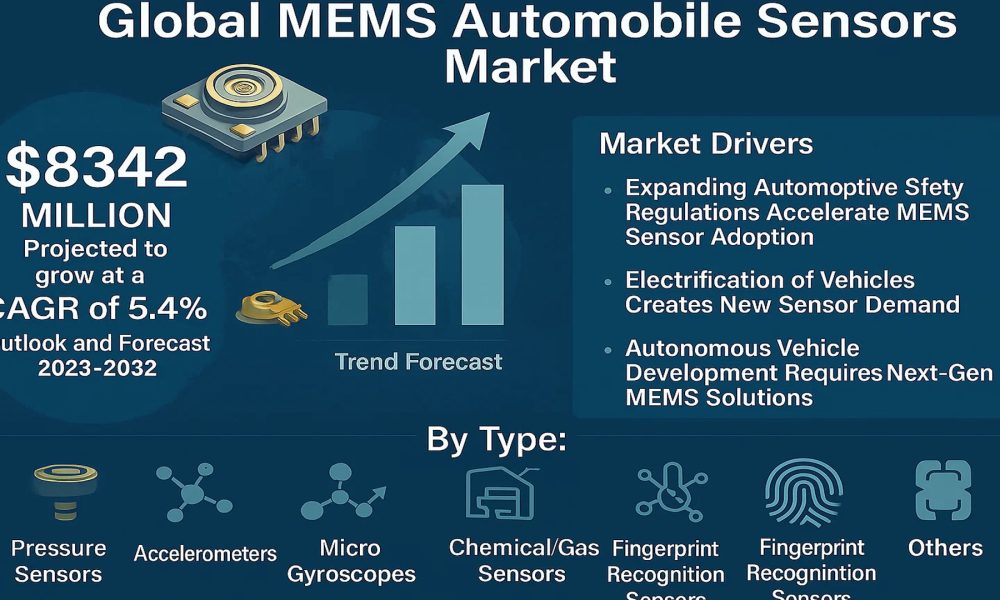
Global MEMS Automobile Sensors Market was valued at 5818 million in 2024 and is projected to reach US$ 8342 million by 2032, at a CAGR of 5.4% during the forecast period.
MEMS (Micro-Electro-Mechanical Systems) automobile sensors are miniature devices that measure physical parameters in vehicles and convert them into electrical signals. These sensors play a crucial role in automotive safety systems, engine management, navigation, and diagnostics. The key product segments include pressure sensors, accelerometers, micro gyroscopes, chemical sensors, and gas sensors, which are extensively used in applications like electronic parking brake systems and anti-lock braking systems (ABS).
The market growth is driven by increasing vehicle production, particularly in Asia where 56% of global automobiles are manufactured. While China dominates production with 32% market share, Japan leads in exports with over 3.5 million vehicles shipped in 2022. The industry is witnessing technological advancements in sensor accuracy and miniaturization, with key players like Bosch, Continental, and Denso investing heavily in R&D. However, market expansion faces challenges from fluctuating automotive production volumes, which declined from 97.3 million units in 2017 to 81.6 million in 2022.
Get Full Report with trend analysis, growth forecasts, and Future strategies : https://semiconductorinsight.com/report/mems-automobile-sensors-market/
Segment Analysis:
By Type
Pressure Sensors Lead Due to Widespread Adoption in Vehicle Safety and Engine Systems
The MEMS Automobile Sensors market is segmented based on type into:
- Pressure Sensors
- Accelerometers
- Micro Gyroscopes
- Chemical/Gas Sensors
- Fingerprint Recognition Sensors
- Others
By Application
Safety Systems Segment Dominates with High Demand for Advanced Driver Assistance
The market is segmented by application into:
- Safety Systems
- Subtypes: Airbag controls, Collision avoidance systems
- Engine Systems
- Navigation/Telematics
- Vehicle Diagnostics
- Electronic Parking Brake Systems
By Vehicle Type
Passenger Vehicles Account for Majority Demand Due to Higher Production Volumes
The market is segmented by vehicle type into:
- Passenger Vehicles
- Commercial Vehicles
- Electric Vehicles
- Two-wheelers
By Technology
Embedded MEMS Technology Preferred for Compact Size and Reliability
The market is segmented by technology into:
- Embedded MEMS
- Discrete MEMS
- Hybrid MEMS
MARKET DYNAMICS
MARKET DRIVERS
Expanding Automotive Safety Regulations Accelerate MEMS Sensor Adoption
Stringent automotive safety mandates worldwide are significantly driving the MEMS sensor market, with regulatory bodies pushing for advanced driver assistance systems (ADAS) in all new vehicles. Over 40 countries have now adopted UN Regulation 79 standards for electronic stability control, requiring MEMS accelerometers and gyroscopes in vehicles to prevent loss-of-control accidents. This regulatory push complements the growing consumer demand for safer vehicles – a trend accelerated by recent studies showing MEMS-based safety systems reduce fatal crashes by approximately 30%. The European Union’s General Safety Regulation, mandating intelligent speed assistance and lane-keeping systems by 2024, exemplifies this global shift towards sensor-enabled vehicle safety.
Electrification of Vehicles Creates New Sensor Demand
The rapid transition toward electric vehicles (EVs) is generating unprecedented demand for specialized MEMS sensors that monitor battery systems, thermal management, and power electronics. Unlike conventional vehicles, EVs require 20-30% more sensors to manage high-voltage systems, with pressure and temperature sensors being critical for battery safety. The global EV market is projected to grow at 19% CAGR through 2030, directly fueling MEMS sensor expansion. Recent developments include high-accuracy MEMS pressure sensors capable of detecting minute changes in battery pack internal pressure – a critical safety feature preventing thermal runaway incidents that affect approximately 1 in 12 million EV battery units annually.
Autonomous Vehicle Development Requires Next-Gen MEMS Solutions
Progress in autonomous driving technology continues to push MEMS innovation, with Level 3+ autonomous systems demanding sensor accuracy improvements of up to 0.1° in angular measurement. Major automakers now integrate multi-axis MEMS inertial measurement units (IMUs) that combine accelerometers, gyroscopes, and magnetometers to enable precise positioning when GPS signals are unavailable. The autonomous vehicle sensor market is expected to require over 200 million MEMS units annually by 2027, creating a $1.2 billion revenue opportunity. Recent breakthroughs include MEMS-based lidar systems achieving 0.01° resolution at sub-100 meter ranges, addressing one of the most challenging perception gaps in self-driving technology.
MARKET OPPORTUNITIES
Integration with Vehicle-to-Everything (V2X) Systems Opens New Avenues
The emerging V2X ecosystem presents a $420 million opportunity for MEMS sensor providers by 2028, as intelligent transportation systems require precise vehicle motion data for collision avoidance and traffic optimization. MEMS-based positioning systems with sub-meter accuracy are becoming essential for V2X communication, complementing GPS with real-time inertial data during signal outages. Recent pilot programs in smart cities demonstrate that MEMS-enabled V2X can reduce intersection accidents by up to 45%, creating strong municipal demand. This application benefits from sensor fusion techniques combining MEMS data with ultra-wideband and cellular signals for centimeter-level positioning accuracy.
Emerging Markets Offer Untapped Growth Potential
Developing economies represent the next frontier for automotive MEMS adoption, with penetration rates currently 40% below North American and European levels. Countries like India and Brazil are implementing their own vehicle safety regulations, potentially adding 18-25 million MEMS sensor units annually to the global market. Localization incentives in these regions are prompting MEMS suppliers to establish regional manufacturing, with production costs 20-30% lower than in traditional manufacturing hubs. The Indian automotive MEMS market alone is projected to grow at 11.7% CAGR through 2030, driven by domestic content requirements and rising middle-class vehicle ownership.
Miniaturization Enables New Application Scenarios
Ongoing MEMS miniaturization is unlocking applications previously constrained by space limitations, particularly in electric two-wheelers and micro-mobility solutions. Latest-generation MEMS pressure sensors now fit within 2mm x 2mm packages while maintaining automotive-grade reliability, enabling integration into compact brake and suspension systems. The micro-mobility sector is expected to consume over 75 million MEMS sensors annually by 2026, creating a $280 million market opportunity. Recent innovations include MEMS-based tire pressure monitoring systems for e-bikes that weigh less than 5 grams while providing 0.1 psi accuracy – a critical feature preventing the 27% of e-bike accidents related to tire failures.
MEMS AUTOMOBILE SENSORS MARKET TRENDS
Rising Demand for Safety and Automation to Drive MEMS Sensor Adoption
The MEMS automobile sensors market is experiencing robust growth, driven by increasing demand for advanced safety features and vehicle automation. With over 90% of modern vehicles now incorporating MEMS sensors in critical systems like anti-lock braking (ABS) and electronic stability control (ESC), these components have become indispensable in automotive manufacturing. The market’s projected growth to $8.34 billion by 2032 reflects this trend. Major automotive hubs in Asia, Europe, and North America—which collectively account for 92% of global vehicle production—are driving substantial demand for pressure sensors, accelerometers, and micro gyroscopes. While traditional combustion engine vehicles dominated early adoption, the shift toward electric vehicles is creating new opportunities as these require sophisticated sensor arrays for battery management and thermal regulation.
Other Trends
Electrification and Smart Mobility Solutions
The automotive industry’s electrification wave is reshaping MEMS sensor requirements, with electric vehicles requiring 30-40% more sensors than conventional vehicles for functions like battery monitoring and energy management. Meanwhile, smart city initiatives are accelerating demand for vehicle-to-everything (V2X) communication systems, which rely heavily on MEMS-based position and environmental sensors. Original Equipment Manufacturers (OEMs) are increasingly collaborating with sensor developers to create customized solutions—Bosch and Continental recently introduced MEMS-based systems that combine airbag deployment sensors with predictive crash algorithms, demonstrating how integration advances are expanding application potential.
Miniaturization and Multi-Functionality
Sensor miniaturization has emerged as a key competitive differentiator, with leading manufacturers developing chips that combine multiple sensing functions in footprints <50% smaller than previous generations. This trend is particularly critical for autonomous vehicles, where space constraints and the need for redundancy drive demand for compact, multi-purpose sensors. Recent product launches showcase this evolution—Murata’s latest 3-axis accelerometer measures just 2x2mm while delivering improved shock resistance and accuracy up to ±1.5%. However, these technological leaps present challenges in thermal management and signal integrity that will require ongoing R&D investment to address.
Recent Developments:
- Expansion in Autonomous Driving Technology
- Advancement: MEMS sensors, especially LIDAR and accelerometers, are being integrated into autonomous vehicle systems. These sensors play a crucial role in object detection, environmental mapping, and collision avoidance.
- Impact: As the demand for autonomous vehicles increases, MEMS sensors are becoming essential for safety and performance, driving the growth of the market.
- Integration of MEMS Sensors in Electric Vehicles (EVs)
- Advancement: MEMS sensors are being increasingly used in electric vehicles for battery management, motor control, and thermal monitoring. These sensors help enhance efficiency and improve the driving experience.
- Impact: With the rise of electric vehicles globally, MEMS sensors are becoming critical for monitoring various systems in real time, fostering significant growth in the automotive sector.
- Miniaturization and Increased Precision
- Advancement: MEMS technology is becoming more advanced with improved miniaturization and precision in sensors. This results in smaller, more accurate sensors that can be seamlessly integrated into vehicle systems.
- Impact: The smaller size and higher precision enable better functionality in tight spaces, especially for safety systems, contributing to their widespread adoption in both passenger and commercial vehicles.
- Development of New Sensor Types for Advanced Driver Assistance Systems (ADAS)
- Advancement: New MEMS sensors are being developed specifically for ADAS applications, including sensors for lane-keeping assistance, parking sensors, and adaptive cruise control.
- Impact: The growing adoption of ADAS features in mainstream vehicles is pushing the demand for specialized MEMS sensors, providing significant opportunities for market players.
- Wireless MEMS Sensors for Real-Time Monitoring
- Advancement: The integration of wireless MEMS sensors for real-time diagnostics and performance monitoring in vehicles is becoming more common.
- Impact: These sensors provide continuous monitoring of tire pressure, engine performance, and other vehicle parameters, enhancing vehicle safety and performance. This is gaining traction in connected cars and telematics systems.
Learn more about Competitive Analysis, and Forecast of MEMS Automobile Sensors Market: https://semiconductorinsight.com/download-sample-report/?product_id=107432
COMPETITIVE LANDSCAPE
Key Industry Players
Automotive MEMS Sensor Suppliers Accelerate Innovation to Meet Evolving Industry Demands
The global MEMS automobile sensors market features a dynamic competitive landscape where Bosch, Continental AG, and Denso Corporation currently dominate with a combined market share exceeding 45% as of 2024. These industry leaders maintain their positions through continuous R&D investment and strategic collaborations with automotive OEMs. Bosch’s recent development of next-generation pressure sensors for EV battery systems exemplifies this trend, reinforcing its technological leadership.
While the top three players command significant market presence, mid-tier competitors like Sensata Technologies and Infineon Technologies are carving out specialized niches. Sensata has gained particular traction in the North American market with its advanced tire pressure monitoring systems (TPMS), while Infineon’s focus on MEMS-based inertial sensors for advanced driver-assistance systems (ADAS) has yielded strong growth in premium vehicle segments.
Emerging players face substantial barriers to entry due to the high capital requirements for MEMS fabrication facilities and the strict automotive qualification processes. However, companies such as InvenSense (a TDK Group company) and Murata Manufacturing are making inroads through innovative packaging technologies that reduce costs while meeting rigorous automotive reliability standards.
The competitive intensity is further heightened by regional dynamics. Asian suppliers including Toshiba Electronics and ROHM Semiconductor are expanding aggressively in their domestic markets, leveraging local automotive production clusters. This geographical diversification creates both opportunities for market expansion and challenges for global pricing strategies.
List of Key MEMS Automotive Sensor Companies Profiled
- Robert Bosch GmbH (Germany)
- Continental AG (Germany)
- Denso Corporation (Japan)
- Sensata Technologies (U.S.)
- Infineon Technologies AG (Germany)
- Delphi Technologies (U.K.)
- NXP Semiconductors (Netherlands)
- TDK Corporation (InvenSense) (Japan)
- Murata Manufacturing Co., Ltd. (Japan)
- Toshiba Electronic Devices & Storage Corporation (Japan)
- STMicroelectronics (Switzerland)
- ROHM Semiconductor (Japan)
- Analog Devices, Inc. (U.S.)
- TE Connectivity (Switzerland)
- Amphenol Corporation (U.S.)
Browse Related Reports : 3nm Chip Market
CONTACT US:
City vista, 203A, Fountain Road, Ashoka Nagar, Kharadi, Pune, Maharashtra 411014
+91 8087992013
[email protected]




