
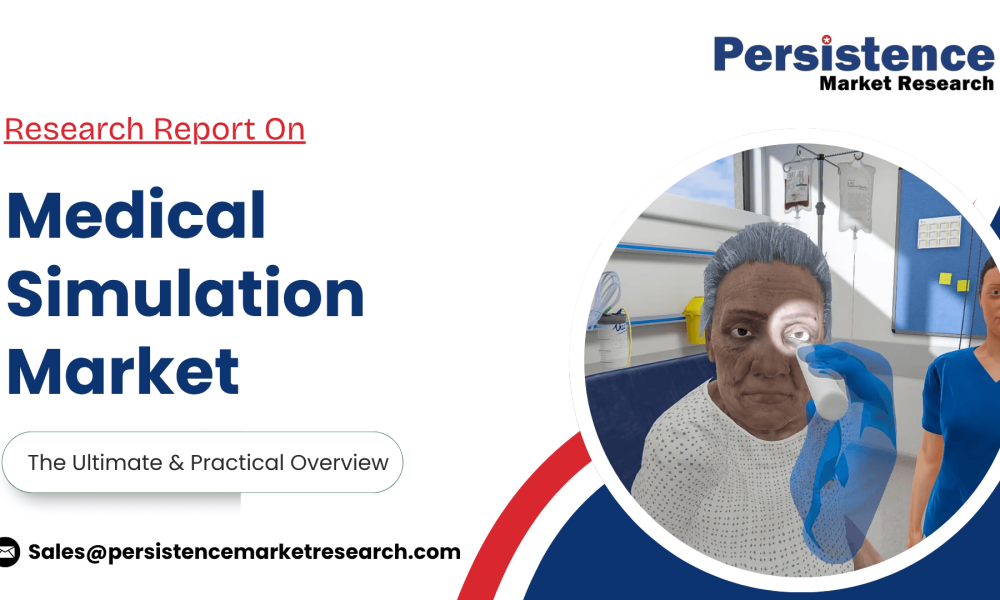
The global medical simulation market is on a robust growth trajectory, projected to expand from an estimated US$2.7 billion in 2025 to US$5.6 billion by 2032, at a CAGR of 11.0% during the forecast period. The sector is being propelled by increasing demand for patient safety, rising adoption of simulation-based education, and continuous technological advancements across healthcare systems worldwide.
Market Size and Trends Analysis
Medical simulation has evolved into a cornerstone of modern healthcare training. The market has witnessed an accelerated compound annual growth rate of 9.1% from 2019 to 2024, with projections indicating stronger performance going forward. In 2025, anatomical models are expected to hold a 36.5% market share, underscoring the demand for tactile, realistic learning experiences. Procedure rehearsal technologies dominate the technology segment with a 42.6% share, empowering practitioners to prepare for complex surgeries with patient-specific simulations. Among end users, academic institutions account for 32.9%, reflecting the emphasis on embedding simulation early in medical education.
Get a Sample Copy of Research Report (Use Corporate Mail id for Quick Response): https://www.persistencemarketresearch.com/samples/32070
Key Industry Highlights
Key developments shaping the landscape include the University of South Florida launching the world’s first undergraduate concentration in Health Care Simulation Operations, aimed at elevating patient safety through simulation. Regionally, North America leads with 49.7% share in 2025 due to institutional investment and advanced training infrastructure, while Europe emerges as the fastest-growing region, supported by specialized simulation centers and academic partnerships.
Market Dynamics
Driver – Enhanced Patient Safety and Competency Development
A major market catalyst is the growing emphasis on reducing clinical errors and enhancing patient outcomes through simulation-based learning. The ability to practice invasive procedures, emergency responses, and diagnostics without involving real patients has proven indispensable. Companies like Osso VR offer immersive surgical simulators, enabling real-time feedback, risk assessment, and performance analytics in specialties such as orthopedics and neurosurgery.
Driver – Interdisciplinary Team Training
Medical simulation is also enhancing interdisciplinary collaboration, helping teams coordinate effectively under pressure. Simulation labs like those at Munson Healthcare allow multidisciplinary teams to rehearse trauma and cardiac emergencies together, significantly improving communication and crisis management.
Restraint – Limitations in Simulated Realism
Despite advancements, a core limitation remains the lack of complete realism in simulated environments. High-fidelity mannequins and VR platforms may fall short in replicating complex physiological and emotional responses, limiting the translatability of certain skills to real-life scenarios. Moreover, simulation bias, where learners behave differently in controlled settings compared to actual clinical environments, continues to challenge outcome effectiveness.
Opportunity – Integration of Haptic Feedback and Emerging Modalities
The rise of haptic feedback technology represents a promising opportunity, providing realistic tactile responses during procedures. Companies such as VirtaMed and Touch Surgery have integrated force feedback into simulators, enabling learners to experience the texture and resistance of tissues, refining their procedural accuracy. Additionally, integrating AI, AR, and VR opens new frontiers in personalized and immersive learning. Solutions like Intelligent Ultrasound’s Medical School Simulator leverage AI analytics to enhance ultrasound training.
Category-wise Analysis
Product Type Insights
Anatomical models continue to dominate due to their high utility in anatomy and procedural training. These models replicate vascular structures, organ systems, and pathological conditions, fostering repeated practice and skill retention. Web-based simulation is gaining ground, providing scalable, remote access to clinical scenarios. Platforms like Oxford Medical Simulation have broadened access to virtual patients during and after the pandemic, accelerating digital adoption across institutions.
Technology Insights
Procedure rehearsal technologies lead with over 42% market share, offering preoperative planning and training through real-time simulation of patient-specific cases. Virtual patient simulation is becoming mainstream, aiding the development of clinical decision-making. The technology’s ability to simulate rare cases makes it indispensable for comprehensive education.
End-user Insights
Academic institutions remain primary adopters, with over 32% share, embedding simulation into medical and nursing curricula. For example, St. John’s University in New York integrates full-spectrum simulation into its training programs. Hospitals utilize simulation to maintain staff readiness for high-risk procedures, with Methodist Healthcare in San Antonio investing heavily in simulation infrastructure.
Request for Customization of the Research Report: https://www.persistencemarketresearch.com/request-customization/32070
Regional Insights
North America
The region maintains a leadership position in the medical simulation market. Investments in high-fidelity training centers are prevalent. Munson Healthcare expanded its simulation capabilities across multiple hospitals, while St. John’s University unveiled a new center featuring lifelike mannequins and VR tools.
Europe
Europe is experiencing accelerated growth, driven by strong governmental and institutional support. Notable centers such as Besta NeuroSim Center in Italy and CLESS in France are innovating in neurosurgical and immersive education. The 2024 SESAM conference in Prague reflected a growing European commitment to simulation training, with record-breaking participation from healthcare educators and professionals.
Asia Pacific
Asia Pacific’s growth is led by China and Japan, with increasing governmental support and local innovation. Companies like MedVisionSim are deploying portable, affordable simulators across more than 20 countries. These tools are addressing the demand for cost-effective training in both urban and rural settings.
Competitive Landscape
The competitive ecosystem is marked by both technological innovation and pricing strategies. Leading players such as CAE Inc., Laerdal Medical, Gaumard Scientific, and Kyoto Kagaku dominate with expansive portfolios covering VR platforms, high-fidelity mannequins, and hybrid solutions. Simulab Corporation, 3D Systems, and Intelligent Ultrasound are investing in AI and haptics to differentiate offerings. Companies like MedVisionSim are targeting emerging markets with budget-friendly, scalable solutions, promoting broader adoption.
Key Players
The global medical simulation market is served by prominent and niche players alike, including:
CAE Healthcare, Inc.
Simulab Corporation
3D Systems, Inc.
Cardionics
Simulaids
Mentice
Laerdal Medical
Kyoto Kagaku Co., Ltd
Gaumard Scientific
Intelligent Ultrasound (MedaPhor Ltd.)
Limbs & Things LTD
These companies are consistently enhancing product functionality, integrating AI, haptics, and data analytics to meet the evolving needs of medical educators and clinicians.
Market Segmentation
The medical simulation market can be segmented across the following parameters:
By Product Type: Anatomical Models, Web-Based Simulations, VR Simulators, Haptic Devices, Simulated Monitors
By Technology: Procedure Rehearsal, Virtual Patient Simulation, Task Trainers, Integrated Simulation Systems
By End-user: Academic Institutions, Hospitals, Military Organizations, Research Centers
By Region: North America, Europe, Asia Pacific, Latin America, Middle East & Africa
This segmentation highlights the growing influence of technology-based simulation systems and academic adoption as primary growth contributors.
Recent Developments
October 2025 witnessed several notable industry advancements. MediSim VR partnered with Himalayan Institute of Medical Sciences to launch Uttarakhand’s first AI and VR-based Center of Excellence, focusing on immersive healthcare education. Gulf Medical University inaugurated the Thumbay Institute of Clinical Simulation at its Ajman campus, providing multi-specialty simulation training facilities for students and professionals.
These initiatives reflect a global movement toward localized, next-generation simulation hubs capable of delivering high-fidelity training across medical disciplines.
Future Outlook
The medical simulation market is poised for transformational growth through 2025 to 2032, as it transitions from supportive training tools to core components of medical education and patient safety strategies. The integration of AI, machine learning, and advanced sensory feedback will enhance realism and training efficiency. Regulatory bodies are increasingly mandating simulation-based competency assessments, particularly in surgery and critical care, further embedding simulation into healthcare systems.
As technology costs reduce and accessibility improves, simulation is expected to play a critical role in addressing skill shortages, standardizing clinical education, and improving outcomes across global healthcare ecosystems. By 2032, simulation will no longer be a niche adjunct—it will be a central pillar in preparing healthcare professionals for the complexities of real-world care.




