
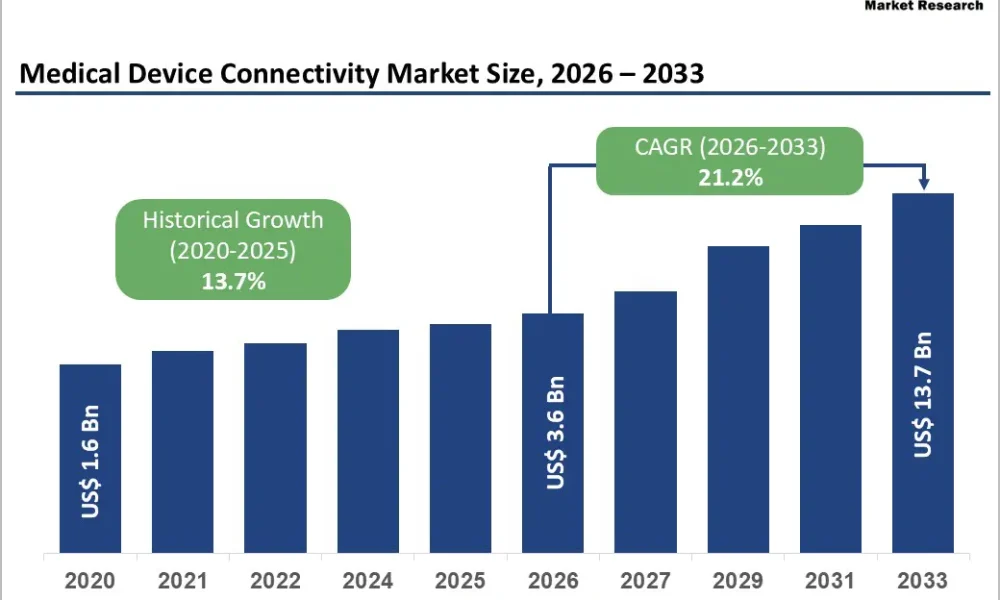
The global medical device connectivity market is poised for significant expansion over the next decade, driven by rising demand for connected healthcare solutions, the growing prevalence of chronic diseases, and accelerating adoption of digital health technologies. According to recent industry estimates, the market—valued at approximately US$ 3.6 billion in 2026—is projected to reach US$ 13.7 billion by 2033, representing a robust compound annual growth rate (CAGR) of 21.2% between 2026 and 2033. Medical device connectivity refers to the technologies and services that enable medical equipment to connect and communicate with hospital information systems, electronic health records (EHRs), patient monitoring platforms, and other digital healthcare infrastructure. These solutions are increasingly recognized as essential components in modern healthcare delivery, facilitating improved patient outcomes, streamlined clinical workflows, and real-time data access.
Download Your Free Sample & Explore Key Insights: https://www.persistencemarketresearch.com/samples/31703
Market Drivers and Growth Dynamics
The strong growth forecast for the medical device connectivity market can be attributed to several converging trends reshaping healthcare globally.
Rising Demand for Interoperable Systems
Healthcare providers, especially in developed regions such as North America and Europe, are under mounting pressure to integrate disparate clinical systems. Connected medical devices help bridge this interoperability gap by feeding vital patient data directly into centralized platforms, reducing manual entry errors, and enabling real-time clinical decision-making.
Increasing Chronic Disease Burden
The global increase in chronic conditions such as diabetes, cardiovascular disease, and respiratory disorders has heightened the need for continuous monitoring solutions. Connected devices that transmit patient data allow clinicians to track vital signs and other health indicators remotely, which is particularly impactful in home healthcare settings and for long-term disease management.
Expansion of Telehealth and Remote Care
The COVID-19 pandemic accelerated digital transformation within healthcare, with telehealth adoption surging worldwide. As remote care models continue to evolve, medical device connectivity plays a pivotal role in enabling effective, secure communication between patients and care teams. Home healthcare devices—once optional—are now increasingly expected to support robust connectivity features.
Get Custom Insights Designed for Your Businecss: https://www.persistencemarketresearch.com/request-customization/31703
Segment Insights: Technology, Components, and Services
The market’s robust forecast is also shaped by innovations and investments across key segments: components, technologies, applications, and services.
Component Segmentation
Within market components, the report highlights three primary categories:
- Solutions: These include software and hardware platforms that connect devices to hospital networks and analytics systems.
- Interface Devices: Acting as bridges between medical equipment and connectivity platforms, these play a crucial role in ensuring seamless data exchange.
- Medical Device Connectivity Hubs: Centralized systems that aggregate data from multiple devices and standardize data formats.
- Medical Telemetry Solutions: Leveraging wireless technologies to enable continuous patient monitoring.
The services component includes consultation, integration and deployment, as well as ongoing support and maintenance—critical elements in ensuring sustained performance and compliance.
Technology Trends: Wired and Wireless Connectivity
Market growth is also being driven by advancements in both wired and wireless connectivity technologies. Wired connectivity provides reliable, high-speed data transmission, which remains essential in intensive care units (ICUs) and surgical environments. On the other hand, wireless connectivity—including Bluetooth, Wi-Fi, and cellular technologies—is gaining rapid traction, especially for wearable devices and remote patient monitoring. Industry analysts point out that wireless solutions not only reduce infrastructure costs but also support mobility and flexible healthcare delivery models, making them highly attractive for future deployments.
Application Areas: Broadening Scope and Impact
The medical device connectivity market serves a wide range of clinical applications, each with unique demands and growth dynamics.
Vital Sign Monitoring Systems
Vital sign monitoring systems represent one of the largest application segments, given their central role in continuous patient assessment across hospital, emergency, and home care settings. Connectivity in these systems enables clinicians to aggregate and interpret key metrics such as heart rate, respiration, blood pressure, and oxygen saturation in real time.
Cardiology and ICU Devices
Cardiology devices, including ECG machines, pacemakers, and implantable devices, benefit significantly from connectivity features. Real-time transmission of cardiac data enhances risk management and allows for more timely interventions. Similarly, ICU systems depend on integrated connectivity to support decision-making for critically ill patients.
Oncology and Home Healthcare Devices
Although the oncology segment currently represents a smaller portion of the connectivity market, increased focus on personalized cancer care and remote monitoring is expected to boost adoption. Connected devices enable better tracking of treatment responses and side effects, while home healthcare devices empower patients to manage chronic conditions with clinician oversight from afar.
End-User Perspectives: Hospitals to Home Healthcare
The utility of medical device connectivity extends across a broad spectrum of end users.
Hospitals and Clinics
Hospitals remain the largest adopters of connectivity solutions, driven by the need to consolidate clinical data and enhance operational efficiency. Connected systems allow large institutions to monitor hundreds of patients simultaneously, reduce manual workload, and support advanced analytics for quality improvement. Clinics and ambulatory centers are also increasing their use of connected devices, albeit at a slower pace. These facilities benefit from improved diagnostic workflows and better integration with centralized health record systems.
Diagnostic Centers
Diagnostic centers—particularly radiology and pathology labs—are adopting connectivity platforms to streamline reporting and reduce turnaround times. These centers increasingly rely on connected imaging and laboratory devices to optimize throughput and improve accuracy.
Growth in Home Healthcare
One of the most dynamic areas of market expansion is home healthcare settings. With aging populations worldwide and the rising prevalence of chronic diseases, patients are increasingly managing care outside traditional clinical environments. Connected devices that transmit data directly to care teams ensure better continuity of care and can reduce hospital readmissions.
Checkout Now & Download Complete Market Report: https://www.persistencemarketresearch.com/checkout/31703
Geographical Insights: Regional Market Trends
The medical device connectivity market is expanding globally, with distinct trends across regions.
North America
North America is expected to remain the dominant regional market, led by extensive healthcare infrastructure, strong technology adoption rates, and favorable regulatory frameworks. The United States, in particular, continues to invest heavily in digital health initiatives, influencing growth across the connectivity ecosystem.
Europe
Europe follows closely, with strong uptake in countries such as Germany, the United Kingdom, and France. Investments in healthcare IT and interoperability frameworks by both public and private stakeholders are driving market expansion.
East Asia and South Asia
East Asia—especially China and Japan—is witnessing growing demand for connected medical devices, fueled by increasing healthcare digitization and government initiatives to modernize health systems. South Asia and Oceania are also emerging as key growth markets, supported by expanding healthcare access and rising telehealth adoption.
Latin America and Middle East & Africa
While currently representing smaller market shares, Latin America and the Middle East & Africa are expected to demonstrate strong growth potential. Investments in healthcare infrastructure, increasing demand for remote diagnostics, and public health initiatives are contributing to rising adoption of medical device connectivity solutions in these regions.
Competitive Landscape: Key Players and Strategic Initiatives
The medical device connectivity market is highly competitive, featuring a mix of established technology companies, healthcare solution providers, and innovative start-ups. Leading players profiled in the industry report include:
- Capsule Technologies Inc.
- Philips Healthcare
- iHealth Labs Inc.
- Lantronix
- S3 Connected Health
- Cerner Corporation
- GE Healthcare
- Medtronic
- Cisco Systems
- Infosys
- Stryker Corporation
- Nuvon
- NantHealth
Major companies are focusing on strategic partnerships, product innovation, and expanded service offerings to capture market share. For instance, integration of artificial intelligence (AI) and advanced analytics into connectivity platforms is enabling predictive insights and enhanced clinical decision support. Partnerships between healthcare IT vendors and medical device manufacturers are also becoming more common, facilitating greater standardization and interoperability across systems. Additionally, emphasis on cybersecurity remains high, given the critical nature of patient data and the increasing threat of digital attacks on healthcare infrastructure.
Challenges and Future Opportunities
Despite strong growth prospects, the medical device connectivity market faces several challenges, including:
- Regulatory Complexity: Compliance with diverse regional standards and data privacy regulations can slow deployment and increase costs.
- Integration Barriers: Legacy systems and lack of standardized protocols continue to hamper seamless connectivity in some healthcare environments.
- Cybersecurity Risks: As connectivity increases, so too does the need for robust security frameworks to protect patient data and ensure device integrity.
However, these challenges also present opportunities for innovation. Continued development of secure, interoperable platforms and expansion into emerging markets are expected to create new revenue pockets for industry participants.
Conclusion
The medical device connectivity market is at the forefront of healthcare transformation, driven by the imperative for connected, data-driven care. With an expected valuation of US$ 13.7 billion by 2033, this rapidly evolving sector promises to reshape how technologies, providers, and patients interact within the global health ecosystem. As healthcare systems continue to digitize and prioritize connectivity, stakeholders across the value chain stand to benefit from enhanced efficiencies, improved patient outcomes, and expanded care delivery models.




