
Definition
Meal replacement bars are nutrient-dense, portable food products specifically designed to substitute traditional meals while providing a balanced array of macronutrients and micronutrients. These bars cater to the modern consumer’s demand for convenience without compromising nutritional intake. Typically, meal replacement bars contain a combination of proteins, fibers, vitamins, and minerals, making them suitable for various dietary needs, including keto, vegan, and gluten-free diets.
The market offers several key product categories:
- Nut Bars: Composed mainly of almonds, peanuts, cashews, and mixed nuts, these bars appeal to consumers seeking healthy snacking options.
- Protein Bars: Formulated with whey, soy, or plant-based proteins, targeting athletes, fitness enthusiasts, and those seeking sustained energy.
- Cereal Bars: Include granola and muesli bars, often fortified with additional nutrients for general wellness or weight management.
Meal replacement bars have become increasingly popular due to urbanization, busy lifestyles, and rising health consciousness. Consumers favor these products for their portability, long shelf life, and ability to provide precise nutritional intake. Brands are innovating with functional ingredients, sustainable packaging, and customized formulations to address weight management, sports nutrition, and general wellness.
Recent Developments
The meal replacement bar market is undergoing significant transformation, driven by consumer demand for convenience, health, and personalized nutrition. Manufacturers are innovating by introducing new product lines that feature functional ingredients like probiotics, adaptogens, and superfoods, catering to specific health goals beyond basic nutrition. There is a strong trend toward plant-based and “clean-label” products, which appeals to consumers seeking vegan, organic, and natural alternatives. Additionally, companies are shifting their marketing focus from solely emphasizing weight loss to highlighting the ease of use and nutritional value for busy, on-the-go lifestyles. The integration of AI and digital platforms is also becoming a key development, allowing for personalized product recommendations and subscription services.
Major Distribution Channels
Meal replacement bars are distributed through a variety of channels, with both traditional and online retail playing a crucial role. Offline channels, particularly hypermarkets, supermarkets, and specialty stores like health food shops and pharmacies, currently hold the largest market share. These stores provide consumers with the opportunity to physically inspect products and receive in-person advice. However, the online retail segment is experiencing the fastest growth. The convenience of e-commerce, accelerated by recent global events, allows for a wider product selection, competitive pricing, and the growth of subscription-based models. Direct-to-consumer (D2C) websites and partnerships with fitness influencers also contribute to the strong performance of online sales.
Market Size
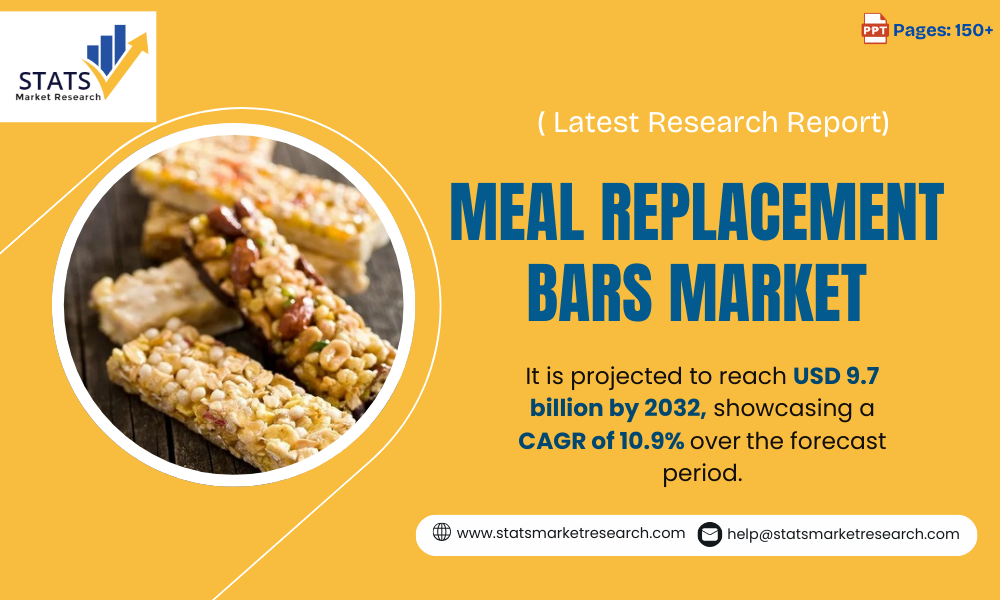
Global meal replacement bars market was valued at USD 4.8 billion in 2024. It is projected to grow from USD 5.3 billion in 2025 to USD 9.7 billion by 2032, registering a CAGR of 10.9% over the forecast period.
Key Market Insights:
- Online Sales: Account for 67% of total revenue, driven by e-commerce growth and direct-to-consumer channels.
- Product Penetration: Nut bars lead the market due to convenience and clean-label formulations.
- Consumer Trends: Health-conscious adults increasingly monitor nutritional intake, leading to strong demand for meal replacement options.
- Regional Contribution: North America remains the largest market, contributing 38% of global revenue, supported by established health and wellness trends.
Historically, the market has experienced substantial growth due to shifts in consumer behavior, including increased demand for portable, shelf-stable nutrition solutions. Post-COVID-19, sales surged approximately 28% during 2020–2021 as homebound consumers sought healthy alternatives to traditional meals.
The combination of rising obesity prevalence (over 39% among adults globally) and a growing emphasis on functional foods has cemented meal replacement bars as an integral segment within the global nutrition market
Download FREE Sample of this Report @ https://www.statsmarketresearch.com/download-free-sample/8057950/global-meal-replacement-bars-forecast-market
Market Dynamics
Drivers
Rising Health Consciousness Among Consumers
Increasing awareness about nutrition is a primary growth driver. Over 60% of adults in developed nations actively monitor their dietary intake, creating demand for convenient, nutrient-rich snack options. Meal replacement bars offer:
- Controlled calorie counts
- Balanced macronutrient profiles
- Functional ingredients such as proteins, fibers, vitamins, and minerals
Urbanization and Busy Lifestyles
Rapid urbanization and hectic schedules are transforming eating habits. Urban population is expected to reach 68% globally by 2050, fueling demand for convenient, ready-to-eat nutrition products. Meal replacement bars satisfy this need with shelf-stable formulations requiring no preparation.
- COVID-19 Impact: Sales increased ~28% during 2020–2021
- Target Audience: Office workers, students, and time-pressed consumers
For instance, Quest Nutrition launched a high-protein, low-sugar bar line in Q2 2023 for professionals seeking sustained energy throughout the workday.
Restraints
Regulatory Scrutiny on Health Claims
Increasing oversight of labeling and health claims limits market expansion. Regulatory bodies are tightening:
- Protein content claims
- Sugar disclosures
- “Healthy” product classifications
The U.S. FDA’s updated definition of “healthy” may disqualify ~24% of meal replacement bars currently making such claims. Similar regulatory developments in Europe and Asia create compliance challenges, necessitating reformulation and higher R&D investment.
Opportunities
Emerging Markets
Developing regions, particularly Southeast Asia and Latin America, offer significant growth potential, with annual sales growth exceeding 18%. Manufacturers are establishing local production to lower operating costs and tailor flavors to regional preferences, e.g., matcha in Asia and tropical fruits in Latin America.
Product Innovation
Functional ingredients and personalized nutrition represent lucrative opportunities:
- Menopause-support bars with phytoestrogens
- Gut-health bars with prebiotics
- Sports nutrition bars with collagen peptides and adaptogens
Strategic partnerships between food-tech startups and established brands are accelerating innovation, focusing on plant-based proteins and eco-friendly packaging.
Challenges
Ingredient Cost Volatility
Fluctuating costs of nuts, dairy proteins, and sweeteners (15–40% increase since 2022) create pressure on margins, particularly for premium or organic products. Many smaller brands operate with gross margins below 35%, making them highly vulnerable.
Consumer Skepticism
- 42% of consumers concerned about artificial additives
- 31% question long-term nutritional adequacy
Market Saturation
Over 200 brands in North America alone make differentiation challenging, leading to margin erosion through promotions and high customer acquisition costs (~25–30% of revenue for emerging brands).
Regional Analysis
North America:
- Dominates with 38% of revenue
- Mature market, health-conscious consumers, high urbanization
- Major brands: BE-KIND, Quest Nutrition, Kellogg
Europe:
- Increasing demand for clean-label and sustainable products
- Local brands like Clif Bar & Company and PhD Nutrition gaining traction
Asia-Pacific:
- Rapid urbanization and growing middle class
- Product customization based on local flavors (matcha, tropical fruits)
- High CAGR (15–20%) projected
Latin America:
- Emerging health-conscious urban population
- Growing online sales channels
Middle East & Africa:
- Niche market
- Increasing awareness of functional foods and fitness-oriented products
Competitor Analysis
The global meal replacement bars market is moderately consolidated, with key players collectively controlling ~35% of global revenue:
- BE-KIND (Kind LLC) – U.S.
- Kellogg Company – U.S.
- Quest Nutrition – U.S.
- Clif Bar & Company – U.S.
- PhD Nutrition – Europe
Strategies:
- Extensive distribution networks
- Brand recognition
- Continuous product innovation
- Expansion into functional nutrition and protein snacks
- Sustainable and clean-label initiatives
Post-pandemic, competitive intensity has increased with companies entering adjacent categories like performance nutrition, medical nutrition, and direct-to-consumer e-commerce platforms.
Get the Complete Report & TOC @ https://www.statsmarketresearch.com/global-meal-replacement-bars-forecast-market-8057950
Global Meal Replacement Bars: Market Segmentation Analysis
This report provides a deep insight into the global meal replacement bars market, covering all its essential aspects. This ranges from a macro overview of the market to micro details of the market size, competitive landscape, development trend, niche market, key market drivers and challenges, SWOT analysis, value chain analysis, etc.
The analysis helps the reader to shape the competition within the industries and strategies for the competitive environment to enhance potential profit. Furthermore, it provides a simple framework for evaluating and assessing the position of the business organization. The report structure also focuses on the competitive landscape of the Global Meal Replacement Bars. This report introduces in detail the market share, market performance, product situation, operation situation, etc., of the main players, which helps the readers in the industry to identify the main competitors and deeply understand the competition pattern of the market.
In a word, this report is a must-read for industry players, investors, researchers, consultants, business strategists, and all those who have any kind of stake or are planning to foray into the meal replacement bars market in any manner.
Market Segmentation (by Application)
- Weight Management
- Athletes & Bodybuilders
- General Consumers
- Others
Market Segmentation (by Type)
- Nut Bars
- Almond, Peanut, Cashew, and others
- Cereal Bars
- Granola Bars, Muesli Bars, and others
- Protein Bars
- Whey Protein, Plant Protein, and others
- Others
Key Company
- BE-KIND (Kind LLC) – U.S.
- Kellogg Company – U.S.
- Quest Nutrition – U.S.
- Simply Protein – Canada
- Optimum Nutrition (Glanbia) – Ireland
- GoMacro – U.S.
- Rise Bar – U.S.
- LABRADA Nutrition – U.S.
- Clif Bar & Company – U.S.
- Abbott Nutrition – U.S.
- Herbalife Nutrition – U.S.
- Kellanova – U.S.
- SlimFast (Glanbia) – U.K.
- ffit8 – U.K.
- OPTISLIM – Australia
- DGI – South Africa
Geographic Segmentation
- North America
- Europe
- Asia Pacific
- Latin America
- Middle East & Africa
FAQ Section
Q1: What is the current market size of the Meal Replacement Bars market?
The global meal replacement bars market was valued at USD 4.8 billion in 2024 and is projected to reach USD 9.7 billion by 2032 at a CAGR of 10.9%.
Q2: Which are the key companies operating in the Meal Replacement Bars market?
Key companies include:
- BE-KIND (Kind LLC)
- Kellogg Company
- Quest Nutrition
- Clif Bar & Company
- Optimum Nutrition (Glanbia)
Q3: What are the key growth drivers in the Meal Replacement Bars market?
- Rising health consciousness and demand for functional nutrition
- Urbanization and busy lifestyles
- Growth in online sales and e-commerce penetration
Q4: Which regions dominate the Meal Replacement Bars market?
North America leads the market with 38% revenue share, followed by Europe and Asia-Pacific, which are growing rapidly due to emerging middle-class populations and urbanization.
Q5: What are the emerging trends in the Meal Replacement Bars market?
- Functional and personalized nutrition bars
- Sustainable and eco-friendly packaging
- Expansion into sports nutrition and weight management segments
- Customized flavors for regional markets (e.g., matcha, tropical fruits)
About Us
☎️ International: +1 (332) 2424 294
📄 Website: www.statsmarketresearch.com
Join us on LinkedIn:- https://www.linkedin.com/company/statsmarketresearch




