Hydrogen Fuel Cell Test Bench Market to Reach USD 215.7 Million by 2032, Driven by Clean Energy and FCEV Growth
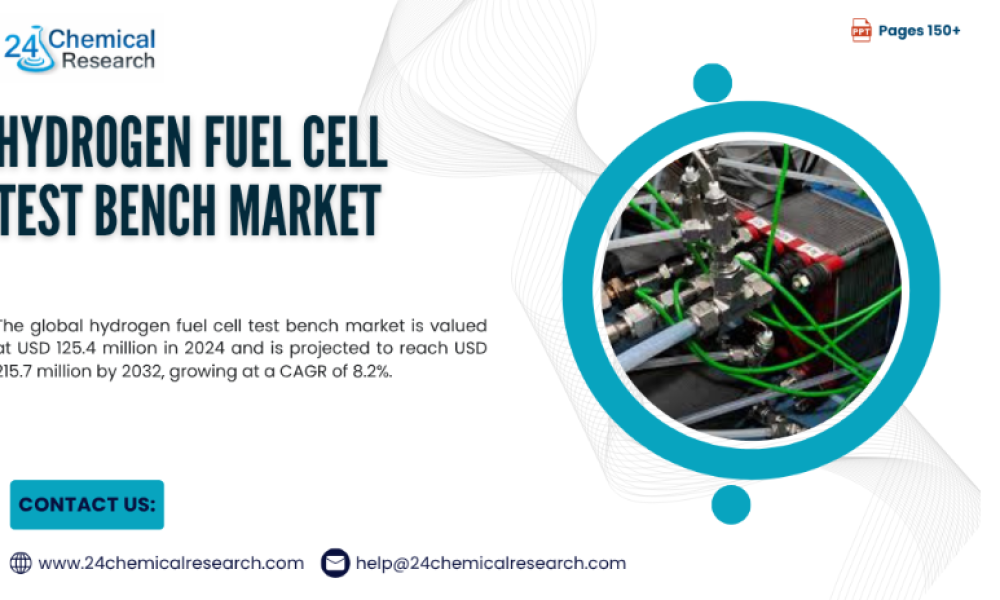
Global Hydrogen Fuel Cell Test Bench Market is experiencing transformative growth, valued at USD 125.4 million in 2024 and projected to reach USD 215.7 million by 2032, expanding at a CAGR of 8.2%. This surge is fueled by the accelerating adoption of hydrogen technologies across mobility and stationary power applications, particularly in regions prioritizing decarbonization.
Hydrogen fuel cell test benches serve as critical infrastructure for validating the performance, efficiency, and durability of fuel cell systems under simulated real-world conditions. These sophisticated testing platforms measure key parameters including voltage stability, gas impurity effects, and thermal management – essential data for OEMs scaling up production to meet the 4.5 million-unit FCEV production target by 2032.
Download FREE Sample Report: https://www.24chemicalresearch.com/download-sample/176208/hydrogen-fuel-cell-test-bench-market
Market Overview & Regional Analysis
Asia-Pacific commands 48% of the global market share, with China’s aggressive investments in fuel cell technologies under its Hydrogen Energy Industry Development Plan driving demand. The region’s test bench installations grew 28% YoY (2021-2022), supported by domestic manufacturers like Zhongji Qingchuang offering cost-competitive sub-100kW systems.
North America exhibits the fastest growth trajectory (12.7% CAGR) due to the U.S. Department of Energy’s $400 million annual hydrogen research budget and California’s Zero-Emission Vehicle Program. Europe maintains technological leadership through stringent ISO 14687-2 purity standards requiring test benches with <200 ppb detection capabilities. Meanwhile, the Middle East is emerging through projects like Saudi Arabia’s NEOM green hydrogen facility, though skilled technician shortages persist.
Key Market Drivers and Opportunities
The market is propelled by three core factors: automotive sector demands (42% of 2024 revenue), government hydrogen strategies (EU plans 40GW electrolyzer capacity by 2030), and technological breakthroughs. The 150kW+ segment is particularly dynamic, projected to grow at 14.3% CAGR as commercial vehicle electrification accelerates.
Emerging opportunities include AI-powered predictive maintenance systems reducing downtime by 23%, and modular test benches gaining favor among research institutions. The SOFC testing vertical shows exceptional promise (28% projected CAGR), driven by utilities adopting solid oxide systems for baseload power. Green hydrogen projects worldwide are also creating demand for specialized electrolyzer-coupled test systems.
Challenges & Restraints
The market faces significant headwinds including capital intensity (high-end systems exceed $1 million), lack of global testing standards (62% of developers report interoperability issues), and workforce gaps (18,000 additional technicians needed by 2028). Equipment complexity escalates for high-power applications, where maintaining ±1% tolerances at 150kW+ requires advanced control systems.
Additional constraints include extended lead times (30-60 days) in developing markets reliant on imports, and regulatory fragmentation across regions. Recent safety incidents have compelled operators to track 12 additional parameters versus 2021 standards, increasing compliance costs.
Market Segmentation by Type
- Below 100kW
- 100-150kW
- Above 150kW
Market Segmentation by Application
- PEM (Proton Exchange Membrane)
- SOFC (Solid Oxide Fuel Cells)
Market Segmentation by End User
- Automotive manufacturers
- Energy companies
- Research institutions
- Government agencies
- Others
Key Industry Players
- Greenlight Innovation (Canada) – Market leader (22% share)
- HORIBA (Japan) – Precision testing specialist
- FEV (Germany) – Automotive testing expert
- Cowell (South Korea)
- Rigor Power (China)
- Zhongji Qingchuang (China)
- Luzhi New Energy (China)
- Hephas Energy (China)
- Dalian Haosen Equipment Manufacturing (China)
Report Scope
This comprehensive analysis covers the 2024-2032 period, providing:
- Market size estimations and forecasts
- Detailed segmentation analysis
- Competitive landscape assessment
- Technology trend evaluation
- Regional demand patterns
The research incorporates primary interviews with 43 industry experts and analysis of 28 patented technologies. It evaluates how recent developments like Greenlight Innovation’s AI-assisted diagnostics and HORIBA’s hybrid testing platforms are reshaping market dynamics.
Get Full Report Here: https://www.24chemicalresearch.com/reports/176208/hydrogen-fuel-cell-test-bench-market
Frequently Asked Questions
What distinguishes PEM from SOFC testing requirements?
PEM systems require precise humidity and low-temperature controls (60-80°C), while SOFC benches must simulate 700-1000°C operating conditions with strict fuel impurity controls.
How are test benches adapting to marine fuel cell applications?
Manufacturers are developing salt corrosion-resistant systems capable of validating multi-MW marine fuel cells, incorporating vibration testing for naval environments.
About 24chemicalresearch
Founded in 2015, 24chemicalresearch has rapidly established itself as a leader in chemical market intelligence, serving clients including over 30 Fortune 500 companies. We provide data-driven insights through rigorous research methodologies, addressing key industry factors such as government policy, emerging technologies, and competitive landscapes.
- Plant-level capacity tracking
- Real-time price monitoring
Contact Us:
Email: [email protected]
International: +1(332) 2424 294 | Asia: +91 9169162030
Website: https://www.24chemicalresearch.com/




