
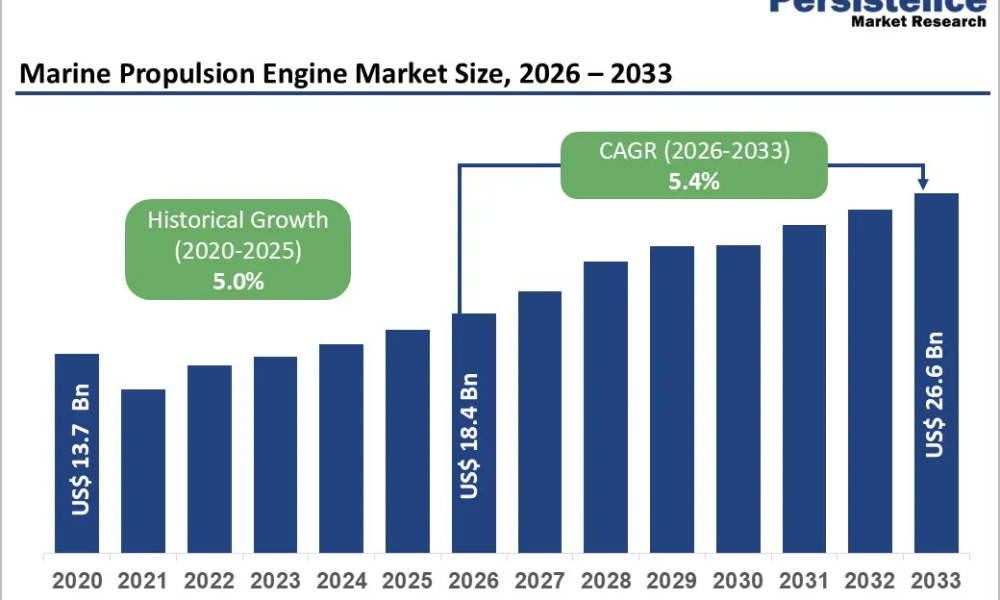
The global marine propulsion engine market is entering a phase of sustained growth, supported by expanding maritime trade, fleet modernization initiatives, and the rapid adoption of efficient and environmentally compliant propulsion technologies. According to consolidated insights from leading market research firms, the market is estimated to be valued at US$ 18.4 billion in 2026 and is projected to reach US$ 26.6 billion by 2033, registering a compound annual growth rate (CAGR) of 5.4% during the forecast period from 2026 to 2033.
This growth trajectory reflects the strategic importance of marine transportation in global supply chains, as over 80% of international trade by volume is carried by sea. Increasing investments in commercial shipping, offshore energy exploration, cruise tourism, and naval defense fleets are directly contributing to rising demand for advanced marine propulsion engines. Additionally, aging vessels across major shipping nations are being retrofitted or replaced with modern propulsion systems to improve fuel efficiency, operational reliability, and regulatory compliance.
Environmental regulations introduced by international bodies, particularly the International Maritime Organization (IMO), are acting as a key catalyst for market growth. Stricter emission norms related to sulfur oxides (SOx), nitrogen oxides (NOx), and greenhouse gases are pushing shipowners to adopt cleaner and more efficient propulsion engines. At the same time, rising fuel costs and pressure to reduce operating expenses are accelerating the shift toward engines with lower lifecycle costs, higher thermal efficiency, and compatibility with alternative fuels.
Technological progress in engine design, digital monitoring, and hybrid propulsion systems is further reinforcing market expansion. Engine manufacturers are increasingly integrating smart technologies to enhance performance optimization, predictive maintenance, and real-time diagnostics, thereby improving vessel uptime and reducing total cost of ownership.
Get Your FREE Sample Report Instantly Click Now: https://www.persistencemarketresearch.com/samples/34872
Market Segmentation
By Power Range
- Above 20,000 HP
- 10,001-20,000 HP
- Upto 1,000 HP
- 1,001-5,000 HP
- 5,001-10,000 HP
By Fuel Type
- Diesel
- Heavy Fuel Oil
- Natural Gas
- Other Fuels
By Application
- Commercial
- Defense
- Passenger
- Others
By Region
- North America
- Europe
- Asia Pacific
- Latin America
- Middle East & Africa
Regional Insights
From a regional perspective, Asia Pacific leads the global marine propulsion engine market, accounting for the largest share in terms of production and consumption. The region’s dominance is attributed to its strong shipbuilding industry, particularly in countries such as China, South Korea, and Japan, which collectively account for a substantial portion of global ship construction. High maritime trade volumes, expanding naval fleets, and government support for domestic shipyards further strengthen the region’s market position.
Europe represents a mature yet innovation-driven market, characterized by early adoption of environmentally friendly propulsion technologies. Stringent emission regulations, strong focus on decarbonization, and significant investments in LNG-powered and hybrid vessels are shaping market dynamics across countries such as Germany, Norway, and the Netherlands. European manufacturers are also at the forefront of developing alternative fuel engines and digital propulsion solutions.
North America continues to demonstrate steady growth, supported by naval modernization programs, offshore energy activities in the Gulf of Mexico, and rising demand for inland waterway transportation. The United States, in particular, is investing in cleaner marine technologies to align with national emission reduction goals.
The fastest-growing region is expected to be the Middle East & Africa, driven by expanding port infrastructure, increasing offshore oil and gas exploration, and rising investments in maritime logistics hubs. Strategic initiatives to diversify economies and strengthen regional trade corridors are encouraging fleet expansion and modernization, thereby boosting demand for marine propulsion engines.
Customize This Report for Your Exact Requirements: https://www.persistencemarketresearch.com/request-customization/34872
Unique Features and Innovations in the Market
Modern marine propulsion engines are increasingly differentiated by their fuel efficiency, emission performance, digital intelligence, and adaptability to alternative fuels. Manufacturers are focusing on modular engine designs that allow easy retrofitting and compliance with evolving regulations without significant structural modifications.
The integration of digital technologies such as artificial intelligence (AI), the Internet of Things (IoT), and advanced data analytics is transforming propulsion system performance and maintenance. AI-powered engine management systems analyze operational data in real time to optimize fuel consumption, detect anomalies, and recommend corrective actions before failures occur. IoT-enabled sensors provide continuous monitoring of engine parameters, enabling predictive maintenance and reducing unplanned downtime.
Connectivity solutions supported by high-speed communication technologies are enhancing ship-to-shore data transmission, allowing fleet operators to remotely monitor engine health and operational efficiency. These innovations not only improve vessel performance but also contribute to regulatory compliance by enabling accurate emission reporting and performance benchmarking.
Market Highlights
The adoption of advanced marine propulsion engines is being driven by a combination of economic, regulatory, and environmental factors. Shipowners and operators are increasingly prioritizing engines that offer lower fuel consumption and reduced maintenance costs, as fuel expenses account for a significant portion of total operating costs.
Regulatory frameworks aimed at reducing maritime emissions are playing a critical role in shaping purchasing decisions. Compliance with IMO emission standards and regional environmental regulations has become a strategic necessity rather than a voluntary initiative. As a result, propulsion engines compatible with LNG, low-sulfur fuels, and emerging carbon-neutral alternatives are gaining prominence.
Sustainability considerations are also influencing long-term investment strategies. Shipping companies are under growing pressure from customers, investors, and regulators to demonstrate measurable progress toward decarbonization. Advanced propulsion engines, combined with digital optimization tools, are emerging as key enablers of sustainable maritime operations.
Key Players and Competitive Landscape
The global marine propulsion engine market is characterized by the presence of several established manufacturers with strong technological capabilities and global distribution networks. Leading players are focusing on product innovation, strategic partnerships, and regional expansion to strengthen their competitive positions.
Key companies operating in the market include:
- Wärtsilä Corporation – Known for its advanced LNG and hybrid propulsion solutions, Wärtsilä continues to invest in digital engine management systems and fuel-flexible engine platforms to support decarbonization goals.
- MAN Energy Solutions – The company emphasizes high-efficiency two-stroke and four-stroke engines, with a strong focus on engines compatible with alternative fuels such as methanol and ammonia.
- Rolls-Royce Power Systems – Through its mtu brand, the company delivers reliable propulsion engines for commercial and naval applications, while expanding its hybrid and electric propulsion portfolio.
- Caterpillar Inc. – Caterpillar leverages its global service network and robust engine designs to support a wide range of marine applications, with increasing emphasis on fuel efficiency and lifecycle support.
- Hyundai Heavy Industries Engine & Machinery – A major supplier to the global shipbuilding industry, the company benefits from close integration with shipyards and continuous innovation in large-bore marine engines.
Competition in the market is largely driven by technological differentiation, compliance capabilities, and aftersales service offerings. Long-term service agreements, digital solutions, and customized engine configurations are becoming critical competitive factors.
Recent Developments
- Leading engine manufacturers have announced the successful testing and commercialization of dual-fuel marine engines capable of operating on LNG and emerging alternative fuels, supporting the transition toward low-carbon shipping.
- Several shipbuilders and propulsion engine suppliers have entered into strategic collaborations to integrate digital monitoring platforms, enabling real-time performance optimization and predictive maintenance across global fleets.
Ready to Dive Deep? Buy Full Report Today: https://www.persistencemarketresearch.com/checkout/34872
Future Opportunities and Growth Prospects
The future of the marine propulsion engine market is closely linked to the global maritime industry’s transition toward decarbonization and digitalization. Opportunities are expected to emerge from the growing adoption of alternative fuels such as methanol, hydrogen, and ammonia, which will require new engine architectures and fuel handling systems.
Technological advancements in energy storage, power electronics, and digital control systems are expected to further accelerate the adoption of hybrid and electric propulsion solutions, particularly in short-sea shipping and coastal applications. At the same time, retrofitting existing vessels with compliant engines and emission-reduction technologies presents a substantial opportunity for market players.
Evolving regulatory frameworks will continue to shape the industry landscape, encouraging innovation while creating barriers for non-compliant technologies. Companies that proactively invest in research and development, fuel flexibility, and digital intelligence are expected to gain a competitive advantage in the coming years.
Overall, the global marine propulsion engine market is set to witness steady and resilient growth through 2033, supported by technological innovation, regulatory alignment, and the essential role of maritime transportation in the global economy.




