
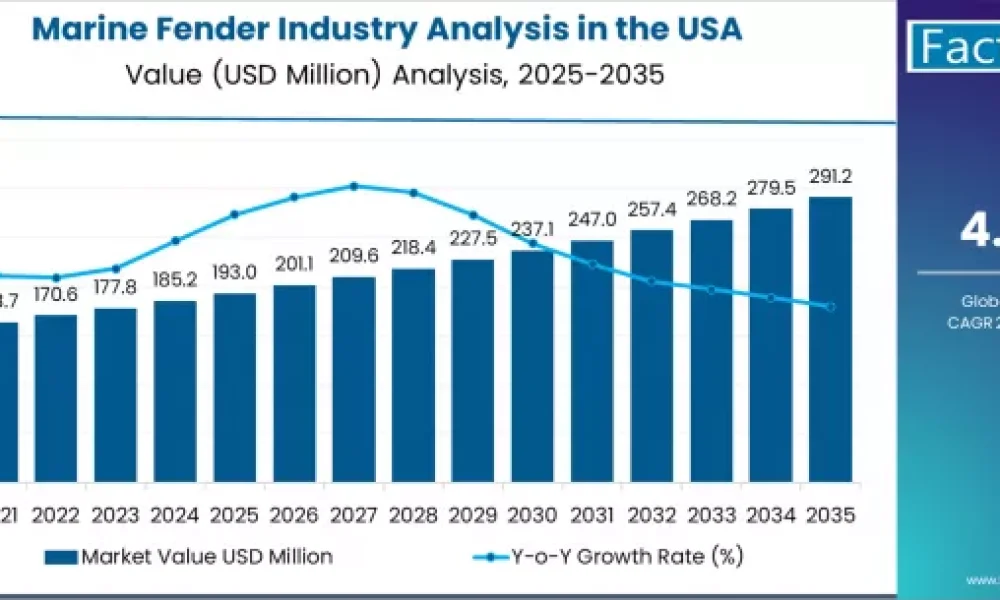
The U.S. marine fender industry is set for steady growth through 2035, supported by surging demand for advanced port infrastructure, rising maritime trade volumes, and increased focus on vessel and harbor safety. According to a recent analysis the market is expected to expand from USD 193.0 million in 2025 to USD 288.0 million by 2035, reflecting a CAGR of 4.20% and recording an absolute increase of USD 95.0 million over the forecast period.
Marine fenders—critical protective systems designed to absorb energy during vessel berthing—are witnessing heightened adoption as U.S. ports upgrade to accommodate larger ships, enhance operational efficiency, and comply with global maritime standards.
Key Market Drivers
Port Expansion and Modernization Initiatives
The USA is investing heavily in port upgrades to support increasing cargo traffic and larger vessel sizes. Modern fender systems—engineered for higher durability, reduced maintenance, and enhanced energy absorption—are becoming integral components of new construction and refurbishment projects. Federal infrastructure funding is accelerating procurement across major coastal and inland ports.
To access the complete data tables and in-depth insights, request a Discount On The Report here: https://www.factmr.com/connectus/sample?flag=S&rep_id=11999
Rising Maritime Trade and Cargo Movement
Growth in containerized trade, oil & gas transport, and bulk cargo operations is driving the installation of high-performance fenders on berths, docks, and offshore platforms. As the volume and frequency of berthing operations increase, demand for robust, long-lasting fender solutions continues to climb.
Focus on Safety, Compliance, and Environmental Standards
With rising emphasis on maritime safety regulations and environmental compliance, ports are shifting to energy-efficient, low-abrasion, and eco-friendly fender designs. High-strength rubber fenders and foam-filled systems are gaining traction due to superior performance and reduced ecological impact.
Regional Market Highlights
West Coast: Strong Adoption in High-Volume Ports
Ports in California and Washington—handling some of the nation’s largest cargo volumes—are prioritizing high-capacity fenders to accommodate mega container vessels and enhance berth safety.
Gulf Coast: Offshore and Petrochemical Demand Surges
Ports in Texas and Louisiana are driving demand through offshore energy operations, petroleum transport, and heavy marine logistics.
East Coast: Infrastructure Revamps Boost Procurement
New York, New Jersey, Georgia, and Florida are investing in port reconstruction and expansion, boosting the adoption of advanced rubber and pneumatic fenders.
Great Lakes & Inland Waterways: Upgrades to Industrial Ports
Industrial and commercial terminals along the Great Lakes region are deploying fenders to support increasing barge traffic and heavy cargo movement.
Market Segmentation Insights
By Fender Type
- Rubber Fenders – Widely used due to high durability and energy absorption.
- Pneumatic Fenders – Preferred for offshore and large vessel berthing.
- Foam-Filled Fenders – Gaining popularity for low maintenance and longevity.
By Application
- Ports & Harbors – Dominant market segment driven by modernization.
- Offshore Platforms – Rising demand in oil & gas operations.
- Shipyards – Expanding adoption for vessel maintenance and repair.
- Naval Facilities – Growing procurement by defense and coast guard sectors.
Key Market Challenges
While the outlook is promising, the U.S. marine fender industry faces several constraints:
- High Installation and Replacement Costs: Complex port infrastructure projects result in elevated installation and lifecycle expenses.
- Supply Chain Constraints: Dependence on specialized rubber, steel, and engineered polymers increases lead times.
- Performance Standardization Needs: Ensuring uniform performance and testing standards across suppliers remains a priority.
- Limited Domestic Manufacturing: Heavy reliance on imports for certain high-grade fender types affects cost competitiveness.
Competitive Landscape
The market is moderately consolidated, with leading companies emphasizing durable materials, customized engineering, and advanced impact-absorption technologies. Firms are expanding partnerships with port authorities and maritime contractors to secure long-term supply contracts.
Prominent Companies Include:
- Trelleborg Marine & Infrastructure
- ShibataFenderTeam
- Bridgestone Corporation
- Qingdao Tiandun Rubber
- Sumitomo Rubber
- The Rubber Company
These companies are investing in innovation, developing eco-friendly materials, and enhancing digital monitoring systems for fender performance analytics.
Future Outlook: Advancing Toward Smart, Safer, and More Resilient Marine Infrastructure
Over the next decade, the U.S. marine fender industry will be shaped by modernization initiatives, sustainability targets, and the need for advanced impact protection systems. Ports transitioning toward smart infrastructure—including IoT-enabled berthing systems and automated terminals—will drive demand for next-generation fender technologies.
Companies investing in high-performance composites, sensor-integrated systems, and sustainable production practices will be best positioned to lead the market’s long-term growth.
Have a specific Requirements and Need Assistant on Report Pricing or Limited Budget please contact us – [email protected]
About Fact.MR
Fact.MR is a global market research and consulting firm, trusted by Fortune 500 companies and emerging businesses for reliable insights and strategic intelligence. With a presence across the U.S., UK, India, and Dubai, we deliver data-driven research and tailored consulting solutions across 30+ industries and 1,000+ markets. Backed by deep expertise and advanced analytics, Fact.MR helps organizations uncover opportunities, reduce risks, and make informed decisions for sustainable growth.



