
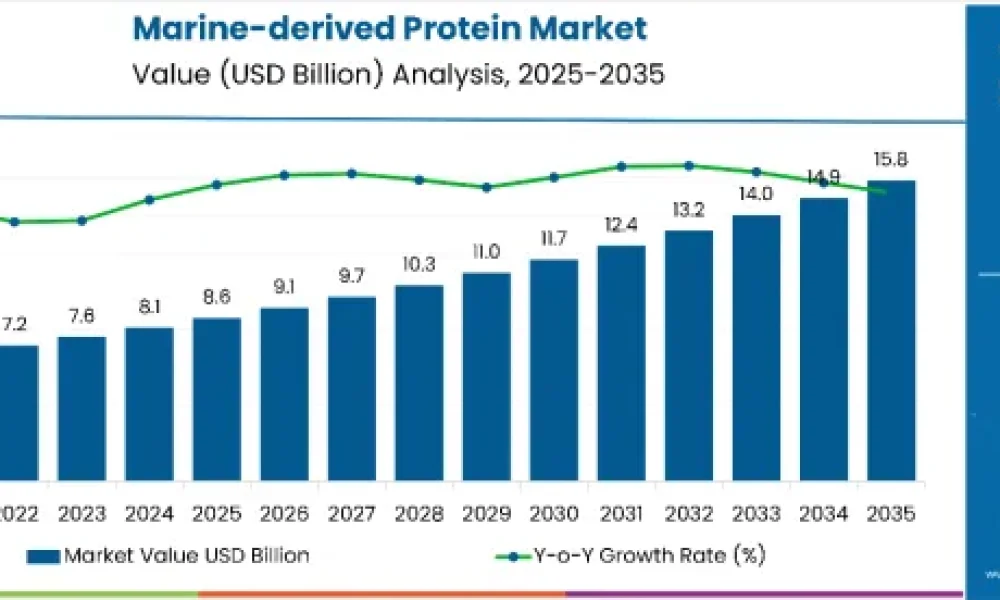
The global marine-derived protein market is entering a high-growth phase as industries increasingly shift toward sustainable, high-quality protein sources with functional and health-enhancing properties. Valued at USD 8.6 billion in 2025, the market is projected to reach USD 15.8 billion by 2035, expanding at a compound annual growth rate (CAGR) of 6.3%. Over the forecast period, the market is expected to generate an absolute dollar opportunity of USD 7.2 billion, underscoring strong and sustained demand momentum.
Market expansion reflects a 1.84× growth trajectory, supported by rising health awareness, clean-label preferences, and expanding applications across food & beverages, pharmaceuticals, and cosmetics & skincare. Marine-derived proteins are increasingly favored for their superior amino acid profile, bioactive peptides, digestibility, and sustainability credentials compared to conventional protein sources.
By 2030, the market is anticipated to reach USD 11.7 billion, accounting for USD 3.1 billion in incremental value during the first half of the forecast period. The remaining USD 4.1 billion is expected to be added between 2030 and 2035, indicating balanced and structurally resilient growth rather than short-term spikes.
Nutritional Superiority and Sustainability Fuel Market Expansion
Marine-derived proteins sourced from fish, algae, shellfish, and marine invertebrates offer high concentrations of essential amino acids, omega-3 fatty acids, and biofunctional peptides. These attributes make them particularly attractive for health-focused consumers and manufacturers seeking ingredients that support muscle health, immunity, cardiovascular wellness, and metabolic function.
At the same time, sustainability is emerging as a decisive purchasing factor. Marine proteins account for nearly 29% of the sustainable protein market, reflecting their traceable sourcing, circular economy compatibility, and lower environmental footprint when derived from responsibly managed marine resources and by-products.
Request for Sample Report | Customize Report | Purchase Full Report – https://www.futuremarketinsights.com/reports/brochure/rep-gb-18173
Technology-Driven Transformation of Marine Protein Production
The market is undergoing a structural transformation driven by advanced extraction and processing technologies. Techniques such as enzymatic hydrolysis, supercritical fluid extraction, and high-pressure processing (HPP) are enhancing protein purity, bioavailability, and functional performance.
Enzymatic hydrolysis alone accounts for approximately 40% of extraction-based applications, enabling the production of high-quality hydrolysates with proven bioactive properties. These innovations are expanding marine protein use beyond traditional food applications into nutraceuticals, clinical nutrition, and premium skincare formulations.
Key Market Snapshot
- Market Value (2025): USD 8.6 billion
- Forecast Value (2035): USD 15.8 billion
- Forecast CAGR (2025–2035):3%
- Leading Type Segment: Concentrates (45% share)
- Leading Source Segment: Fish-derived proteins (40% share)
- Key Growth Regions: Asia Pacific, North America, Europe
Fish-Derived Proteins Lead Source-Based Demand
Fish-derived proteins dominate the market with 40% share in 2025, driven by their complete amino acid profile, high digestibility, and versatility across end-use industries. Expanding aquaculture production, availability of fish processing by-products, and regulatory support for sustainable fishing practices are strengthening supply stability and cost efficiency.
These proteins are widely used in functional foods, dietary supplements, pharmaceuticals, and cosmetics, supporting applications ranging from muscle recovery and heart health to skin regeneration and anti-inflammatory formulations.
Concentrates Remain the Most Lucrative Product Type
By type, protein concentrates account for 45% of total market revenue, favored for their affordability, functional versatility, and ease of formulation. Concentrates are extensively used in fortified foods, beverages, supplements, and animal nutrition, particularly in North America and Europe where consumer awareness of protein-enriched diets is high.
Their dominance reflects alignment with clean-label trends, functional nutrition demand, and scalable production economics.
Food & Beverage Applications Anchor Demand
Marine-derived proteins account for approximately 31% of protein applications in the food and beverage sector, driven by growing use in fortified foods, functional beverages, and dietary supplements. Additionally, the market contributes nearly 23% to the marine-based nutraceuticals segment, particularly through hydrolysates, isolates, and concentrates.
Overall, marine-derived proteins represent close to 40% of the alternative protein market, highlighting their strong competitive position versus plant-based and synthetic protein sources.
Regional Growth Accelerates Across Asia and Developed Markets
Asia Pacific remains the fastest-growing region, supported by expanding aquaculture, rising middle-class incomes, and strong government backing for sustainable marine resource utilization. Country-level growth highlights include:
- India: 14% CAGR, driven by aquaculture expansion and nutraceutical demand
- China:7% CAGR, supported by seafood processing scale and export strength
- Japan:5% CAGR, focused on premium clinical and aging-nutrition products
- United States:3% CAGR, fueled by sports nutrition and clean-label trends
- United Kingdom:7% CAGR, supported by sustainability-driven consumption
Competitive Landscape Focused on Innovation and Value-Added Proteins
Key market participants including Omega Protein Corporation, TripleNine North Atlantic, Nissui Corporation (USA Operations), Scanbio Marine Group, and Biomega AS are strengthening their positions through investments in advanced extraction technologies, organic certifications, and customized protein formulations.
Competitive differentiation increasingly depends on extraction purity, bioactive efficacy validation, sustainability credentials, and regulatory compliance, creating high entry barriers for new entrants.
Outlook
From 2025 to 2035, the marine-derived protein market is expected to evolve from a niche alternative into a core pillar of sustainable nutrition and functional ingredient strategies. As health awareness, sustainability mandates, and advanced processing technologies converge, marine-derived proteins are positioned for durable, innovation-led growth across global end-use industries.
About Future Market Insights (FMI)
Future Market Insights, Inc. (FMI) is an ESOMAR-certified, ISO 9001:2015 market research and consulting organization, trusted by Fortune 500 clients and global enterprises. With operations in the U.S., UK, India, and Dubai, FMI provides data-backed insights and strategic intelligence across 30+ industries and 1,200 markets worldwide.
Contact Us:
Future Market Insights Inc.
Christiana Corporate, 200 Continental Drive,
Suite 401, Newark, Delaware – 19713, USA
T: +1-347-918-3531
For Sales Enquiries: [email protected]



