
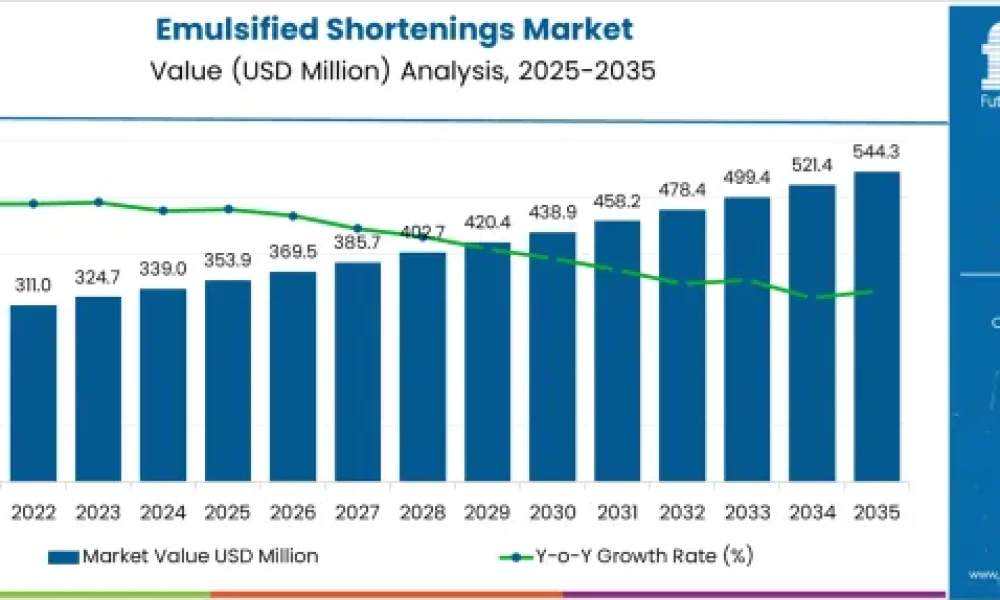
The global emulsified shortenings market is entering a phase of steady and quality-driven expansion, supported by evolving food manufacturing requirements and shifting consumer preferences toward cleaner, more functional ingredients. The market is estimated to be valued at USD 353.9 million in 2025 and is projected to reach USD 544.3 million by 2035, registering a compound annual growth rate (CAGR) of 4.4% over the forecast period.
This growth reflects the food industry’s increasing reliance on high-performance fats that enhance texture, stability, and shelf life while aligning with plant-based and clean-label trends. Emulsified shortenings have become a critical ingredient across bakery, confectionery, dairy, desserts, and broader food processing applications, where consistency and efficiency remain paramount.
Ingredient Functionality Drives Market Expansion
Food manufacturers are placing greater emphasis on ingredient functionality to meet rising expectations around product quality and nutritional perception. Emulsified shortenings offer multiple performance benefits, including improved crumb structure, enhanced moisture retention, better dough handling, and superior mouthfeel. These attributes are especially valuable in large-scale food processing environments where consistency and yield optimization are critical.
Advancements in emulsification technologies have further expanded the versatility of these shortenings, allowing manufacturers to tailor formulations to specific applications. At the same time, growing consumer scrutiny around ingredient sourcing has encouraged the development of shortenings derived from natural and plant-based sources.
Market Snapshot
- Market Value (2025): USD 353.9 million
- Forecast Value (2035): USD 544.3 million
- Forecast CAGR (2025–2035): 4.4%
- Leading Form Segment: Dry (42.8% share in 2025)
- Dominant Source Segment: Plant-based (67.5% share)
- Primary End Use: Food Processing (33.2% share)
Request for Sample Report | Customize Report | Purchase Full Report – https://www.futuremarketinsights.com/reports/brochure/rep-gb-9709
Dry Form Maintains Leadership in Form Segment
By form, the Dry segment is projected to account for 42.8% of total market revenue in 2025, retaining its leadership position. Dry emulsified shortenings are widely preferred due to their extended shelf life, ease of storage, and lower risk of microbial contamination compared to liquid alternatives.
Food processors value dry formats for their ability to deliver precise dosing and seamless integration into dry mixes and dough systems. As manufacturers continue to prioritize production efficiency and ingredient standardization, demand for dry emulsified shortenings is expected to remain resilient throughout the forecast period.
Plant-Based Sources Dominate Ingredient Preference
From a sourcing perspective, plant-based emulsified shortenings are anticipated to represent 67.5% of market revenue in 2025, driven by strong demand for vegetarian- and vegan-friendly formulations. Health, sustainability, and ethical considerations are accelerating the shift away from animal-derived fats across global food portfolios.
Plant-based shortenings offer clean-label advantages while maintaining functional parity with traditional fats. Improvements in plant oil processing and fat structuring technologies have enhanced their performance across bakery and snack applications, further strengthening adoption.
Food Processing Remains the Core End-Use Segment
The Food Processing segment is projected to hold 33.2% of market revenue in 2025, making it the largest end-use category. Emulsified shortenings play a vital role in ensuring uniform texture, volume, and shelf stability across baked goods, confectionery products, and processed snacks.
Rising consumption of packaged and convenience foods—particularly in emerging markets—continues to support demand from industrial food processors. Regulatory emphasis on food safety and quality assurance is also encouraging manufacturers to adopt high-performance shortening solutions.
Opportunities and Growth Constraints Shape Market Dynamics
Emulsified shortenings are gaining traction due to their ability to enhance taste, texture, moisture retention, and volume across a wide range of food products. Increasing global consumption of cakes, bread, chocolates, desserts, dairy products, and frozen treats is expected to bolster market growth.
However, rising awareness of lifestyle-related health conditions such as obesity, diabetes, and hypertension presents a restraint. Growing consumer focus on reducing intake of high-fat and calorie-dense foods may limit demand in certain categories, prompting manufacturers to innovate with balanced and reformulated solutions.
Regional Outlook Highlights North America and Europe
North America is projected to remain a highly attractive market through 2035, supported by strong demand for bakery and convenience foods. Expansion within the HoReCa sector and continued investment in retail bakery formats are contributing to sustained ingredient demand.
Europe is emerging as a particularly lucrative region, driven by rapid adoption of plant-based ingredients and clean-label formulations. Product launches focused on sustainable and specialty emulsified shortenings are supporting regional growth, especially in Western Europe.
Competitive Landscape Focuses on Innovation and Scale
The emulsified shortenings market is moderately competitive, with leading players including Cargill, Incorporated; Bunge Limited; Mallet & Company, Inc.; Lonza Group AG; Palsgaard; Archer Daniels Midland Company; Wilmar International Limited; Ventura Foods LLC; and AAK AB.
Market participants are actively pursuing strategies such as product innovation, capacity expansion, collaborations, and acquisitions to strengthen their market presence and meet evolving customer requirements.
Outlook
Between 2025 and 2035, the emulsified shortenings market is expected to advance steadily as food manufacturers balance performance, sustainability, and health considerations. With dry and plant-based formulations leading adoption and food processing remaining the primary demand center, the market is positioned for consistent, innovation-led growth over the next decade.
About Future Market Insights (FMI)
Future Market Insights, Inc. (FMI) is an ESOMAR-certified, ISO 9001:2015 market research and consulting organization, trusted by Fortune 500 clients and global enterprises. With operations in the U.S., UK, India, and Dubai, FMI provides data-backed insights and strategic intelligence across 30+ industries and 1,200 markets worldwide.
Contact Us:
Future Market Insights Inc.
Christiana Corporate, 200 Continental Drive,
Suite 401, Newark, Delaware – 19713, USA
T: +1-347-918-3531
For Sales Enquiries: [email protected]



