
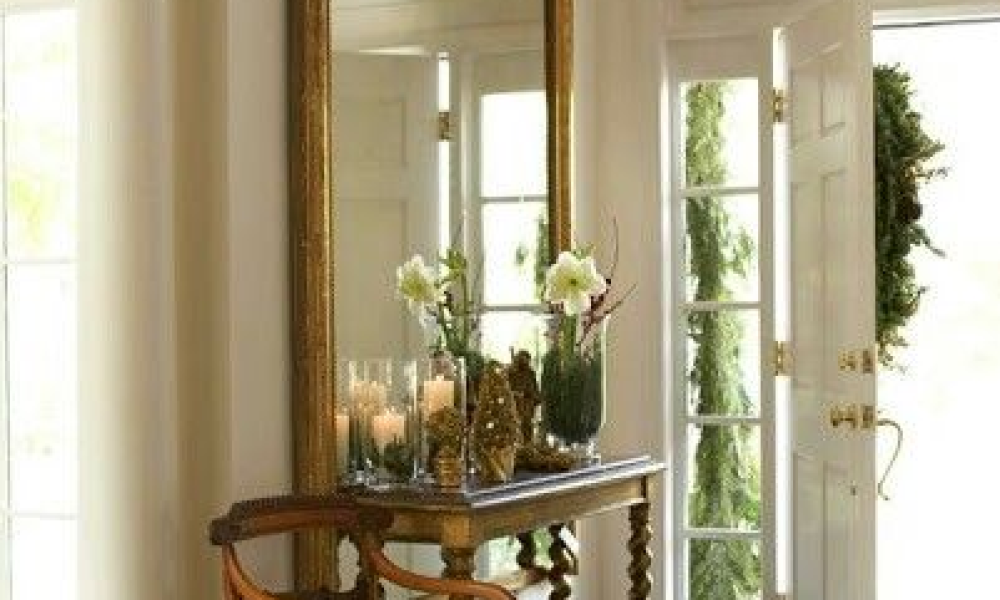
Luxury entryway ideas that actually work start with recognizing something that most home design conversations overlook — the entryway is the first and last space every visitor and every household member experiences, which makes it disproportionately influential on how a home feels overall relative to its actual square footage. A beautifully furnished great room behind a neglected, poorly considered entryway creates a disconnect that visitors register immediately even if they can’t articulate why. Getting the entryway right sets a tone that carries through the rest of the home.
The Console Table as the Entryway’s Anchor
The console table is the foundational piece in most entryway furniture arrangements — providing a surface for practical items while contributing the primary visual statement the space makes. The right console table for a luxury entryway balances scale with the space, offers the right visual weight for the home’s architectural character, and creates a composed vignette when paired with accessories and lighting rather than serving as a drop zone for daily accumulated clutter.
Scale is the first consideration. A console table that’s too narrow for the wall it occupies reads as tentative and underscaled. One that’s too wide crowds the passage and makes the entryway feel compressed rather than welcoming. Depth matters for function — a table too shallow to hold a lamp, a tray, and a few thoughtfully chosen objects forces a spare aesthetic that may not suit the home’s overall style.
Material choices in the entryway deserve more consideration than in rooms with more forgiving light conditions. Entryways often have limited natural light and rely on artificial sources that reveal surface quality clearly — which means the difference between quality marble, stone, or solid wood and their lower-cost simitations is immediately visible to anyone who spends a moment in the space.
Mirrors and the Light They Create
A well-chosen mirror is the entryway piece that does the most work per square inch of wall space. It visually expands a space that’s almost always smaller than the rooms it connects, reflects light from fixtures and windows to brighten what can be a dim transitional area, and provides the functional moment — a last glance before leaving — that entryways are uniquely positioned to offer.
The mirror’s frame should coordinate with the console table below it while contributing its own visual interest — whether through architectural detailing, material contrast, or scale that commands the wall rather than simply occupying it. An oversized mirror that runs significantly taller and wider than the console below it makes a stronger design statement and does more to expand the perceived dimensions of the space than a conservatively sized mirror that reads as an afterthought.
A luxury furniture showroom visit is the most reliable way to evaluate how specific console and mirror combinations actually read together in person before committing to pieces that will live at eye level in one of the most scrutinized spaces in the home.
Seating That Serves a Real Purpose
Entryway seating — a bench, an accent chair, or an upholstered ottoman — is justified by function when the entryway is large enough to accommodate it without impeding flow. The functional case is strong: putting on and taking off shoes, waiting while others gather, and providing a moment of pause at the transition between inside and outside are all genuine uses that make seating more than decorative.
The design case is equally strong. A bedroom furniture quality upholstered bench at the base of a staircase, or an accent chair positioned beside a console in a wider entry hall, introduces softness and human scale that hard furniture surfaces alone don’t provide. Upholstery in a durable, cleanable fabric — an entryway sees more contact from outdoor clothing and bags than any interior room — is a practical requirement that shouldn’t be sacrificed for aesthetic preference alone.
Storage That Disappears Into the Design
The entryway’s functional demands — somewhere for keys, mail, bags, and outerwear — can either be addressed elegantly or allowed to produce the visual clutter that undermines even well-chosen furniture. Luxury entryway furniture ideas that solve both the aesthetic and functional problems simultaneously use storage that integrates into the design rather than announcing itself as a practical concession.
Console tables with drawers handle the small items — keys, sunglasses, everyday carry — without surface accumulation. Built-in or furniture-quality storage benches address outerwear and bag storage in entryways with adequate depth. The goal is a space that looks as composed at the end of a busy day as it does when freshly arranged — which requires that the storage solution genuinely accommodates daily use rather than requiring constant editing to maintain the appearance.
Getting the Scale and Flow Right
Luxury entryway furniture ideas that translate well from inspiration photos to actual homes account for the flow requirements that the space’s function imposes. A passage that needs to accommodate multiple people moving in different directions simultaneously — which describes most family home entryways — needs furniture positioned to facilitate rather than impede that movement. Pieces that look beautiful in a staged photo but require careful sidestep navigation in daily use lose their appeal quickly.
The living room sofa rule of anchoring the room’s most important piece first and building outward applies equally to entryways — choose the console table, get it right, then add the mirror, the lighting, and the seating around it rather than trying to compose the space from multiple pieces simultaneously.




