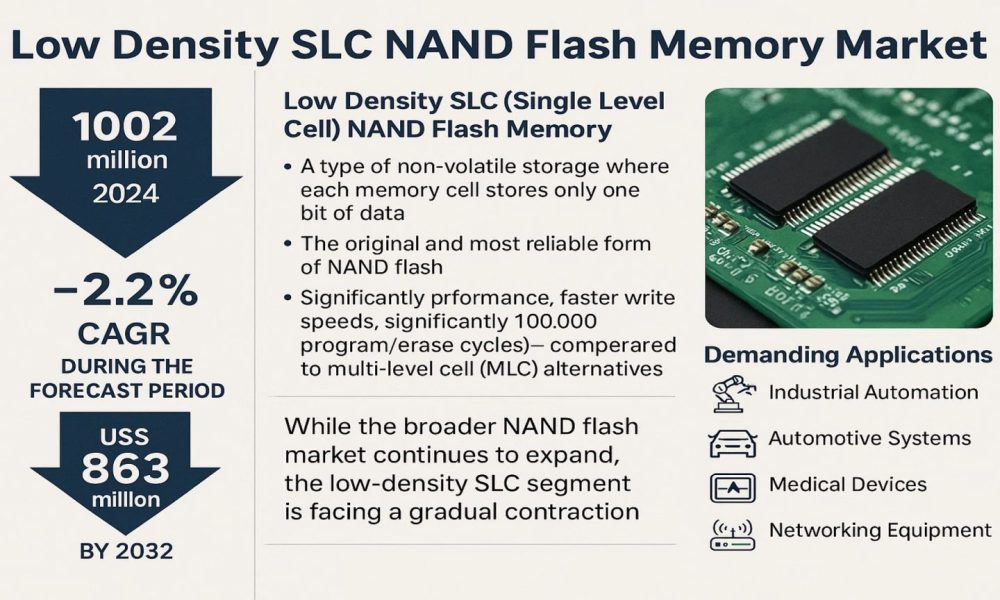
Low Density SLC NAND Flash Memory Market was valued at 1002 million in 2024 and is projected to reach US$ 863 million by 2032, at a CAGR of -2.2% during the forecast period.
Low Density SLC (Single Level Cell) NAND Flash Memory is a type of non-volatile storage technology where each memory cell stores only one bit of data. This architecture is the original and most reliable form of NAND flash, offering superior performance, faster write speeds, and significantly higher endurance—often exceeding 100,000 program/erase cycles—compared to multi-level cell (MLC) alternatives. Its robustness makes it ideally suited for demanding applications in industrial automation, automotive systems, medical devices, and networking equipment where data integrity and longevity are paramount.
While the broader NAND flash market continues to expand, the low-density SLC segment is facing a gradual contraction. This is primarily because newer, higher-density 3D NAND technologies are increasingly cost-effective for many applications. However, the unique value proposition of low-density SLC—its exceptional reliability and endurance—ensures it remains critical for niche, high-performance markets where failure is not an option. Consequently, demand persists in specific sectors, creating a stable, though slowly declining, specialized market.
Unlock Your Free Sample Report Here- Low Density SLC NAND Flash Memory Market
MARKET DYNAMICS
MARKET DRIVERS
Robust Demand from Industrial Automation and IoT Applications to Sustain Market Growth
Low Density SLC NAND Flash Memory continues to experience steady demand from industrial automation and Internet of Things (IoT) applications due to its superior reliability and endurance characteristics. Industrial environments require memory solutions that can withstand extreme temperatures, frequent read/write cycles, and extended operational lifespans. SLC NAND’s ability to handle over 100,000 program/erase cycles per block makes it ideal for industrial controllers, embedded systems, and IoT edge devices. The global industrial automation market continues to expand, with manufacturing sectors increasingly adopting smart technologies that rely on robust data storage solutions. This sustained industrial demand provides a stable foundation for Low Density SLC NAND despite overall market contraction.
Critical Infrastructure Applications Drive Consistent Need for High-Reliability Memory
Critical infrastructure sectors including aerospace, defense, medical devices, and automotive systems maintain consistent demand for Low Density SLC NAND Flash Memory because of its exceptional data retention and reliability. These applications cannot compromise on data integrity, as memory failures could lead to catastrophic outcomes. Medical equipment manufacturers, for instance, require memory that maintains data integrity for patient monitoring systems and diagnostic equipment over many years. The aerospace and defense sectors utilize SLC NAND in avionics, navigation systems, and military communications where data reliability is non-negotiable. This ongoing requirement from safety-critical applications provides a stable revenue stream for Low Density SLC NAND manufacturers despite market challenges.
Furthermore, regulatory requirements in these sectors often mandate the use of proven, high-reliability components, which reinforces the position of SLC NAND in applications where newer memory technologies might not meet stringent certification standards.
➤ For instance, automotive grade SLC NAND must operate reliably across temperature ranges from -40°C to 105°C and maintain data integrity for over 10 years, specifications that Low Density SLC NAND consistently meets.
The persistent need for legacy system support and long product lifecycles in these sectors ensures continued demand, even as the broader memory market shifts toward higher density alternatives.
Recent Developments in the Low Density SLC NAND Flash Memory Market
- Advancements in Automotive-Grade NAND Flash:
Leading manufacturers such as Micron and Kioxia have introduced low-density SLC NAND solutions tailored for automotive applications, offering enhanced reliability and wide temperature support for advanced driver-assistance systems (ADAS) and infotainment units. - Increased Demand from Industrial Applications:
The market has witnessed rising adoption of low-density SLC NAND memory in industrial automation, IoT devices, and embedded systems due to its endurance, stability, and longer data retention capabilities compared to MLC or TLC NAND. - Product Launches with Extended Lifespan:
Several companies are launching new SLC NAND products with extended program/erase (P/E) cycles, ensuring higher durability for mission-critical applications like networking equipment, medical devices, and industrial controllers. - Strategic Collaborations and Partnerships:
Semiconductor companies are partnering with embedded storage module manufacturers to co-develop optimized flash solutions. For instance, collaborations between NAND producers and system integrators are helping expand the reach of SLC NAND in niche, high-reliability markets. - Emergence of Hybrid NAND Architectures:
The industry is seeing innovations combining SLC cache layers with other NAND types (like TLC) to improve performance and endurance while maintaining cost efficiency, catering to both consumer and industrial segments. - Focus on Secure and Reliable Data Storage:
With growing cybersecurity concerns, companies are integrating advanced data protection, ECC (Error Correction Code), and power-failure management features in low-density SLC NAND to ensure data integrity in harsh environments.
MARKET OPPORTUNITIES
Growing Cybersecurity Requirements Create New Demand for Secure Memory Solutions
The increasing emphasis on cybersecurity across industrial, automotive, and critical infrastructure applications presents significant opportunities for Low Density SLC NAND Flash Memory. These applications require memory solutions that not only provide high reliability but also incorporate security features such as hardware-based encryption, secure boot capabilities, and tamper resistance. Low Density SLC NAND’s simpler cell structure allows for more straightforward implementation of security features compared to complex multi-level cell architectures. The global focus on securing connected devices and critical systems drives demand for memory components that can serve as trusted storage elements in security architectures.
Additionally, the expansion of 5G infrastructure and edge computing deployments requires reliable storage solutions for network equipment and base stations operating in harsh environmental conditions. These applications often specify SLC NAND for its proven reliability in telecommunications infrastructure, creating new deployment opportunities despite overall market contraction.
The ongoing digital transformation in industrial sectors and the imperative to secure operational technology networks against cyber threats further reinforces the value proposition of reliable, secure memory solutions where Low Density SLC NAND maintains competitive advantages.
List of Key Low Density SLC NAND Flash Memory Companies Profiled
- Micron Technology, Inc. (U.S.)
- KIOXIA Corporation (Japan)
- Winbond Electronics Corporation (Taiwan)
- Macronix International Co., Ltd. (Taiwan)
- Integrated Silicon Solution Inc. (U.S.)
- GigaDevice Semiconductor Inc. (China)
- Infineon Technologies AG (Germany)
- Samsung Electronics Co., Ltd. (South Korea)
- STMicroelectronics N.V. (Switzerland)
Unlock Your Free Sample Report Here- Low Density SLC NAND Flash Memory Market
Segment Analysis:
By Density
Lower Density Variants Maintain Critical Niche Due to Superior Endurance and Reliability in Harsh Environments
The market is segmented based on density into:
- 1Gb and below
- 2Gb to 4Gb
- 8Gb
- 16Gb and above
By Interface
Parallel Interface Segment Holds Significance for Legacy System Compatibility and Industrial Applications
The market is segmented based on interface into:
- Parallel Interface (Async & ONFI)
- Serial Interface (SPI)
By Application
Industrial Automation Segment Leads Owing to Unmatched Data Integrity and Longevity in Critical Systems
The market is segmented based on application into:
- Industrial Automation & Control Systems
- Automotive Electronics
- Networking & Telecommunications Equipment
- Consumer Electronics (High-End)
- Medical Devices
- Others
By End-User
OEMs Represent the Primary Consumer Base for Integrated Product Manufacturing and Long-Term Supply Assurance
The market is segmented based on end-user into:
- Original Equipment Manufacturers (OEMs)
- Aftermarket & Component Distributors
About Semiconductor Insight:
Established in 2016, Semiconductor Insight specializes in providing comprehensive semiconductor industry research and analysis to support businesses in making well-informed decisions within this dynamic and fast-paced sector. From the beginning, we have been committed to delivering in-depth semiconductor market research, identifying key trends, opportunities, and challenges shaping the global semiconductor industry.
Our expertly developed semiconductor market reports offer actionable intelligence, including detailed semiconductor industry analysis, market forecasts, competitive analysis, and insights into technological advancements, enabling our clients to maintain a competitive edge. With nearly a decade of expertise, we remain at the forefront of innovation, delivering strategic clarity to businesses in the semiconductor sector.
Our commitment to providing insights into semiconductor market share and industry trends ensures that our clients have the information they need to succeed in the ever-evolving semiconductor market.
CONTACT US:
City vista, 203A, Fountain Road, Ashoka Nagar, Kharadi, Pune, Maharashtra 411014
[+91 8087992013]
[email protected]




