
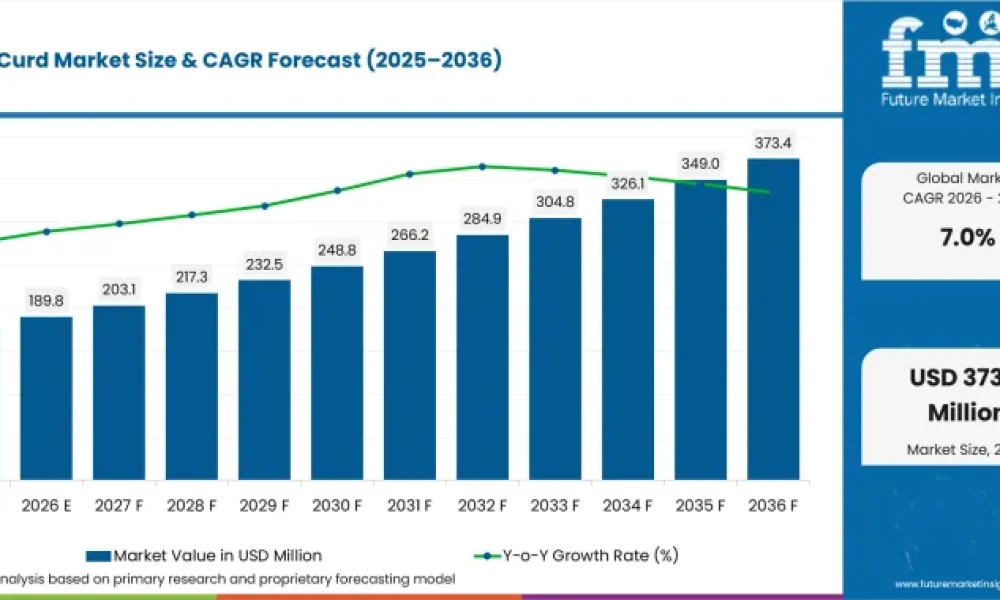
The global Lemon Curd Market is projected to grow from USD 189.8 million in 2026 to USD 373.4 million by 2036, advancing at a 7.0% CAGR during the forecast period, according to the latest research from Future Market Insights (FMI).
The market is driven by increasing demand for lemon-curd systems that provide controlled acidity, consistent texture, and predictable filling behavior across industrial bakery applications. Bakeries and food manufacturers increasingly value standardized ingredients that can reduce recipe adjustments between production runs and maintain consistent finished-product characteristics.
Get Detailed Market Forecasts, Competitive Benchmarking, and Pricing Trends: https://www.futuremarketinsights.com/reports/sample/rep-gb-35288
Standard-grade lemon curd is estimated to account for 39.0% of product type demand in 2026. Its broad formulation flexibility and familiar industrial specifications make standard-grade products suitable for a wide range of bakery and food manufacturing applications.
By form, powder-dry products are projected to represent 47.0% of demand in 2026. Dry formats provide compact storage and controlled reconstitution, supporting centralized bakery production and ingredient handling.
By application, bread & rolls are anticipated to account for 33.0% of demand in 2026. These applications benefit from repeatable depositing, controlled acidity, and bake-stability requirements across commercial production lines.
Analyst Perspective
“Lemon-curd systems earn repeat orders after a formulation survives the bakery’s actual depositing, bake and storage conditions. Commercial value comes from fewer line adjustments and clear allergen records that remain usable after the first successful plant trial.” — Nandini Roy Choudhury, Principal Consultant, Future Market Insights
Controlled Acidity Creates Commercial Demand
Commercial bakeries increasingly require lemon-curd ingredients that deliver predictable acidity and filling behavior across repeated production runs.
Variations in raw lemon supply can affect acidity, solids, flavor, and finished texture. These variations can create additional formulation challenges when processors need to maintain consistent filling performance across different ingredient batches.
Industrial lemon-curd systems therefore provide value by helping manufacturers establish defined specifications for acidity, texture, and application performance before ingredients reach the production line.
For bakery manufacturers, consistency becomes particularly important when lemon curd is used as a filling or layered component. Changes in viscosity or acidity can influence depositing, product structure, baking performance, and final sensory characteristics.
Suppliers that can provide stable specifications and reliable batch-to-batch performance can therefore support repeat production while reducing the need for frequent recipe adjustments.
Standard Grade Supports Mainstream Bakery Adoption
Standard-grade lemon curd maintains a significant position because it provides manufacturers with broad formulation flexibility and established industrial specifications.
Manufacturers can adapt standard formulations to different bakery applications while balancing acidity, sweetness, texture, stability, and processing requirements.
This flexibility supports applications across filled breads, rolls, pastries, cakes, desserts, and other bakery products where lemon flavor and controlled filling performance are required.
For industrial bakeries, qualification of a lemon-curd system can involve multiple production stages. Suppliers must demonstrate that the product performs consistently during depositing, baking, cooling, storage, and final consumption.
As a result, ingredient suppliers increasingly compete not only on flavor but also on technical consistency, documentation, and compatibility with commercial bakery processes.
Powder-Dry Formats Improve Storage and Handling Flexibility
Powder-dry lemon-curd formats are projected to account for 47.0% of form demand in 2026, supported by compact storage and controlled reconstitution requirements.
Dry formats can provide centralized production facilities with greater flexibility in ingredient storage and transportation compared with formulations that require more demanding handling conditions.
Controlled reconstitution also allows processors to prepare ingredients according to defined production specifications, supporting repeatability across manufacturing locations and production runs.
However, the commercial value of dry lemon-curd systems depends on the consistency of reconstitution. Variations in water addition, mixing conditions, acidity, or solids concentration can affect the final product’s viscosity and application performance.
Manufacturers therefore need clear preparation specifications and technical support to ensure that dry ingredients deliver predictable results on the production line.
Bread and Roll Applications Expand Commercial Opportunities
Bread & rolls are expected to represent 33.0% of application demand in 2026, reflecting the importance of repeatable depositing and bake-stability requirements.
Lemon curd can provide a distinctive fruit-acid profile within filled bakery products, allowing manufacturers to create differentiated products while using established production platforms.
Commercial applications require the filling to remain stable during processing while maintaining the desired flavor and texture after baking and storage.
Depositing consistency is particularly important for industrial bakeries because uneven filling distribution can affect product quality, portion economics, and consumer experience.
For manufacturers, the ability to maintain filling performance across high-volume production lines can therefore become an important factor when selecting lemon-curd suppliers.
Allergen Controls and Raw Material Variation Affect Qualification
Although demand is expanding, ingredient qualification can remain a significant consideration for industrial buyers.
Allergen documentation is increasingly important because bakery manufacturers must maintain accurate ingredient records and ensure that approved formulations remain compatible with their labeling and production requirements.
Raw lemon variation can create an additional challenge. Differences in acidity, solids, and flavor intensity may require adjustments to commercial formulations before the ingredient can be approved for repeated use.
A successful initial plant trial therefore does not automatically guarantee long-term qualification. Suppliers must demonstrate that product specifications and documentation remain consistent across subsequent batches.
Manufacturers that provide dependable allergen records, technical documentation, and stable ingredient specifications can help reduce the time and complexity associated with repeat qualification.
Regional Markets Require Different Ingredient Strategies
Market adoption varies across regions as industrial bakery structures, ingredient supply chains, regulatory requirements, and logistics conditions differ.
In the United States, bakery manufacturers place significant emphasis on line trials, ingredient specifications, and allergen records before moving toward repeated production. This makes technical documentation and consistent processing performance important factors for ingredient suppliers.
The UAE presents a different commercial environment, where imported ingredients and regional logistics can increase the importance of shelf-life documentation and stable industrial packaging formats.
For suppliers, these regional differences highlight the need to adapt ingredient distribution and documentation strategies rather than relying on a single commercial approach across markets.
Stable packaging, predictable shelf life, and clear handling specifications can help processors manage supply-chain requirements while maintaining consistent production performance.
Competitive Landscape
The Lemon Curd Market includes global bakery-ingredient companies, specialty filling manufacturers, foodservice suppliers, and ingredient technology providers.
Key companies identified by FMI include Barry Callebaut, Puratos, Dawn Foods, Zeelandia, CSM Ingredients, Bakels, AGRANA, Zentis, Fabbri 1905, and Irca Group.
Competition centers on acidity control, filling consistency, texture stability, allergen documentation, storage performance, formulation flexibility, and technical support.
For ingredient suppliers, maintaining reliable performance across depositing, baking, storage, and final consumption remains an important competitive consideration.
Manufacturers that can combine consistent sensory performance with dependable technical documentation can support longer-term bakery relationships and repeat purchasing.
Market Outlook
The global Lemon Curd Market is projected to reach USD 373.4 million by 2036, rising from USD 189.8 million in 2026 at a 7.0% CAGR.
Standard-grade products, powder-dry formats, and bread & roll applications are expected to remain important market segments as industrial bakeries seek ingredients that deliver consistent acidity, texture, and filling behavior.
The market’s development will increasingly depend on manufacturers’ ability to manage raw-material variation, allergen documentation, reconstitution performance, and application stability across commercial production environments.
For suppliers, the central opportunity lies in delivering lemon-curd systems that reduce production variability while maintaining consistent flavor, texture, and processing performance.
Report Scope
FMI’s Lemon Curd Market study covers product type (standard grade and other commercial grades), form (powder-dry and other formats), application (bread & rolls and other bakery applications), distribution channels, and regional markets.
The study examines commercial lemon-curd demand across industrial bakery and food manufacturing environments, with analysis of product specifications, application requirements, qualification considerations, competitive dynamics, and market opportunities through 2036.
To explore how FMI Custom Research can support your strategic priorities, please connect with our team at – [email protected]
About Future Market Insights (FMI)
Future Market Insights (FMI) delivers actionable, decision-focused market intelligence designed to support strategic business and investment decisions.
The company provides:
- In-depth pricing and cost benchmarking analysis
- Demand forecasting based on real industry inputs
- Procurement and buyer behavior insights
- Supply chain and trade flow intelligence
- Technology and application trend analysis across industries
FMI follows a bottom-up research methodology, combining insights from industry experts, procurement leaders, manufacturers, and technical professionals to provide practical market intelligence.
For Press & Corporate Inquiries
Rahul Singh AVP – Marketing and Growth Strategy
Future Market Insights, Inc.
Web: https://www.futuremarketinsights.com



