
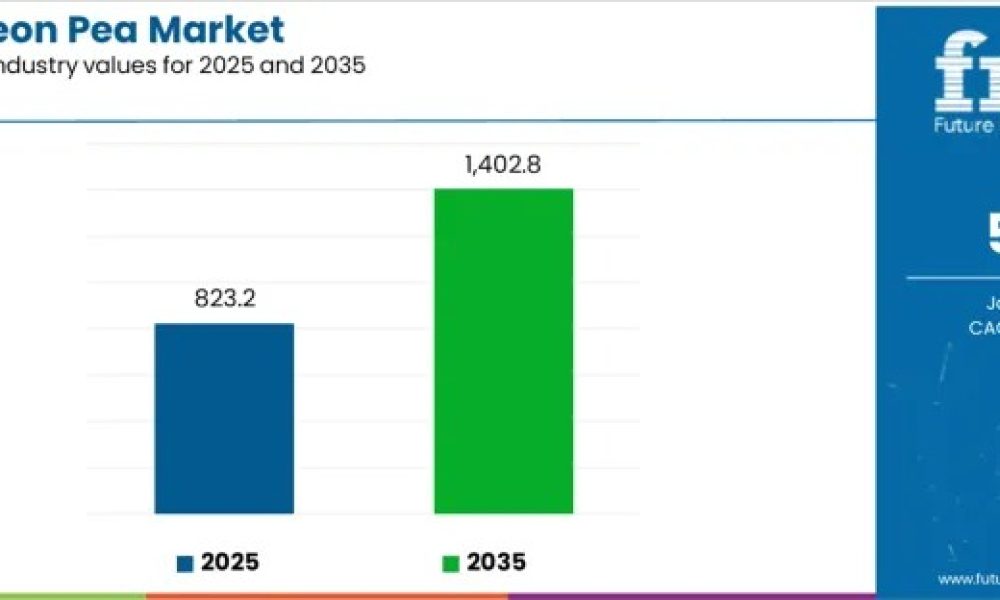
Demand for pigeon pea in Japan is entering a sustained growth phase, driven by changing dietary preferences, rising interest in plant-based proteins, and the expansion of functional and convenience foods. The market is valued at USD 823.2 million in 2025 and is projected to reach USD 1,402.8 million by 2035, reflecting a compound annual growth rate (CAGR) of 5.5% over the forecast period.
Pigeon pea, a protein- and fiber-rich legume, is gaining recognition among Japanese consumers and food manufacturers as a nutritious, versatile ingredient. Traditionally underutilized compared to soybeans and adzuki beans, pigeon pea is increasingly being incorporated into processed foods, frozen meals, snacks, and plant-based formulations as Japan’s food landscape evolves toward health, sustainability, and dietary diversification.
The market’s growth is aligned with broader consumer shifts toward wellness-oriented eating. Rising awareness of lifestyle-related health concerns has accelerated interest in legumes that offer high protein content, dietary fiber, and micronutrients. At the same time, sustainability considerations are encouraging plant-forward diets, positioning pigeon pea as a relevant ingredient within Japan’s expanding alternative protein ecosystem.
To Explore Detailed Market Data, Segment-Wise Forecasts, and Competitive Insights, Request Sample Report!
Market Growth Trajectory Remains Steady and Predictable
Absolute growth analysis highlights consistent expansion throughout the forecast period. From USD 823.2 million in 2025, demand is expected to rise to USD 868.3 million in 2026 and USD 915.8 million in 2027, reflecting early adoption across food processing and specialty retail channels.
Between 2027 and 2030, demand is projected to cross the USD 1.07 billion mark, supported by the increasing availability of pigeon pea–based products and growing acceptance among health-conscious and flexitarian consumers. By 2035, the market is expected to add nearly USD 580 million in incremental value, underscoring its gradual but durable integration into Japan’s food supply.
Key Market Indicators at a Glance
- Market value (2025): USD 823.2 million
- Forecast value (2035): USD 1,402.8 million
- Forecast CAGR (2025–2035): 5.5%
- Leading price segment: Premium (51% share)
- Dominant form: Frozen pigeon peas (35% share)
What Is Driving Demand in Japan?
Growth is primarily fueled by rising interest in plant-based proteins and diversified legume consumption. Pigeon pea is increasingly viewed as a complementary protein source, particularly for consumers seeking alternatives to animal-based foods. Its adaptability across soups, curries, ready meals, and mixed-legume products makes it suitable for both traditional and modern food applications.
Food manufacturers and importers are also exploring pigeon pea for use in processed foods, plant-protein blends, and ethnic cuisine offerings, responding to consumer demand for variety, nutrition, and global flavors. While domestic production remains negligible, import-based supply chains are enabling wider availability across health food, ethnic, and specialty retail channels.
Segment Insights: Premium and Frozen Lead the Market
Premium pigeon peas dominate the price spectrum, accounting for 51% of total demand. Quality-conscious consumers and high-end food applications favor premium-grade legumes due to their superior taste, consistency, and processing standards.
By form, frozen pigeon peas lead with a 35% share, benefiting from long shelf life, ease of storage, and convenience. Their suitability for ready-to-cook meals and foodservice applications has strengthened adoption, particularly among urban households with limited preparation time.
Regional Demand Outlook Shows Broad-Based Growth
Demand is expanding across all major regions, led by areas with higher health awareness and plant-based food adoption:
- Kyushu & Okinawa: 6.8% CAGR
- Kanto: 6.3% CAGR
- Kansai: 5.5% CAGR
- Chubu: 4.9% CAGR
- Tohoku: 4.3% CAGR
- Rest of Japan: 4.1% CAGR
Kyushu & Okinawa benefit from a growing focus on sustainable agriculture and balanced diets, while Kanto’s urban population and strong alternative protein demand are accelerating adoption. Kansai’s culinary openness and sustainability initiatives further support steady growth.
Unlock the complete analysis—Get the full report now.
Competitive Landscape Remains Import-Driven
Japan’s pigeon pea supply is dominated by international agribusiness and trading firms serving importers, processors, and wholesalers. Competition centers on supply reliability, quality standards, logistics efficiency, and pricing stability. Key players include:
- MAF Co Ltd.
- Sun Impex
- Interamsa Agroindustrial SAC
- A.B.agro Company
- Arvind Limited
As consumer awareness grows and manufacturers expand legume-based product lines, suppliers with consistent quality and transparent sourcing are best positioned to capture incremental demand.
About Future Market Insights (FMI)
Future Market Insights, Inc. (FMI) is an ESOMAR-certified, ISO 9001:2015 market research and consulting organization, trusted by Fortune 500 clients and global enterprises. With operations in the U.S., UK, India, and Dubai, FMI provides data-backed insights and strategic intelligence across 30+ industries and 1,200 markets worldwide.



