
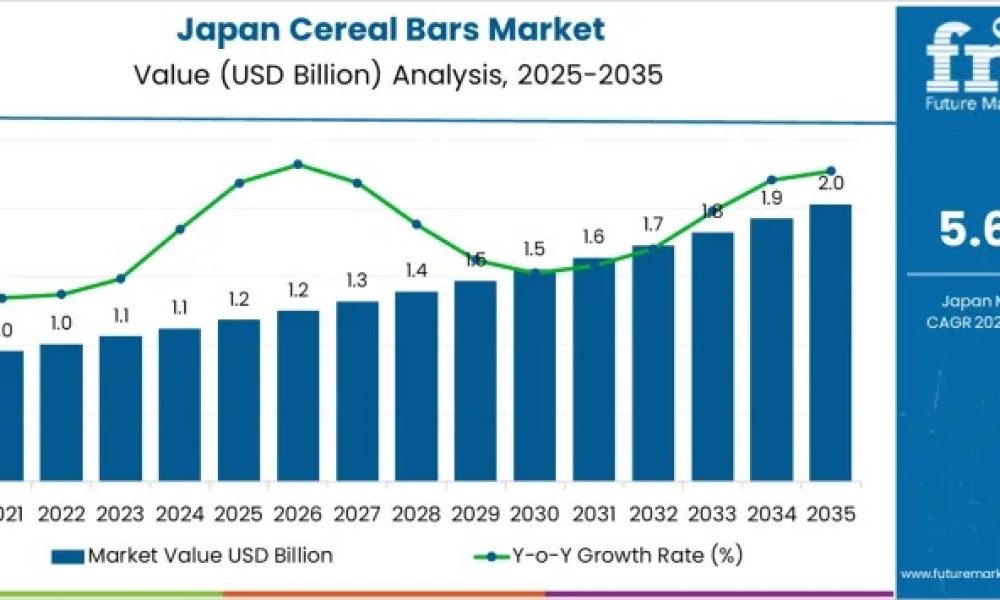
The cereal bars industry in Japan is experiencing sustained growth, with market valuation projected to increase from USD 1.2 billion in 2025 to USD 2.0 billion by 2035, representing a robust compound annual growth rate (CAGR) of 5.6%. Rising consumer preference for portion-controlled nutrition, portable snacking solutions, and functional food positioning continues to shape the category’s expansion across urban centers.
Cereal bars are increasingly becoming a staple for office workers, students, and commuters seeking convenient, energy-sustaining alternatives to traditional breakfast and mid-day snacks. Leading product segments include protein-enriched bars, fiber-based formats, and low-sugar variants, with granola and muesli bars accounting for approximately 50% of overall demand. Urban consumption is concentrated in the Kanto, Kinki, and Chubu regions, where working population density and frequent out-of-home eating patterns drive repeat purchases.
Explore trends before investing – request a sample report today!
Ingredient sourcing remains closely tied to Japan, Southeast Asia, and select European suppliers, particularly for oats, nuts, and functional additives. Domestic manufacturers dominate shelf presence, while select international brands capture niche health-focused segments. Distribution through convenience stores, hypermarkets, and vending machines reinforces on-the-go consumption behavior, with packaging innovations supporting portion control and flavor variety.
Japan Cereal Bars Market Forecast 2025–2035
Cereal bar demand in Japan is forecast to grow from USD 1.2 billion in 2025 to USD 1.5 billion by 2030, adding USD 0.3 billion in value. This period reflects steady adoption as a daily nutrition solution for commuters and students, with functional positioning around protein, fiber, and reduced sugar formulations supporting broader appeal. Private label offerings also expand retail shelf density, increasing unit throughput across urban corridors.
From 2030 to 2035, demand is projected to rise from USD 1.5 billion to USD 2.0 billion, adding USD 0.5 billion in incremental value. Growth is bolstered by elderly nutrition adoption, hospital food services, sports recovery diets, and mixed-flavor bundle packaging that drives higher transaction values on e-commerce platforms. Domestic manufacturers are increasingly collaborating with functional ingredient suppliers to support claims around digestion, satiety, and muscle maintenance.
Key Market Drivers and Trends
- Urban Eating Habits: Commuters and office workers rely on compact, portable foods suitable for breakfast or mid-day snacks, with convenience stores and vending machines as primary distribution points.
- Functional Nutrition: Japanese consumers favor cereal bars with digestive support, protein balance, and blood sugar management, influencing repeat purchase patterns.
- Flavor and Texture Innovation: Product development emphasizes restrained sweetness, soft chew textures, and seasonal rotations to maintain consumer interest.
- Private Label Growth: Retailer-led brands strengthen affordability and increase shelf presence, applying competitive pressure on established brands.
Product and Channel Insights
Granola and muesli bars dominate product demand due to their association with breakfast replacement and fiber intake. Supermarkets and hypermarkets lead by distribution channel, capturing 39% of total market demand through household-oriented bulk purchases and multi-pack formats. Vending machines and convenience store channels remain critical for single-serve, impulse-driven purchases.
Regional Consumption Patterns
- Kyushu & Okinawa: Fastest-growing region at 6.9% CAGR, driven by tourism-linked retail and portable breakfast demand.
- Kanto: Urban lifestyle and commuting patterns sustain 6.4% CAGR, with strong adoption of protein-fortified and functional nutrition bars.
- Kansai: Balanced growth at 5.6% CAGR, supported by youth snacking habits and fitness-oriented consumption.
- Chubu, Tohoku, Rest of Japan: Moderate growth (4.1–4.9% CAGR), reflecting industrial workforce routines and steady, localized retail expansion.
Market Players and Competitive Landscape
Japan’s cereal bars market is shaped by a mix of domestic and international brands. Key domestic players include Asahi Group Foods, Calbee, Morinaga, and Otsuka Pharmaceutical, offering functional and energy-focused bars aligned with local taste preferences. International brands such as Nestlé, General Mills, Mars, BellRing Brands, and Naturell India serve niche segments, including premium, plant-based, and specialty protein bars. Procurement strategies emphasize sugar control, texture softness, allergen labeling, and shelf-life stability under varying temperature and humidity conditions.
Access the full report for detailed market trends.
Conclusion
Cereal bar demand in Japan is underpinned by lifestyle nutrition adoption, high urban retail throughput, and controlled premiumization rather than mass rural volume expansion. Future growth depends on product alignment with Japanese taste preferences, restrained sweetness, functional nutrition claims, and portability requirements. With stable weekday consumption patterns and rising health-conscious snacking trends, the cereal bars industry is positioned for steady, sustainable expansion through 2035.
About Future Market Insights (FMI)
Future Market Insights, Inc. (FMI) is an ESOMAR-certified, ISO 9001:2015 market research and consulting organization, trusted by Fortune 500 clients and global enterprises. With operations in the U.S., UK, India, and Dubai, FMI provides data-backed insights and strategic intelligence across 30+ industries and 1,200 markets worldwide.



