
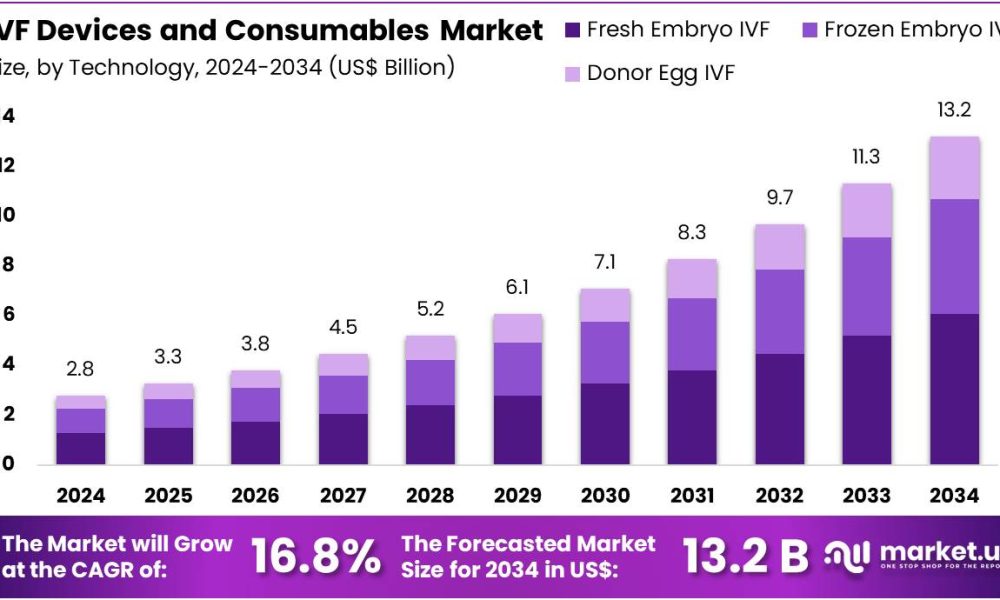
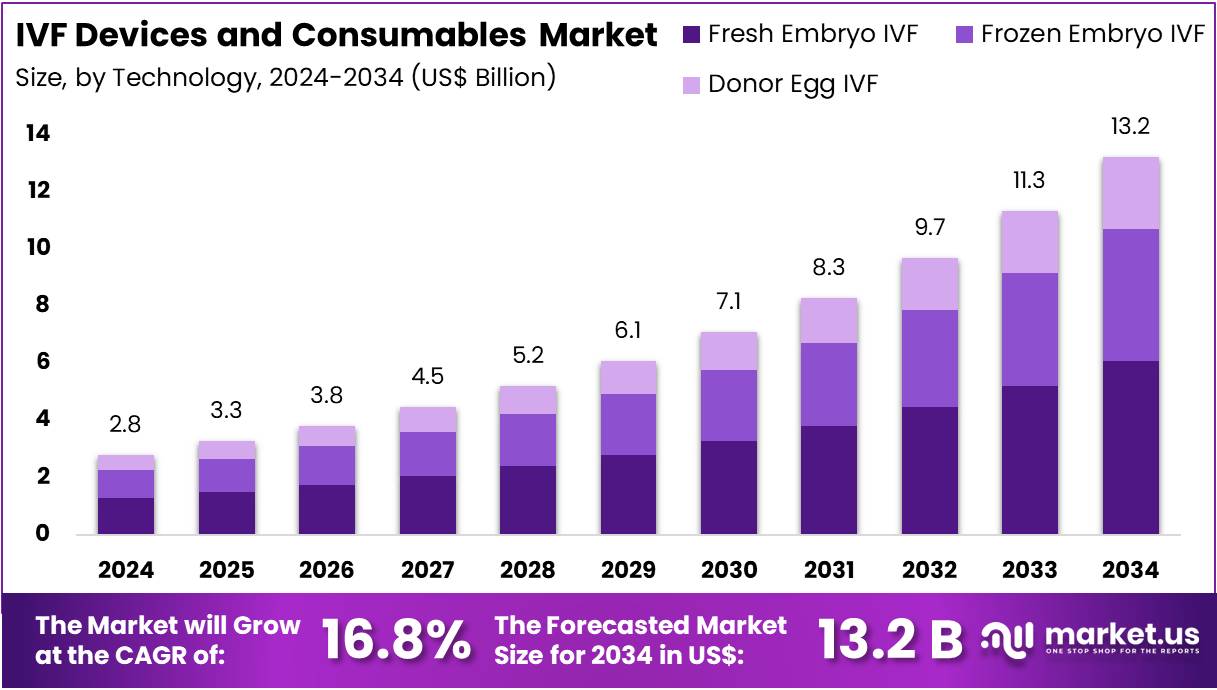
The Global IVF Devices And Consumables Market is projected to grow from US$ 2.8 billion in 2024 to approximately US$ 13.2 billion by 2034, expanding at a CAGR of 16.8%. North America held a dominant share of over 44.5% in 2024, with a market value of US$ 1.2 billion. This growth is driven by the rising adoption of assisted reproductive technologies, increasing infertility rates, and delayed parenthood. IVF procedures rely on specialized devices and consumables, supporting embryo culture, cryopreservation, and fertilization for improved clinical outcomes.
Europe contributes significantly to the market due to strong healthcare infrastructure, greater awareness, and widespread availability of advanced technologies. In contrast, the Asia-Pacific region is expected to grow at the fastest pace. Factors supporting this growth include a rise in infertility cases, increasing healthcare investments, and improving access to fertility services. Government initiatives, such as India’s efforts to regulate and expand ART services, are also shaping the market. In February 2024, the state of Telangana inaugurated a public IVF facility at Gandhi Hospital, signaling state-level investment in fertility care.
The primary driver of this market is the global rise in infertility, with the World Health Organization reporting one in six individuals affected. IVF tools like micromanipulators, culture media, and embryo transfer catheters are crucial in supporting precision during treatment. Infertility rates have increased annually by 0.5% in men and 0.7% in women over the past three decades. The emotional, financial, and social impacts of infertility are also fueling demand for accessible, high-quality treatment solutions worldwide.
High treatment and device costs act as a significant barrier to adoption. IVF cycles can cost over US$ 20,000 in regions such as the U.S., making it unaffordable for many. Equipment like Cryolock® vitrification devices and micromanipulators can cost over US$ 600 and US$ 1,500, respectively. These high costs restrict access in low-income regions. Local regulations, insurance policies, and healthcare financing models further affect affordability and influence patient decision-making regarding fertility treatments.
Technological innovation presents a key opportunity. Emerging solutions include time-lapse imaging and AI-based embryo selection, which improve success rates and streamline workflows. Microfluidic sperm selection devices, such as those developed by the University of Technology Sydney in 2023, are enhancing the reliability of IVF procedures. Additionally, digital health integration is improving access and personalization of care. The growth of fertility clinics and medical tourism—especially in India, Thailand, and Mexico—is further expanding the global footprint of IVF solutions, making advanced fertility treatments more accessible.
Key Takeaways
- In 2024, the global IVF devices and consumables market earned US$ 2.8 billion, with projections reaching US$ 13.8 billion by 2034 at a 16.8% CAGR.
- The product segment includes instruments, accessories, and reagents; in 2023, accessories and disposables led the segment with a dominant 43.2% market share.
- IVF technologies are categorized into fresh embryo IVF, frozen embryo IVF, and donor egg IVF; fresh embryo IVF captured a 38.2% share in 2023.
- Based on end users, fertility clinics held the top spot in 2023, accounting for a substantial 42.3% of the total market revenue.
- North America emerged as the leading region in 2024, holding a commanding 44.5% share of the IVF devices and consumables market.
Get Sample: https://market.us/report/global-ivf-devices-and-consumables-market/request-sample/
Regional Analysis
North America remains the leading region in the IVF devices and consumables market. This dominance is supported by its advanced healthcare infrastructure and widespread adoption of fertility technologies. The growing prevalence of infertility, influenced by delayed pregnancies and lifestyle changes, has increased the demand for IVF treatments. Between 2012 and 2021, assisted reproductive technology (ART) procedures more than doubled in the U.S. In 2021, one in every 42 babies was born through IVF, highlighting the region’s reliance on these medical interventions for family planning.
Technological advancements in embryo culture systems and cryopreservation have significantly improved IVF success rates. Demand for personalized and high-precision IVF treatments is rising, further strengthening market growth. Additionally, favorable reimbursement policies and supportive insurance frameworks make fertility treatments more accessible. In October 2022, nearly 9 million individuals in the U.S. became eligible for extended fertility benefits. Leading fertility centers in California, New York, Texas, and Massachusetts continue to drive innovation, maintaining North America’s leading market position in assisted reproductive technologies.
Meanwhile, the Asia-Pacific region is projected to record the highest CAGR during the forecast period. Rapid healthcare investments in countries like China and India support this growth. Rising disposable incomes and a growing middle class are fueling demand for advanced fertility solutions. India performs over 45,000 IVF cycles annually, with high success rates attracting international patients. The region’s high infertility rates and growing medical tourism are key drivers. Government-backed healthcare reforms and reproductive health programs are accelerating access to IVF, making Asia-Pacific a promising market for future expansion and innovation.
Segmentation Analysis
In 2024, accessories and disposables led the IVF devices and consumables market, accounting for over 48.90% of the product type segment. Their dominance stems from essential use at every IVF stage and single-use design, which ensures sterility. These items, including catheters, needles, and culture dishes, are in constant demand due to high consumption per IVF cycle. Unlike reusable tools, disposables reduce contamination risks and enhance procedure safety. Their role in maintaining gamete and embryo integrity reinforces their critical value in modern assisted reproductive technologies.
Technological advancements are further shaping the IVF landscape, particularly in software and digital tools. Algorithms are now used to enhance reproductive data analysis and diagnostic accuracy. This has elevated the importance of digital platforms in clinical decisions. A key development in this space occurred in May 2024, when Vitrolife AB acquired eFertility. This acquisition aims to expand digital solutions and standardize IVF protocols globally. The integration of AI and advanced analytics is enabling more personalized, efficient, and effective treatment outcomes, thereby accelerating market growth in IVF-related software.
In the technology segment, Fresh Embryo IVF held a dominant 38.2% market share in 2024. Its benefits include quicker pregnancy outcomes, higher implantation rates, and reduced risks compared to frozen embryo transfer. The approach aligns with the body’s hormonal cycle, enhancing implantation success. Fresh embryos are transferred within the same cycle, eliminating cryopreservation steps. According to the Human Fertilisation and Embryology Authority (HFEA), the pregnancy rate per embryo transferred in fresh IVF cycles is about 41% among women aged 18–34, indicating its strong effectiveness in younger age groups.
By Product Type
- Instruments
- Incubators
- Cryosystems
- Ovum Aspiration Pumps
- Sperm Separation System
- Imaging Systems
- Cabinets
- Micromanipulators
- Others
- Accessories and Disposables
- Catheters
- Needles
- Culture Dishes
- Reagents and Media
- Embryo Culture Media
- Cryopreservation Media
- Semen Processing Media
- Ovum Processing Media
By Technology
- Fresh Embryo IVF
- Frozen Embryo IVF
- Donor Egg IVF
By End-User
- Fertility Clinics
- Hospitals
- Clinical Research Institutes
Key Players Analysis
The IVF devices and consumables market is evolving rapidly with a focus on developing advanced and efficient technologies. Key players are investing heavily in research and development to create precision instruments, high-quality consumables, and real-time monitoring systems. These innovations aim to improve IVF success rates and optimize treatment outcomes. Companies are integrating digital tools and automation to enhance procedural accuracy and reduce variability in clinical settings. The emphasis on innovation is supported by regulatory compliance, ensuring safe and effective use in fertility treatment centers worldwide.
Strategic partnerships with fertility clinics and healthcare providers are shaping the competitive landscape. Collaborations with regulatory bodies are helping manufacturers expand the accessibility of IVF solutions. Leading companies are also introducing cost-effective products without compromising quality. This balance between affordability and adherence to global standards is crucial for broad adoption across diverse markets. Efforts to raise awareness about infertility treatments are further supporting the expansion of IVF services. As a result, companies are well-positioned to meet the growing demand for assisted reproductive technologies.
Leading Key Players in the IVF devices and consumables Market
- Cook Group
- Merck KGaA
- Thermo Fisher Scientific
- FUJIFILM Holdings Corporation
- Cooper Surgical
- Vitrolife AB
- Hamilton Thorne Inc.
- Genea Biomedx
- Nidacon International
- Esco Medical
- Labotect
- MedGyn
- Memmert GmbH + Co. KG
Buy Directly https://market.us/purchase-report/?report_id=145482
Conclusion
The global IVF devices and consumables market is set to grow steadily due to rising infertility rates and greater awareness of assisted reproductive technologies. Advanced tools, digital innovations, and growing investments in fertility care are improving treatment success and access worldwide. While North America leads in adoption, the Asia-Pacific region shows strong growth potential due to rising demand and government support. High treatment costs remain a challenge, especially in low-income areas. However, ongoing innovation and cost-effective solutions are helping make IVF more widely available. With strong support from clinics, healthcare systems, and technology providers, the IVF market is expected to expand and play a key role in reproductive healthcare.
Get in Touch with Us:
Market.us (Powered By Prudour Pvt. Ltd.)
Address: 420 Lexington Avenue, Suite 300, New York City, NY 10170, United States.
Contact No: +1 718 874 1545 (International), +91 78878 22626 (Asia).
Email: [email protected]
View More



